When Every Day Counts: Understanding Time-Sensitive Construction Projects
Time-sensitive construction projects are builds, renovations, or repairs where missing a deadline carries real financial, legal, or personal consequences.
If you need a quick answer, here’s what matters most:
Key facts about time-sensitive construction projects:
- Nearly all construction projects in North America experience delays, often stretching timelines by more than a third
- Delays trigger higher labor costs, extra material expenses, and potential contract penalties
- The most common causes are weather, supply chain disruptions, labor shortages, and scope changes
- The best contractors beat deadlines through detailed upfront planning, milestone tracking, and proactive communication
- Technology like project management software and drone surveys can compress timelines significantly
For homeowners in Greater Boston and Middlesex County, MA, a delayed addition or new build isn’t just an inconvenience. It means months of disrupted family life, rising costs, and a contractor relationship built on stress instead of trust.
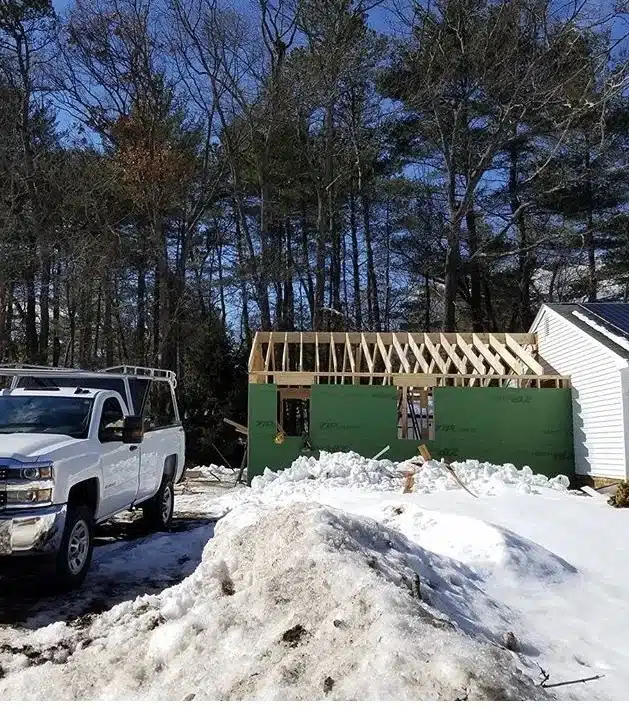
The stakes are real. A kitchen remodel that runs three weeks over schedule can push back a family move-in. A garage addition delayed by poor planning can miss a winter deadline entirely. And in commercial or infrastructure work, the numbers are even sharper — the Eastern Busway Alliance compressed five months of traditional construction into just over two weeks by applying disciplined planning and coordinated execution.
The good news? Most delays are preventable — not inevitable.
This guide walks you through exactly how to manage deadlines, contracts, and surprises on your next project.
Defining Time-Sensitive Construction Projects and Their Criticality
What exactly makes a project “time-sensitive”? In our experience serving Billerica, Reading, and the surrounding Middlesex County towns, it’s any project where the completion date is as vital as the build quality itself. This includes urgent excavation services to prevent foundation failure, disaster recovery after a harsh New England storm, or residential additions that must be finished before a new family member arrives.
The reality of the industry is sobering: nearly all construction projects in North America experience some form of delay. When these timelines stretch, the ripple effect is massive. For a homeowner in Andover or Lexington, a delay doesn’t just mean a messy yard for a few more weeks; it often leads to significant cost overruns. These include extended labor costs, additional material expenditures due to inflation, and even potential penalties for breaching contractual agreements.
Beyond the wallet, there is the community impact. Rapid response is critical for infrastructure repair to minimize neighborhood disruption. When we handle a project, we know that our reputation—and your satisfaction—hinges on hitting those dates. Timely completion builds trust, fosters referrals, and ensures that your life can get back to normal as quickly as possible.
Overcoming Common Obstacles in Rapid Response Construction
In places like Chelmsford and North Reading, we face a unique set of “clock-stoppers.” The most obvious is our unpredictable New England weather. A sudden February blizzard or a torrential spring downpour can halt a foundation pour or framing crew in their tracks.

However, weather isn’t the only hurdle. We also navigate:
- Supply Chain Disruptions: Material availability has become a moving target. If a specific premium window or specialized flooring isn’t ordered months in advance, the whole project can stall.
- Labor Shortages: There is a persistent shortage of skilled craftsmen. Finding an experienced team that can move quickly without sacrificing quality is a major challenge for many firms.
- Regulatory Hurdles: Permitting in towns like Bedford or Burlington requires navigating specific local building codes and zoning laws. If this isn’t handled proactively, your project sits idle while paperwork gathers dust.
- Scope Creep: It starts with “while you’re here, can we also…” Small changes add up. Without a formal change control procedure, these additions can quietly kill a schedule.
To combat communication-related delays, many top-tier teams Try Yourco for free today or use similar SMS-based platforms to ensure field workers and subcontractors are aligned instantly, bypassing the “I didn’t see the email” excuse.
Proven Strategies for Managing Time-Sensitive Construction Projects
Achieving speed without chaos requires a shift from reactive fixing to proactive management. Whether we are embarking on new home construction or a complex commercial renovation, the strategy remains the same: plan for the worst while executing for the best.
Effective management of time-sensitive construction projects relies on three pillars:
- Resource Allocation: Ensuring that materials, labor, and equipment are on-site exactly when needed. This often means ordering long-lead items before the first shovel hits the ground.
- Risk Mitigation: Identifying potential bottlenecks—like a known delay in local utility hookups—and building a plan to work around them.
- Stakeholder Alignment: Keeping everyone from the homeowner to the electrical subcontractor on the same page. When everyone knows the “why” behind a deadline, they are more likely to hustle to meet it.
Planning with the Critical Path Method (CPM)
To keep a project moving, we use the Critical Path Method (CPM). This isn’t just a fancy term; it’s a way of identifying the specific sequence of tasks that must be completed on time for the entire project to finish on schedule.
By using Gantt charts, we can visually map out task dependencies. For example, you can’t hang drywall until the electrical rough-in is inspected. By understanding these links, we can focus our most intense resources on the “critical” tasks while managing “float” in non-critical areas. Breaking large projects down using Work Breakdown Structures (WBS) ensures no small detail—like a specific permit or a custom fixture—slips through the cracks.
Setting SMART Milestones for Time-Sensitive Construction Projects
Vague goals like “finish the garage soon” don’t work. Instead, we set SMART milestones: Specific, Measurable, Achievable, Relevant, and Time-bound.
For a garage addition, a SMART milestone might be: “Foundation poured and inspected by October 15th.” These act as checkpoints. If we miss a milestone by two days, we know immediately that we need to adjust the schedule or add manpower to prevent that two-day delay from becoming a two-week disaster by the end of the month.
Leveraging Technology for Accelerated Project Delivery
The days of paper blueprints and “gut feeling” scheduling are over. Technology has revolutionized how we handle rapid-response builds.
Drones are now essential for site reconnaissance and geospatial mapping. In towns like Carlisle or Wilmington, a quick drone flight can provide more accurate site data in thirty minutes than a ground crew could gather in a day. This data feeds into our management systems, allowing for real-time tracking of progress against our original baseline.
Furthermore, Help Pages and AI-driven tools are beginning to help contractors use predictive analytics. These tools can flag “red flags”—like a pattern of missed sub-milestones—long before they become project-ending delays.
Software Solutions for Time-Sensitive Construction Projects
To maintain transparency and speed, we utilize industry-leading software. Platforms like Procore, Buildertrend, and Microsoft Project allow us to host all project data in the cloud.
This means:
- Instant Updates: If a change order is approved in the office, the crew in the field sees it on their tablets immediately.
- Mobile Reporting: Daily logs and photos are uploaded from the site, giving owners peace of mind.
- Seamless Communication: Using tools like Slack or Microsoft Teams keeps the conversation off of messy email threads and in dedicated project channels.
Case Studies: Lessons from High-Speed Construction Success
Looking at large-scale successes provides a blueprint for residential and local commercial work. While these examples are massive, the principles of 24/7 scheduling and collaborative models apply to any project on a tight clock.
- The Infrastructure Blitz: The Eastern Busway Alliance is a masterclass in compression. They finished five months of work in just over two weeks (348 hours of continuous shifts). They achieved this by using an “alliance model” where all parties shared the risk and the reward, ensuring everyone was motivated to move fast.
- The Tunnel Modernization: A Skanska JV wrapped up a $450M tunnel project nearly two years early. How? They used a “progressive design-build” method, allowing them to start construction while the design was still being finalized. They also used precast concrete slabs, which could be dropped into place much faster than traditional “pour-in-place” methods.
- Hyperspeed Healthcare: In a Race Against the Clock, a team delivered a 51,500-square-foot facility in just 24 months. They used “Takt Planning,” which treats construction like an assembly line, moving trades through “zones” in a rhythmic, predictable fashion.
| Strategy | Traditional Timeline | Accelerated Timeline | Key Differentiator |
|---|---|---|---|
| Complex Intersection | 5 Months | 2 Weeks | 24/7 Shifts & Pre-work |
| Tunnel Renovation | 6 Years | 4 Years | Progressive Design-Build |
| Custom Home Build | 18 Months | 12 Months | Early Procurement & IPD |
Frequently Asked Questions about Construction Timelines
What are the primary causes of delays in time-sensitive projects?
While every site is different, the “Big Four” are weather (especially in Middlesex County), supply chain disruptions, labor shortages, and design changes. In fact, nearly all construction projects face these, but the difference lies in how the contractor prepares for them. Proactive teams build “buffer” time into the schedule to account for these inevitabilities.
How can contractors mitigate risks in urgent scenarios?
Risk mitigation starts with a solid remodeling services plan. This includes creating contingency buffers in the schedule, ordering materials months in advance (early procurement), and maintaining strong partnerships with local suppliers and subcontractors to ensure we are their first priority when materials are scarce.
Why is the design-build model preferred for work?
The design-build model creates a single point of responsibility. Instead of you playing “middleman” between an architect and a builder, we handle both. This streamlines communication and allows for overlapping phases—we can start site prep and excavation while the final interior details are still being polished, which is perfect for ADU in-law additions or other urgent home expansions.
Conclusion
At MB Construction, LLC, we don’t believe that “fast” has to mean “sloppy.” Based in Billerica, MA, we have built our reputation on delivering time-sensitive construction projects that meet the highest standards of quality. By combining premium materials, expert craftsmen, and the latest project management technology, we ensure your project stays on track—no matter what the New England weather throws at us.
Whether you are looking for a home addition in Tewksbury or a new build in Lexington, we provide guaranteed workmanship and a commitment to your deadline. Don’t let your next project become a cautionary tale of delays and rising costs.
Ready to get your project moving? Request an Estimate today and let’s start beating the clock together.