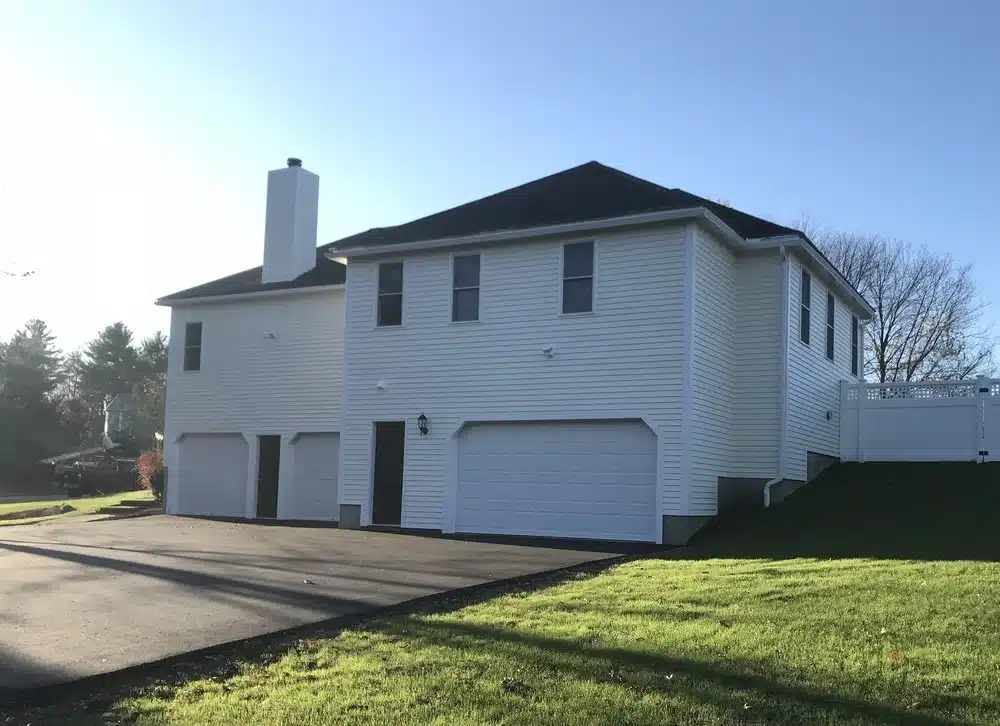
Why Homeowners in Massachusetts Are Choosing to Add Attached Garage Space
If you want to add attached garage space to your home, here’s what you need to know upfront:
Quick Answer: How to Add an Attached Garage
- Check zoning and permits – Verify local setbacks, lot coverage limits, and HOA rules before anything else
- Set your budget – Expect to pay $16,000–$43,000 on average, depending on size and finishes
- Choose your dimensions – A single-car garage starts at 12×20 ft; a two-car runs 24×28 ft or larger
- Hire a licensed contractor – Foundation work, framing, roof tie-in, and fire separation all require professional execution
- Match your home’s design – Roofline, siding, and trim should blend seamlessly with the existing structure
- Plan for safety and utilities – Fire-rated walls, ventilation, and electrical wiring are required by code
Here’s a simple truth: nearly two-thirds of U.S. homes already have a garage or carport. If yours doesn’t — or if it’s too small — you’re missing out on daily convenience, storage, and serious resale value.
For homeowners in Middlesex County and Greater Boston, that gap feels even bigger. Massachusetts winters are no joke. Scraping ice off your windshield at 7 a.m., hauling groceries through a snowstorm, tracking slush through the front door — an attached garage solves all of that in one project.
And the financial case is just as strong. Garage additions can boost your home’s value by $20,000 to $35,000, with a return on investment ranging from 64% to 81%. That’s one of the strongest ROIs of any home improvement project.
But getting it right takes careful planning. The garage needs to meet local building codes, match your home’s architecture, and be built to last. This guide walks you through everything — costs, permits, design, construction, and safety — so you can move forward with confidence.
The Benefits and ROI When You Add Attached Garage Space
Deciding whether to add attached garage bays or build a separate structure is often the first hurdle for homeowners. In our experience working across Middlesex County, the “attached” route is almost always the winner for residential properties.
The primary reason is cost efficiency. Because an attached garage shares at least one wall with your existing house, you save significantly on materials and labor. On average, an attached garage is about 12% cheaper to build than a detached one. You aren’t just saving on the wall itself; you’re also reducing the distance for utility runs like electricity and heat.
Beyond the initial savings, the lifestyle benefits in New England are unmatched. Imagine never having to run through a downpour in Andover or shovel a path to your car in Carlisle just to get to work. An attached garage acts as a buffer, keeping you and your vehicles protected from the elements.
Value Drivers: ROI and Resale
When it comes to the numbers, few projects perform better. Increased property value and ROI are major motivators for this project. Industry data shows that a garage addition has an average return on investment (ROI) of 78%–81% of the construction cost. In high-demand areas like Lexington or Reading, a well-built garage can be the deciding factor for a buyer.
| Feature | Attached Garage | Detached Garage |
|---|---|---|
| Average Cost | $16,000 – $40,000 | $19,000 – $50,000+ |
| Construction Time | 4–8 weeks | 5–10 weeks |
| Convenience | Direct home access | Requires outdoor walk |
| Cost Savings | ~12% cheaper (shared wall) | Full independent structure |
| Best Use | Daily parking & storage | Workshops or noisy hobbies |
If you are looking for more info about Garage Additions, it is important to realize that the “value” isn’t just in the resale price. It’s also in the protection of your second-largest investment: your vehicles. Keeping a car in a garage prevents paint oxidation, protects against hail, and eliminates the need for salt-heavy ice melting on your driveway right next to your car’s undercarriage.
Planning Dimensions to Add Attached Garage Bays
Before we break ground, we need to talk about size. A garage that is too small is a frustration you’ll feel every single day. While there are “minimum” sizes, we always recommend planning for the “recommended” dimensions to account for modern vehicle sizes and storage needs.
- Single-car Garage: The absolute minimum is 12×20 feet, but we suggest 14×24 feet if your lot allows it. This gives you enough room to open doors comfortably without hitting the walls.
- Two-car Garage: A standard two-car garage is often 20×20 feet, but this is tight for two SUVs. We recommend 24×28 feet. This extra depth allows for a workbench or seasonal storage at the front of the garage.
- Ceiling Height: The International Residential Code (IRC) requires a minimum height, but for functionality, you want at least 8 to 9 feet. This allows for taller garage doors (7-foot minimum) and overhead storage racks.
Traffic Flow and Access When you add attached garage space, you also need to consider how you enter the house. Most homeowners prefer the internal door to lead into a mudroom or near the kitchen. This makes unloading groceries or managing kids’ sports gear much easier. We also look at the “swing” of the door; it should never swing into the path of a parked car.
Planning, Zoning, and Building Codes
In towns like Billerica or North Reading, you can’t just start pouring concrete. Every municipality has specific zoning laws that dictate where you can build on your property.
Setbacks and Lot Coverage
The most common hurdle is the “setback” requirement. This is the minimum distance your garage must be from your property lines. In many Middlesex County towns, side setbacks can range from 10 to 25 feet. Additionally, towns have “lot coverage” limits—a maximum percentage of your land that can be covered by structures. If your home is already large for the lot, we have to be very strategic with the garage footprint.
Permits and Site Plans
You will almost always need a building permit to add attached garage space. Building permit costs and requirements vary, but skipping this step can result in heavy fines or even an order to tear down the structure. A professional site plan is required for the permit application. This plan shows the existing house, the proposed garage, property lines, and any nearby features like septic systems or wetlands.
If you are planning Garage Additions in Billerica, MA, you must also consider the International Residential Code (IRC) standards. These codes ensure the structure is safe, specifically regarding the foundation depth (to prevent frost heave) and fire separation between the garage and the living quarters.
Essential Steps to Add Attached Garage Additions
Building a garage is a specialized form of home addition. It’s not just a “box” on the side of the house; it’s a structural expansion that must be tied into your home’s existing systems.
- Site Preparation: We start by clearing the area and marking the footprint. This often involves removing existing walkways or landscaping.
- Foundation Excavation: In Massachusetts, we must dig footings below the frost line (usually 48 inches) to ensure the garage doesn’t shift during our harsh winters.
- Concrete Curing: Once the footings and slab are poured, the concrete needs about a week to cure before we can begin framing.
- Structural Framing: This is where the “skeleton” of the garage goes up. We use high-quality lumber to frame the walls and the roof rafters.
- Roof Tie-in: This is the most technical part. We have to “marry” the new garage roof to your existing house roof. This requires expert flashing to ensure there are no leaks where the two structures meet.
- Exterior Finishing: We install the roofing, siding, and trim. To ensure a “perfect match,” we source materials that mimic the texture and color of your home.
- Interior Drywall: While some choose an unfinished look, most homeowners opt for fire-rated drywall to meet safety codes and provide a cleaner look.
Design and Construction Integration
One of the biggest fears homeowners have when they add attached garage space is that it will look like an afterthought—a “tacked-on” box that ruins the home’s curb appeal.

At MB Construction, LLC, we focus on architectural harmony. This means more than just using the same color paint. We look at:
- Roof Pitch: The angle of the garage roof should match or complement the pitch of the main house.
- Siding Coordination: If your home has vinyl siding, we match the profile and color. If it’s brick or cedar, we find the closest match possible to ensure a seamless transition.
- Window Trim: The style of the windows and the width of the trim on the garage should be identical to the rest of the house.
- Lighting Fixtures: Matching the exterior sconces on the garage to your front porch lights creates a unified look at night.
For those planning Garage Additions in Lexington, MA, we often deal with historic or traditional styles where these details are even more critical. A well-integrated garage should look like it was built with the house in the first place.
Safety, Utilities, and Functional Upgrades
An attached garage is technically part of your home, which means safety is the top priority. Because garages store vehicles (and their fuel/fumes), there are strict requirements to keep your family safe.
Fire Separation and Ventilation
The IRC mandates a fire-separation barrier between the garage and the house. This usually involves installing 5/8-inch Type X gypsum board (fire-rated drywall) on the garage side of any shared walls or ceilings. The door leading from the garage to the house must also be fire-rated—typically a solid wood or honeycombed steel door that is at least 1-3/8 inches thick.
Proper ventilation is also key. We ensure the garage is designed to prevent carbon monoxide and gasoline fumes from seeping into your living spaces. This often includes specific sealants around the entry door and proper soffit or ridge venting in the garage roof.
Utilities: Electricity, Plumbing, and HVAC
Most homeowners want more than just a place to park. When you add attached garage bays, you should plan for:
- Electrical Wiring: At a minimum, you’ll want several outlets for tools and a dedicated circuit for a garage door opener. We also recommend pre-wiring for an Electric Vehicle (EV) charging station, which is a major value-add in today’s market.
- Plumbing: A utility sink is a lifesaver for cleaning up after yard work or washing a dog. If you’re planning a “man cave” or workshop, you might even consider a small half-bath.
- HVAC: If you plan to use the garage as a workshop year-round, adding a mini-split system for heating and cooling is a smart investment.
Above-Garage Living and ADU Potential
If your lot is small but you need more square footage, look up! Adding a room above the garage is one of the most cost-effective ways to add a guest suite, home office, or “Accessory Dwelling Unit” (ADU).
However, this changes the structural requirements. The floor of that room must be able to support a “live load” of at least 40 pounds per square foot. You will also need to ensure the floor is heavily insulated to prevent the cold air in the garage from making the room above uncomfortable.
Frequently Asked Questions about Attached Garages
How much does it cost to add an attached garage?
In the Greater Boston area, a basic one-car attached garage typically starts around $16,000, while a high-end two-car garage with a finished interior and premium siding can reach $43,000 or more. Factors like foundation complexity, roof tie-in difficulty, and whether you add plumbing or HVAC will influence the final price.
How long does the construction process take?
From the time we break ground, a standard garage addition takes between 4 and 8 weeks. However, the pre-construction phase—including design, site plans, and waiting for town permits—can add another 4 to 6 weeks to the total timeline.
Does an attached garage require a specific foundation?
Yes. In Massachusetts, you cannot simply pour a slab on top of the ground. You need a “frost-protected” foundation. This involves digging footings down to the frost line (usually 4 feet deep) to prevent the ground from “heaving” during the winter and cracking your new garage or damaging the connection to your house.
Conclusion
When you decide to add attached garage space, you aren’t just building a place for your car; you are investing in your home’s future and your own daily comfort. From the convenience of avoiding a snowy walk to the 81% ROI you might see when you sell, the benefits are undeniable.
At MB Construction, LLC, we specialize in making these additions look and feel like a natural part of your home. Whether you are in Burlington, Chelmsford, or Wilmington, our team of expert craftsmen uses premium materials to deliver a project that is both beautiful and built to withstand the New England climate. We take pride in our quality-driven, time-sensitive approach, ensuring your project is finished on schedule without cutting corners.
Ready to transform your property? Start your project with a professional Garage Addition and let us help you create the perfect match for your home. We serve Middlesex County and the Greater Boston area with guaranteed workmanship you can trust.