
Why Adding a 2nd Floor to a Detached Garage Is Worth Serious Consideration
Adding a 2nd floor to a detached garage is one of the most practical ways to gain significant living space without expanding your home’s footprint — and for homeowners in suburban Massachusetts, it’s becoming an increasingly popular move.
Here’s a quick summary of what’s involved:
- Cost: Roughly $300–$650 per square foot, depending on finish level and complexity
- Common uses: Home office, guest suite, in-law apartment (ADU), gym, or hobby room
- Feasibility: Most existing garages need structural reinforcement — foundation, framing, or both
- Permits: Required in all Massachusetts towns; zoning rules vary by municipality
- Timeline: Most projects run 6–9 months from design through completion
It’s not a simple weekend project. But done right, it can dramatically increase your home’s value and livability.
About a quarter of homeowners already use their garage primarily for storage rather than parking. That means the ground floor is often underutilized — and the airspace above it is completely wasted.
Whether you’re thinking about housing an aging parent, carving out a quiet workspace, or creating a rentable unit, the space above your garage may be the smartest square footage on your property.
The key is knowing what you’re getting into before you break ground.
This guide walks you through everything — from structural feasibility and permitting to costs, design, and construction — so you can make a confident, informed decision.
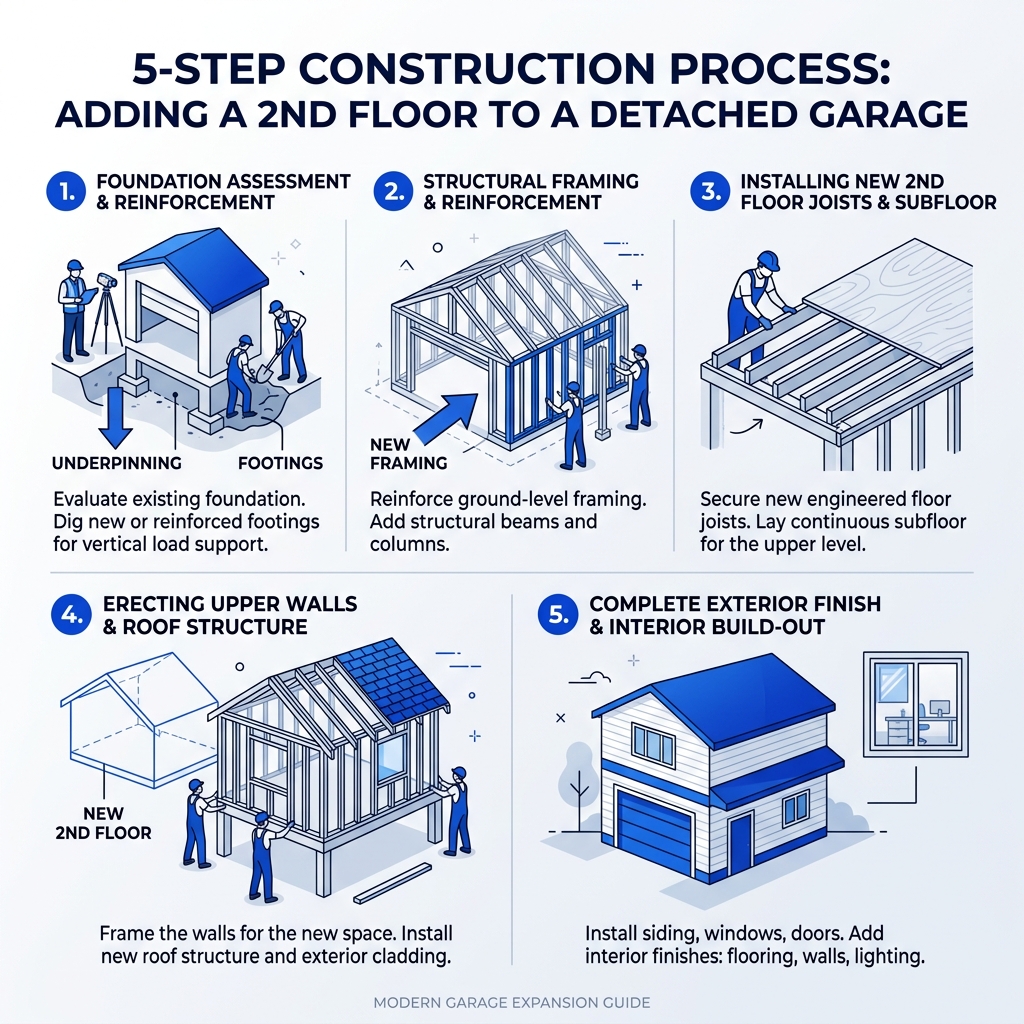
Is Adding a 2nd Floor to a Detached Garage Structurally Feasible?
The short answer is: almost always, but rarely without some homework first. Most detached garages in Middlesex County were originally designed as “single-story, light-occupancy” structures. This means the original builder likely used the minimum required materials to keep the rain off your car, not to support the weight of a fully furnished apartment, a pool table, or a home gym.
When we look at adding 2nd floor to detached garage projects, our first step is a rigorous foundation assessment. We have to determine if the existing concrete slab or footings can handle the “dead load” (the weight of the new structure) and the “live load” (the people and furniture inside it). In many older Massachusetts homes, garages were built on “floating slabs” without deep footings. To go vertical, we often need to excavate around the perimeter and add underpinning or new footings to ensure the building doesn’t sink or crack under the new pressure.
The “Lift vs. Remove” Debate
One of the most common questions we hear is whether to keep the existing roof. You have three main options:
- Remove and Rebuild: We tear off the old roof, reinforce the walls, and build a new floor and roof. This is usually the most straightforward for engineering.
- Roof Lifting: In some cases, a crane can lift the existing roof structure, allowing us to build the new walls underneath before lowering it back down. This can sometimes save on material costs, but the labor and crane rental often equalize the price.
- Total Tear Down: If the existing garage is leaning, has significant rot, or a failing foundation, it is often more cost-effective to start from scratch.
Before deciding, we highly recommend soil testing. The ground in areas like Chelmsford or Billerica can vary; if you’re building on soft clay or high-water-table areas, the foundation requirements become even more stringent. You can find more Structural feasibility and load testing discussion to see how professionals evaluate these older frames.
For more detailed insights on how we handle these transitions, check out our page on More info about garage additions.
Structural Requirements for Adding a 2nd Floor to a Detached Garage
To satisfy Middlesex County building codes, your garage needs to be “beefed up” significantly. We aren’t just adding a few 2x4s; we are transforming a shed-like structure into a residential-grade building.
- Footing Depth: In Massachusetts, footings must reach below the frost line (typically 48 inches) to prevent shifting during our brutal winters.
- Shear Panels: To handle wind loads—especially important for taller, detached structures—we often install shear panels (structural plywood or OSB) to prevent the building from “racking” or leaning.
- Engineered Wood Beams: Because a garage needs wide, open spaces for cars, we can’t just put a post in the middle of your parking spot. We use LVLs (Laminated Veneer Lumber) or steel I-beams to span the width of the garage and support the new floor above.
We recently completed a project that highlights these needs perfectly: a Garage addition in Billerica, MA where we had to integrate heavy-duty framing to support a new master suite above a two-car bay.

Navigating Zoning, Permits, and ADU Laws in Massachusetts
If the structural engineer is the “muscle” of your project, the local zoning board is the “brain”—and sometimes the headache. Every town from Reading to Lexington has its own set of bylaws regarding how high you can build and how close you can be to your neighbor’s fence.
The MA Affordable Homes Act: A Game Changer
As of early 2025, Massachusetts has made it significantly easier to build Accessory Dwelling Units (ADUs). The Affordable Homes Act allows homeowners in most single-family zones to build a detached ADU “by right.” This means you may no longer need a special permit to turn that garage loft into a legal apartment, provided it stays under 900 square feet (or half the size of your main house).
However, “by right” doesn’t mean “no rules.” You still have to follow:
- Setback Requirements: Most towns require a detached structure to be a certain distance from the property line (often 5 to 15 feet).
- Height Restrictions: While you’re “going up,” you can’t go too high. Many residential zones cap detached structures at 20–25 feet.
- Egress: You must have a safe way to exit the second floor in case of a fire, which usually means a full-sized staircase and specific window sizes (emergency escape and rescue openings).
For example, a Garage addition in Lexington, MA will have different aesthetic and historical requirements than a Garage addition in Concord, MA. In Lexington, we often work with tighter property lines and more rigorous design reviews.
Zoning Regulations for Adding a 2nd Floor to a Detached Garage
When we look at adding 2nd floor to detached garage plans, we have to account for fire separation. Since the lower level will likely still house vehicles (and flammable gasoline), the ceiling of the garage must be lined with fire-rated material—typically 5/8-inch Type X drywall—to protect the living space above.
We also have to consider the “bulk” of the building. Adding a second story can sometimes trigger “floor area ratio” (FAR) limits in towns like Reading. If your lot is already “maxed out” with a large house and a pool, the town might limit the square footage of your garage addition. We’ve navigated these waters for many clients, including a Garage addition in Reading, MA and a Garage addition in North Andover, MA, where we had to balance the client’s need for space with the town’s density requirements.
The Cost of Adding a 2nd Floor to a Detached Garage
Let’s talk numbers. Adding a second story is rarely “cheap,” but it is almost always more affordable than buying a new home in today’s Massachusetts market. On average, you should budget between $300 and $650 per square foot.
Why such a wide range? It comes down to “fit and finish.”
| Feature | Basic Storage Loft | Luxury ADU / Guest Suite |
|---|---|---|
| Structural Work | Minimal (light framing) | Extensive (footings, LVLs) |
| Plumbing | None | Full Bath + Kitchenette |
| HVAC | None or simple space heater | Dedicated Mini-split system |
| Electrical | Basic lights/outlets | Full panel upgrade + appliances |
| Estimated Cost | $35,000 – $75,000 | $150,000 – $350,000+ |
In towns like Andover, where property values are high, the return on investment (ROI) for a high-end addition is excellent. A Garage addition in Andover, MA can easily add $200k+ to the resale value of a home, especially if it includes a legal bedroom and bath.
Factors Influencing the Price
- Utilities: Running water, sewer, and gas lines from the main house to a detached garage is a major expense. If the garage is 50 feet away, you’re looking at significant trenching and plumbing costs.
- Material Expenses: In the last few years, the cost of premium siding and roofing to match the main house has fluctuated. We pride ourselves on using expert craftsmen and premium materials to ensure the addition doesn’t look like an “afterthought.”
- Labor: In the Greater Boston area, skilled labor is in high demand. Projects like a Garage addition in North Reading, MA require licensed electricians and plumbers who understand the specific local codes.
Design and Utility Challenges: From Access to HVAC
Designing the space is the fun part, but it comes with unique logistical puzzles.
Access: Interior vs. Exterior Stairs
This is a huge decision.
- Interior Stairs: These take up about 50–80 square feet of your garage floor. If you have a tight two-car garage, an interior staircase might force you to park one car outside. However, they are much more comfortable in a Massachusetts blizzard.
- Exterior Stairs: These save interior space but leave you exposed to the elements. They are often the preferred choice for rental units or ADUs to provide a sense of privacy and a separate entrance.
Climate Control and Insulation
Garages are notoriously difficult to heat and cool. Because the floor of your new room is the ceiling of an unheated garage, you need superior insulation. We almost always recommend closed-cell spray foam insulation. It provides a high R-value and acts as an air seal, preventing car exhaust and cold drafts from seeping into your living space.
For HVAC, a ductless mini-split system is the gold standard. It provides both heating and cooling without requiring bulky ductwork that would eat into your headroom. This is a common solution we implement in projects like a Garage addition in Chelmsford, MA.
The Mental Health Factor
Don’t underestimate the value of separation. Research shows that working from your bedroom isn’t great for your mental health. A detached garage office provides a physical and psychological “commute” that helps you switch from “home mode” to “work mode.” We’ve seen a surge in requests for these quiet retreats in Wilmington and Tewksbury as remote work becomes permanent.
Frequently Asked Questions about Garage Additions
How much does adding a 2nd floor to a detached garage increase home value?
While it depends on the town, adding conditioned square footage—especially a bathroom—is one of the highest-ROI renovations you can do. In Bedford, MA, where land is at a premium, adding a 500-square-foot suite can significantly boost your appraisal. If the space is a legal ADU, the potential for rental income adds another layer of financial value.
Should I tear down and rebuild or add to the existing garage?
If your garage was built before 1950, the foundation might not have any steel reinforcement. In cases like a Garage addition in Burlington, MA, we often find that the cost of reinforcing an old, crumbling structure is 80% of the cost of a new one. In those cases, tearing down and starting fresh allows for better ceiling heights, better insulation, and a 100% guaranteed foundation.
What fire safety measures are required for a garage second story?
Safety is non-negotiable. You will need:
- Type X Drywall: On the entire ceiling and any shared walls of the garage.
- Smoke/CO Detectors: Interconnected with the main house.
- Fire-Rated Entry Door: If there is an internal door between the garage and the stairs. We take these regulations seriously in every town, including Carlisle, MA, to ensure your family (and your investment) is protected.
Conclusion
Adding 2nd floor to detached garage is a sophisticated undertaking that requires a blend of structural engineering, zoning expertise, and high-end design. At MB Construction, LLC, we specialize in these complex “vertical” projects. Whether you are in Billerica, Lexington, or anywhere in Middlesex County, we bring a quality-driven, time-sensitive approach to every build.
We use only premium materials and expert craftsmen to ensure your new space is as comfortable as your main home—if not more so. From the first shovel in the ground to the final coat of paint, our workmanship is guaranteed.
Ready to stop wasting that airspace and start building your dream studio, office, or guest suite?
Start your garage addition project today with a team that knows Massachusetts homes inside and out. Let us help you go up a level!
