
Why Adding an Apartment Above Your Garage Is One of the Smartest Moves You Can Make
Adding an apartment above your garage is a practical way to gain extra living space, generate rental income, or house a family member — without buying a new property or expanding your footprint.
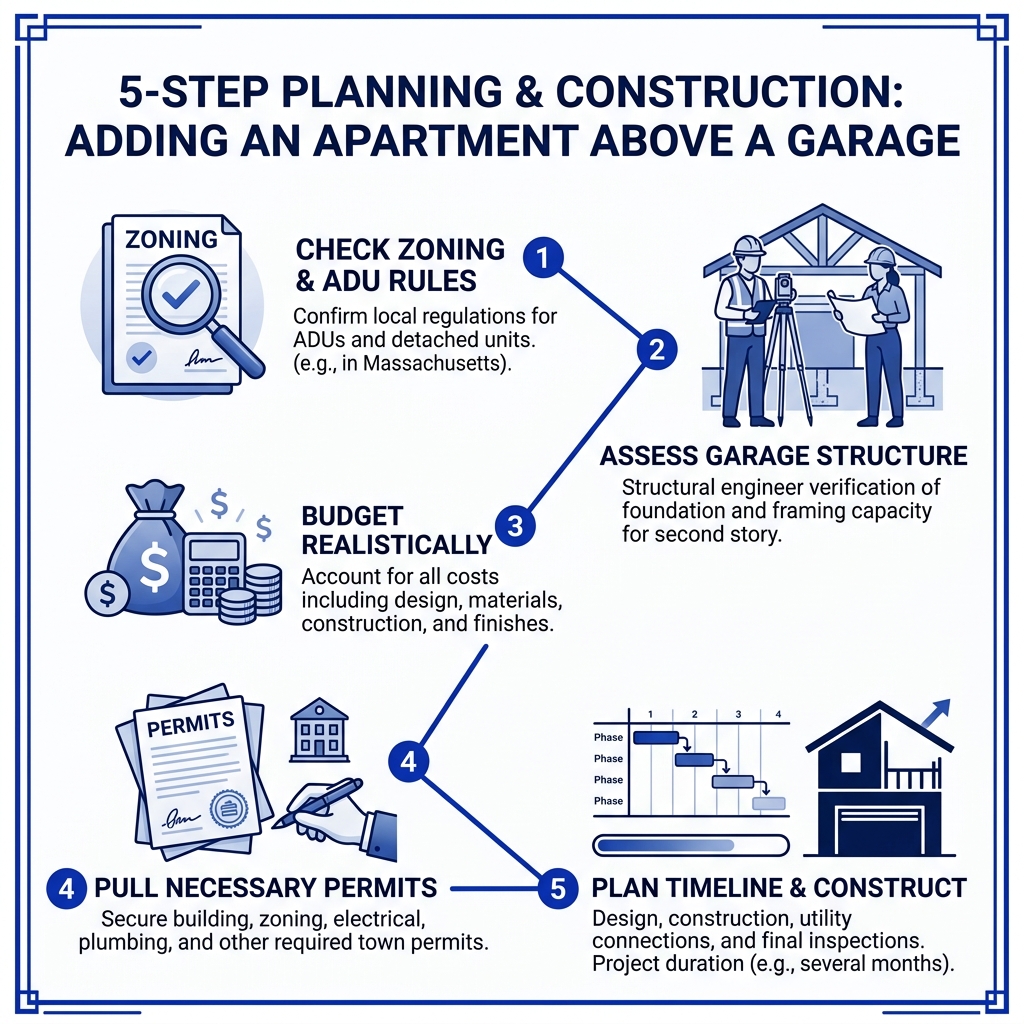
Here’s what you need to know to get started:
- Check your zoning — In Massachusetts, the 2025 Affordable Homes Act now allows most homeowners to add a detached ADU up to 900 sq ft by right, with no special permit required.
- Assess your garage structure — A structural engineer must confirm whether your existing foundation and framing can support a second story.
- Budget realistically — Expect $90,000 to $200,000 for a second-story addition over an existing garage, depending on size and finishes.
- Pull the right permits — Building, zoning, and ADU permits are required in every Massachusetts town.
- Plan your timeline — Most projects run 6 to 9 months from design through final inspection.
Whether you’re a homeowner in Lexington, Chelmsford, or anywhere across Middlesex County, the idea of building above your garage is more achievable today than ever before. Recent changes to Massachusetts state law have dramatically reduced the red tape around accessory dwelling units (ADUs).
That said, this isn’t a small project. It touches structural engineering, local zoning codes, fire safety, utility connections, and design — all at once.
This guide walks you through every step, so you can plan with confidence and avoid costly surprises.
Benefits and ROI of Garage Apartments
When we talk to homeowners in Billerica or Bedford about why they want to add apartment above garage spaces, the reasons usually fall into two categories: financial gain and lifestyle flexibility.
Financial Impact and Property Value
One of the most compelling reasons to build upward is the immediate boost to your property value. Research indicates that adding a high-quality garage apartment can increase a property’s market value by 10% to 20%. In high-demand areas like Greater Boston, this percentage can be even higher.
Beyond equity, there is the “golden goose” of rental income. A well-designed studio or one-bedroom unit can generate significant monthly cash flow. Whether you use it for long-term leasing or as a legal ADU in-law addition, the space effectively pays for itself over time.
Multigenerational Living and Lifestyle
We are seeing a massive trend toward multigenerational housing. A garage apartment provides the perfect “Goldilocks” solution: close enough for safety and connection, but with a separate entrance for true independence. It’s an ideal spot for:
- Aging Parents: Providing a safe, accessible space without the stairs of a traditional second floor.
- Adult Children: Giving college grads a place to land while they save for a down payment.
- Guests: Offering friends and family a private suite that doesn’t disrupt the main house’s flow.
There are many six reasons for building a studio apartment over a detached garage, ranging from creating a quiet home office to building a dedicated hobby studio. By building up rather than out, you preserve your precious yard space—a major plus in towns like Reading or Wilmington where lot sizes vary.
Key Considerations Before You Add Apartment Above Garage
Before we pick up a hammer, we have to put on our “planning hats.” Adding a second story to an existing structure is significantly more complex than building on raw land.
Zoning and Feasibility
The first hurdle is always the law. Fortunately, the MA Affordable Homes Act (effective early 2025) has changed the game. It guarantees the right to build an ADU up to 900 square feet (or half the size of the main house) on most single-family lots. However, local setbacks—the distance the building must be from the property line—and height restrictions still apply. In Carlisle, for example, there are specific guidelines for Accessory Dwelling Units & 2-Family Conversions that must be respected.
Timeline Expectations
A project of this scale isn’t finished in a weekend. A typical timeline for a garage apartment in Middlesex County looks like this:
- Design and Permitting: 2–4 months.
- Structural Reinforcement: 1 month.
- Construction and Finishing: 3–5 months.
- Total: 6–9 months.
Conversion vs. New Build
Should you keep the old garage or tear it down?
| Feature | Garage Conversion (Adding Above) | New Detached Build |
|---|---|---|
| Cost | Generally lower ($90k – $200k) | Higher ($250k – $450k) |
| Complexity | High (Reinforcing old foundations) | Moderate (Start from scratch) |
| Foundation | Existing (requires upgrade) | New (engineered for load) |
| Design Freedom | Limited by existing footprint | Unlimited |
If you are considering a larger project, you can find more info about home additions to see how different configurations might work for your specific lot.
Structural Steps to Add Apartment Above Garage Safely
You cannot simply slap a floor on top of a standard garage. Most residential garages were built to hold a roof, not the “live load” of people, furniture, and appliances.
- Foundation Assessment: We often need to perform “underpinning,” which involves digging under the existing foundation to pour deeper, wider concrete footings.
- Perimeter Support: Since garages have large open spans for cars, we must reinforce the walls to carry the weight of the second floor without adding poles in the middle of your parking space.
- Floor Joists: To meet code, floors must be engineered for at least 40 pounds per square foot (psf) live load.
- Fire Safety: This is non-negotiable. Building codes require fire-rated drywall requirements on the garage ceiling and walls to create a one-hour fire separation between the cars below and the living space above.
Maximizing Small Footprints to Add Apartment Above Garage
When you’re working with a footprint of roughly 20×20 or 24×24 feet, every inch counts. We recommend:
- Open Floor Plans: Minimize interior walls to make the space feel larger.
- Clerestory Windows: These high-set windows provide privacy from neighbors while flooding the room with natural light.
- Built-in Storage: Use the “knee walls” under sloped roofs for drawers and closets.
- Strategic Finishes: Look into flooring and interior finish trends like light-colored woods and large-format tiles to create an airy feel.
For those in specific areas, you can check out more info about 2nd and 3rd floor additions in Chelmsford, MA for inspiration on vertical expansion.
Structural and Safety Requirements for Habitable Space
Safety is our primary concern when we add apartment above garage structures. Living above a space where internal combustion engines run and flammable liquids are stored requires strict adherence to the International Residential Code (IRC).
The One-Hour Fire Barrier
Because of the risk of vehicle fires, the ceiling of the garage must be finished with 5/8-inch Type X fire-rated drywall. All “penetrations”—places where wires or pipes go through the ceiling—must be sealed with fire-blocked foam or caulk. This ensures that if a fire starts in the garage, the occupants upstairs have at least one hour to evacuate safely.
Ventilation and Carbon Monoxide
Carbon monoxide (CO) is a silent killer. We install hardwired CO detectors in the sleeping area and often recommend a dedicated ventilation fan in the garage that triggers when it senses movement or high CO levels.
Egress and Access
Every bedroom must have an “egress” window—one large enough for a firefighter in full gear to climb through. Additionally, most towns in Middlesex County require a separate exterior entry for the apartment. This ensures the tenant or family member doesn’t have to walk through your main house or the garage to get home. If you’re looking for more info about garage additions in Lexington, MA, you’ll find that separate access is a key design feature we prioritize.
Utility Connections
The apartment needs its own “life support” systems:
- Plumbing: Tying into the main sewer line can be tricky if the garage is detached.
- Electrical: You will likely need a sub-panel to handle the kitchen appliances and HVAC.
- HVAC: We often recommend ductless mini-split systems. They provide both heating and cooling, are incredibly energy-efficient, and don’t require bulky ductwork that eats into your ceiling height.
Navigating Zoning Laws and Permits in Massachusetts
The legal landscape for ADUs in Massachusetts has shifted dramatically in favor of the homeowner. However, “legal by right” doesn’t mean “anything goes.”
The MA Affordable Homes Act
As of 2025, the state has overridden many restrictive local bylaws. You can now build an ADU up to 900 square feet without needing a “Special Permit” or a trip to the Zoning Board of Appeals in most cases. This is a huge win for homeowners in North Andover and Andover who previously faced uphill battles.
Local Constraints
Even with state law on your side, you must still follow:
- Setbacks: Most towns require the structure to be at least 5 to 15 feet from the property line.
- Impervious Coverage: This is a fancy way of saying “how much of your lot is covered by buildings and pavement.” If your lot is mostly paved, you might need a special drainage plan.
- Historical Districts: If you live in a historic part of Concord or Lexington, the exterior materials (like brick or siding) must match the character of the neighborhood.
For specific local details, check out more info about garage additions in Bedford, MA. We handle the permitting process for our clients to ensure everything from the floor plan to the flooring meets local standards.
Frequently Asked Questions about Garage Apartments
How much does it cost to add an apartment above a garage?
In the Massachusetts market, a second-story addition over an existing garage typically ranges from $90,000 to $200,000.
- Lower end ($90k – $120k): Basic studio layout, standard finishes, and minimal foundation reinforcement.
- Higher end ($150k – $200k+): One or two bedrooms, premium materials (like quartz counters or custom cabinetry), and extensive structural or utility work. If you are building a new detached garage with an apartment from the ground up, costs can range from $250,000 to over $400,000.
Does a garage apartment count as an ADU?
Yes! In Massachusetts, an Accessory Dwelling Unit (ADU) is defined as a self-contained living space on the same lot as a single-family home. To qualify, it must have its own:
- Kitchen (including a stove, sink, and refrigerator).
- Bathroom (toilet, sink, and shower/tub).
- Separate entrance.
- Sleeping area.
Can I rent out my garage apartment as an Airbnb?
This depends entirely on your specific town’s bylaws in Middlesex County. While the state allows you to build the unit, towns like Burlington or Reading may have specific rules regarding short-term rentals (less than 30 days). Some towns require the property owner to live in either the main house or the ADU to allow rentals. Always check with your local planning department first.
Conclusion
Building a garage apartment is an investment in your property’s future and your family’s flexibility. While the structural and regulatory hurdles can seem daunting, the reward is a high-value asset that provides income, housing, and peace of mind.
At MB Construction, LLC, we specialize in navigating these complexities for homeowners throughout Billerica, Lexington, Chelmsford, and the Greater Boston area. Our team of expert craftsmen is dedicated to providing quality-driven, time-sensitive projects using premium materials. We don’t just build rooms; we build solutions that fit your life.
If you’re ready to explore how to add apartment above garage space on your property, we’re here to help. From the first structural assessment to the final coat of paint, we ensure your project is built to last.
For more inspiration and technical details, visit our page on garage additions and let’s start planning your new space today.
