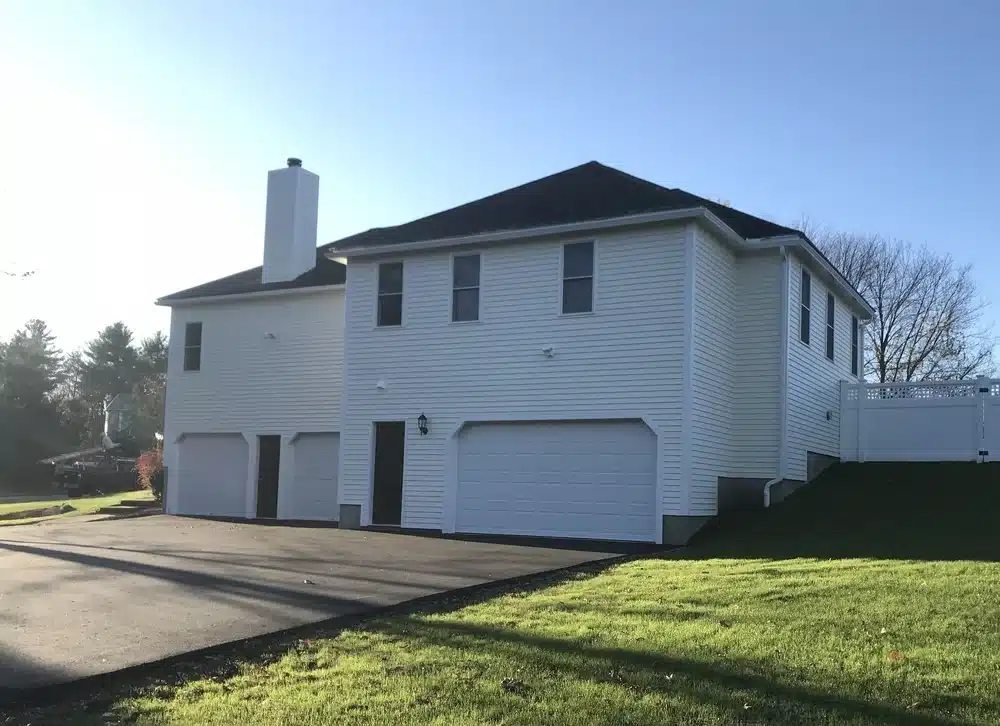
How Much Does a 2 Car Garage Addition Cost?
The 2 car garage addition cost typically falls between $25,000 and $125,000+ for most homeowners, depending on size, finish level, location, and whether the garage is attached or detached. Here’s a quick snapshot based on average internet data:
| Garage Type | Typical Cost Range |
|---|---|
| Basic attached 2-car garage | $25,000 – $45,000 |
| Mid-level attached 2-car garage | $45,000 – $80,000 |
| Premium attached 2-car garage | $80,000 – $125,000+ |
| Basic detached 2-car garage | $30,000 – $55,000 |
| Premium detached 2-car garage | $55,000 – $125,000+ |
Note: These are average costs based on internet data. Actual prices vary significantly by region, contractor, and project scope.
In Massachusetts — including towns like Billerica, Burlington, and across Middlesex County — labor rates and permit costs tend to push totals toward the higher end of these ranges.
So why is the price range so wide? A homeowner in a Quora forum recently summed it up well: a contractor quoted roughly $100,000 for an attached 2-car garage in New Hampshire, and the homeowners were shocked. But as other respondents pointed out, the number of variables involved makes a single “standard” price nearly impossible. Finish level, foundation type, site conditions, utility connections, and local building codes all move the needle — sometimes dramatically.
This guide walks you through every major cost factor so you can build a realistic budget before you talk to a contractor.
Similar topics to 2 car garage addition cost:
Understanding the Average 2 Car Garage Addition Cost in 2026
When we look at the landscape of home improvement in 2026, the 2 car garage addition cost has evolved alongside material prices and labor demands. If you are browsing the web for estimates, you will find that a standard 20×20 or 24×24 foot structure is the “sweet spot” for most suburban homes in Middlesex County. However, “average” is a tricky word in construction.
Based on current internet data benchmarks, the national average for a standard 2-car garage ranges from $30,000 to $60,000. But here in the Greater Boston area, we often see those numbers climb. Regional pricing is heavily influenced by our local climate—meaning we need deeper footings for frost protection—and our strict building codes.
For a comprehensive look at how these numbers break down nationally, you can check out this Cost to Build a 2 Car Garage (2026 Pricing Guide). To help you visualize the tiers, we’ve put together a comparison of finish levels:
| Feature | Basic (Shell) | Mid-Level | Premium (Custom) |
|---|---|---|---|
| Average Cost | $25,000 – $40,000 | $45,000 – $85,000 | $90,000 – $250,000+ |
| Interior | Unfinished studs | Drywall & basic lighting | Fully finished, HVAC, epoxy floors |
| Siding | Basic vinyl | Color-matched to home | Brick, stone, or fiber cement |
| Doors | Manual/standard | Insulated with opener | Custom carriage-style, smart tech |
Estimating Your Specific 2 Car Garage Addition Cost
Every property in towns like Reading or Lexington is unique. While the internet might suggest a project could cost $25,000, large-scale custom additions with living space above or complex architectural tie-ins can easily scale up to $550,000 or more.
The square footage is the primary driver. A basic 400-square-foot garage is much different from a 600-square-foot “oversized” two-car garage that includes a workshop area. If you’re curious about how these costs compare to other types of expansions, you can find more info about Massachusetts addition costs on our site to help put your garage project into perspective.
Regional Variations in Massachusetts and New England
In our neck of the woods—specifically Middlesex County and the Greater Boston area—we deal with a few “Bay State” realities. Labor rates here are among the highest in the country, often accounting for 50% to 70% of your total project cost.
Furthermore, permit fees in towns like Billerica or Chelmsford aren’t just a flat rate; they are often calculated based on the project’s value. You also have to factor in the cost of professional designs. Because of our snow loads and soil conditions, a “simple” garage often requires a structural engineer’s stamp to get through the local building department.
Primary Factors Affecting Construction Estimates
If you’ve ever wondered why one neighbor paid $40,000 and another paid $100,000 for what looks like the same garage, the answer lies beneath the surface—literally. Site preparation is a massive variable. If we have to excavate through New England granite or manage a steep slope in Carlisle, the groundwork alone can eat up a significant portion of the budget.
Then there is the big question: attached or detached? Each has its own set of rules. For a deep dive into the logistics of connecting a garage to your home, see our guide on The Perfect Match: Adding an Attached Garage Successfully.
Attached vs. Detached Structural Requirements
Attached garages are often perceived as cheaper because they share at least one wall with the house. While this can save on siding and framing, it introduces “fire separation” requirements. Massachusetts code requires specific fire-rated drywall on the shared wall and a self-closing, fire-rated door leading into the house.
Detached garages, on the other hand, are standalone structures. They offer more flexibility in placement but require their own utility trenching. If you want electricity, heat, or water in a detached garage in Wilmington, we have to dig a trench from the main house to the new structure, which adds to the 2 car garage addition cost.
Material Selection and Finish Levels
We always advocate for using premium materials because they withstand our harsh winters better. Choosing fiber cement (like James Hardie) over basic vinyl siding might increase the upfront cost, but it lasts longer and looks significantly better.
Roofing is another area where costs shift. Matching your existing home’s architectural shingles is standard, but if you have a slate or metal roof, the garage must match to maintain curb appeal. For more data on how these finishes impact the bottom line, you can review this guide on How Much Does a Garage Extension Cost? [2025 Data].
Itemized Breakdown of Garage Construction Expenses

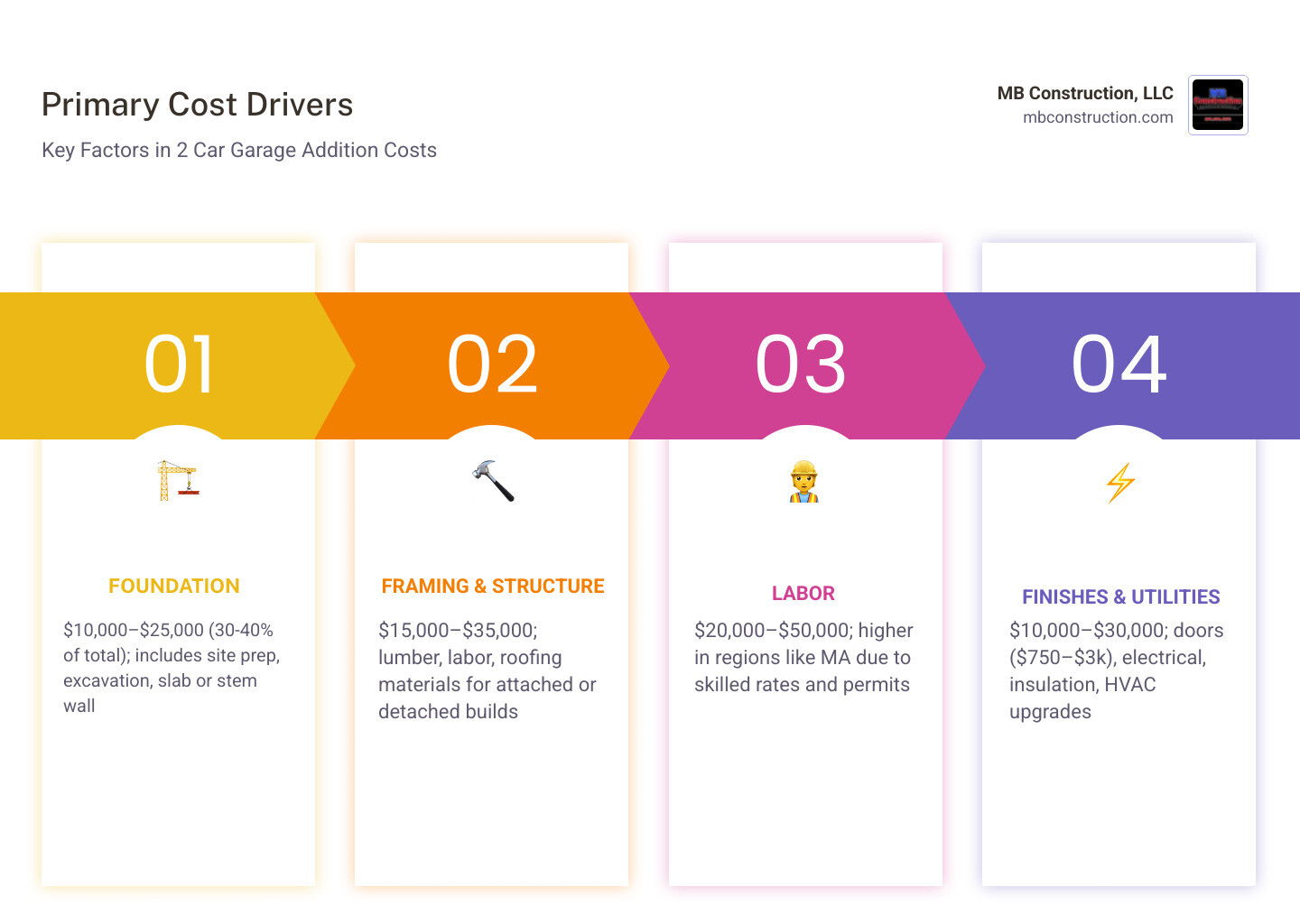
To help you plan, we like to break the project down into percentages. Generally, the foundation and slab will take up about 10–15% of the budget, while the framing and roof structure account for 20–25%. Labor, across all trades, usually sits between 30% and 40% of the total.
Foundation and Site Preparation
In Massachusetts, we can’t just pour a thin slab on the ground. We have to deal with the “frost line.” This usually means a monolithic slab (where the edges are thickened) or a stem wall foundation.
- Monolithic Slab: $5–$16 per square foot.
- Stem Wall: $6–$18 per square foot.
- Grading and Drainage: Essential to prevent your new garage from becoming a new swimming pool during the spring thaw.
Hidden Expenses in a 2 Car Garage Addition Cost
There are always costs that don’t show up on a “kit” price tag. Structural engineering fees typically range from $200 to $1,500. Building permits can range from $500 to over $2,500 depending on your town.
Then there are electrical upgrades. If your current electrical panel in Andover is already full, adding a garage with lights, an opener, and power tools might require a panel upgrade (often $2,000–$4,000). If you are considering even bigger plans, like living space, you should look into more info about adding a second story.
Exterior and Interior Finishing
The “face” of your garage—the doors—can vary wildly in price. A basic steel door might cost $750, but a pair of custom, insulated carriage doors with high-end openers can easily reach $6,000 or more.
- Insulation and Drywall: $1.50–$6 per square foot.
- Lighting and Outlets: $1,000–$3,000 for a standard setup.
- HVAC: If you want to use the garage as a workshop year-round in North Reading, a mini-split system can add $3,000–$6,000.
Return on Investment and Property Value Impact
Is it worth it? Absolutely. A garage is one of the most sought-after features for homebuyers in New England. Protecting your cars from ice and snow isn’t just a luxury; it’s a practical necessity that buyers are willing to pay for.
The average ROI for a garage addition ranges from 64% to 85%. If you spend $100,000 on a high-quality garage, you could see your home value increase by $64,000 to $85,000 immediately. For more perspectives on the value of these additions, check out How Much Does It Cost to Build a Garage Addition? – MLC Associates LLC.
Enhancing Curb Appeal and Functionality
Beyond the numbers, a garage provides a dedicated workshop area and massive amounts of storage. By moving the lawnmowers, snowblowers, and holiday decorations into the garage, you free up space inside your home. In towns like Lexington, where curb appeal is king, a well-designed garage that matches the home’s architecture can make the property much more marketable.
Long-term Financial Benefits
A garage addition is a “hard” asset. It increases your home’s square footage (even if it’s unfinished) and improves your equity. If you ever decide to convert the space later or add an ADU, you already have the foundation and structure in place. For those thinking about the ultimate value-add, read our more info about garage apartments.
Frequently Asked Questions
How long does it take to complete a 2-car garage addition?
On average, a garage addition takes between 6 to 12 weeks of active construction. This doesn’t include the “soft” time for architectural design and waiting for the Billerica or Burlington building departments to issue permits, which can take another 4 to 8 weeks.
Is an attached garage cheaper than a detached one?
Generally, yes. Attached garages are often 10% to 15% less expensive because they utilize an existing wall and typically have shorter runs for electrical and heating lines. However, the requirement for fire-rated materials and complex roof tie-ins can sometimes close that price gap.
Does a garage addition require a new foundation?
Yes, always. Even if you have an existing driveway, it is not designed to support the weight of a garage structure. We must excavate, pour footings below the frost line, and pour a reinforced concrete slab to ensure the garage doesn’t shift or crack during the Massachusetts freeze-thaw cycles.
Conclusion
At MB Construction, LLC, we understand that a garage is more than just a place to park—it’s an investment in your home’s future. Based in Billerica, MA, we serve homeowners across Middlesex County and Greater Boston, including towns like North Reading, Tewksbury, and Wilmington.
Our team is dedicated to quality-driven, time-sensitive projects. We use only premium materials and expert craftsmen to ensure that your 2 car garage addition cost translates into lasting value and guaranteed workmanship. We don’t just build structures; we build additions that look like they were always part of the original home.
Ready to protect your vehicles and level up your property? Request a quote for your garage addition today, and let’s get started on your project.