
Why Home Addition Financing Options Matter More Than You Think
Home addition financing options are the methods homeowners use to pay for expanding their living space — and choosing the right one can save you tens of thousands of dollars.
Here are the most common ways to finance a home addition:
| Financing Option | Best For | Typical APR | Loan Amount |
|---|---|---|---|
| Home Equity Loan | Large, one-time projects | 7.90–8.15% | Up to 80% of equity |
| HELOC | Phased or ongoing projects | 7.00–7.63% (variable) | Up to 80–85% of equity |
| Cash-Out Refinance | Replacing existing mortgage | Varies with market | Based on home value |
| Personal Loan | No equity, fast funding | 6.74–29.99% | $3,000–$100,000 |
| FHA 203(k) | Low credit, limited equity | Varies | Up to after-reno value |
| Construction Loan | Large-scale builds | Varies | Based on future value |
| RenoFi Loan | Maximizing borrowing power | Varies | Up to 90% of ARV |
Home additions are one of the biggest financial decisions a homeowner can make. The average cost sits around $51,042 — and can climb well past $150,000 for a second-story addition or primary suite.
For most families in suburban Massachusetts, that kind of money doesn’t come from a savings account alone.
The good news? There are more ways to fund a home addition than most people realize. The tricky part is figuring out which one fits your situation — your equity, your credit, your timeline, and how much you’re willing to take on.
Get it right, and you add space, comfort, and real value to your home. Get it wrong, and you could be paying a high-interest loan long after the drywall is dry.
This guide walks you through every major financing option — what each one costs, who qualifies, and when it makes sense to use it.
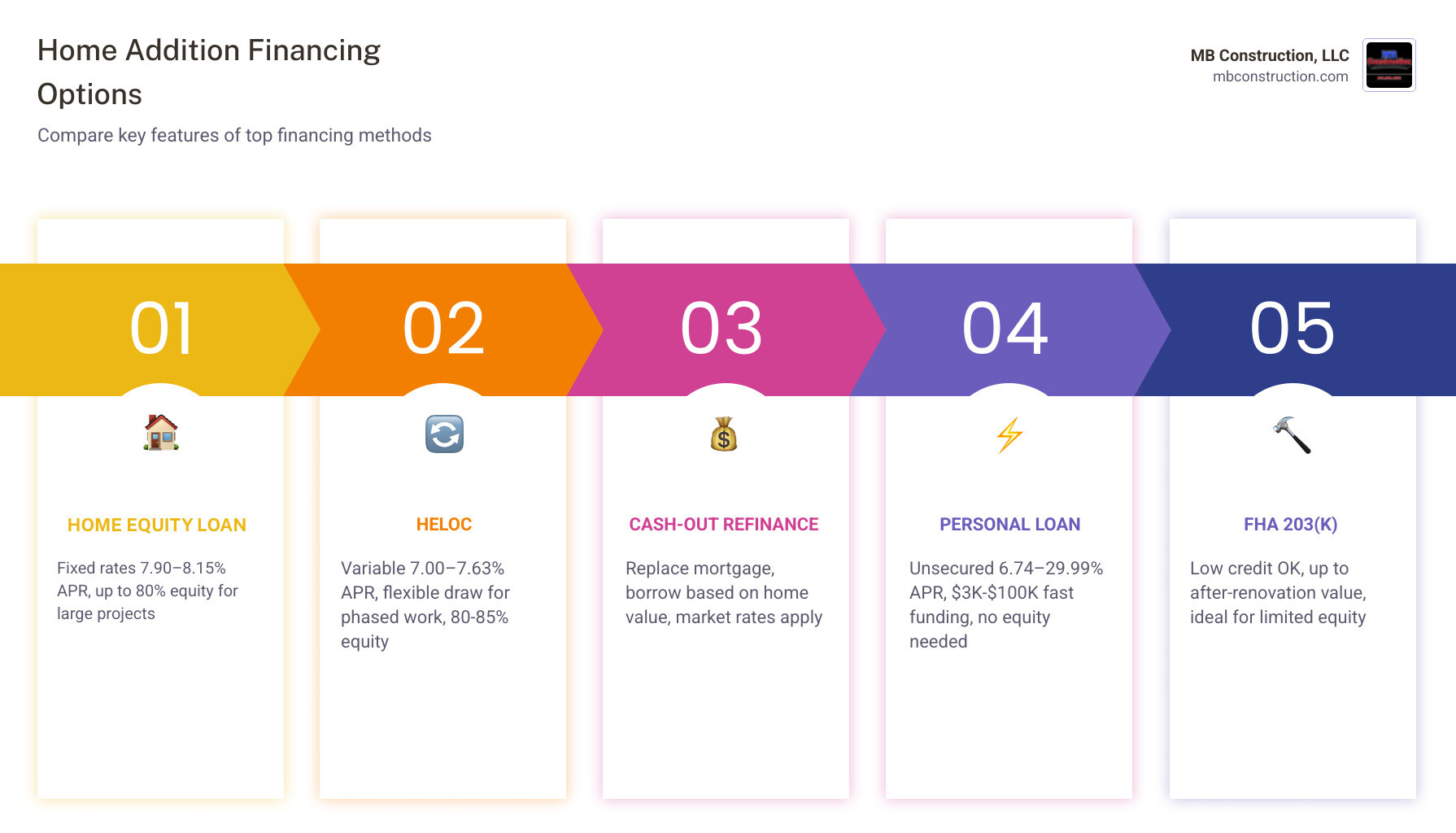
Simple home addition financing options word guide:
Understanding the Cost of Home Additions in Massachusetts
Before you sign on the dotted line for a loan, you need to know exactly what you’re paying for. In Middlesex County and the Greater Boston area, building isn’t just about wood and nails; it’s about navigating a unique regulatory landscape.
The national average cost for a home addition is roughly $51,042, with most projects falling between $21,936 and $88,339. However, in towns like Lexington, Reading, or Billerica, costs often trend 20% to 40% higher than the national average due to local labor rates and material costs. For a deeper dive into these numbers, see our guide on Breaking Down the Average Cost of Home Addition in Massachusetts.
Several local factors influence your final bill:
- Labor Costs: In Massachusetts, labor typically accounts for 40% to 60% of your total budget. Skilled trades like licensed electricians and plumbers in our region command a premium.
- The Stretch Energy Code: Many communities in Eastern Massachusetts, including Bedford and Burlington, follow the “Stretch Energy Code.” This requires new additions to meet strict energy efficiency standards, often necessitating a HERS (Home Energy Rating System) index score. While this saves you money on utilities long-term, it can increase upfront insulation and HVAC costs.
- Zoning and Permits: Zoning laws vary wildly by municipality. Whether you’re dealing with setbacks in Carlisle or historic overlay districts in Andover, permit fees can range from $500 to $5,000.
- Material Prices: From premium lumber to high-end fixtures, material choices can swing a budget by tens of thousands of dollars.

Comparing Home Addition Financing Options
Choosing between home addition financing options is a bit like choosing the right foundation for your house — it depends on what you’re building on top of it. If you have significant equity, you’ll likely look at secured options. If you’re a newer homeowner, unsecured loans might be your best bet.
| Feature | HELOC | Personal Loan | Home Equity Loan |
|---|---|---|---|
| Interest Rate | Variable (usually lower) | Fixed (usually higher) | Fixed (mid-range) |
| Collateral | Your Home | None | Your Home |
| Funding Speed | 2–6 Weeks | Same Day to 1 Week | 2–4 Weeks |
| Repayment Term | 10–30 Years | 2–7 Years | 5–30 Years |
| Tax Deductible? | Potentially (if used for home) | No | Potentially (if used for home) |
When you finance the cost of a home addition, you are essentially balancing the cost of borrowing against the speed and convenience of the funds.
Secured vs. Unsecured Home Addition Financing Options
The biggest fork in the road is whether the loan is “secured” or “unsecured.”
Secured Loans (Home Equity Loans & HELOCs): These use your home as collateral. Because the lender has a “safety net” (the ability to foreclose if you don’t pay), they offer much lower interest rates. However, the risk is entirely on you. If you hit a financial rough patch, your house is on the line. These are excellent for large-scale projects where you want the lowest possible APR.
Unsecured Loans (Personal Loans): These don’t require collateral. Lenders look at your credit score and income to decide if you’re a good risk. The upside? You can get funds incredibly fast—sometimes the same day you sign—and you aren’t risking your home. The downside? You’ll pay for that convenience with higher interest rates, often ranging from 10% to 25% or more depending on your credit. Before committing, it’s wise to review these 10 questions to ask before hiring a home renovation Massachusetts contractor to ensure your budget is solid.
Tapping into Equity: Home Equity Loans and HELOCs
If you’ve lived in your Wilmington or North Reading home for a few years, you’ve likely built up equity. Equity is the difference between what your home is worth and what you owe on your mortgage. Most lenders allow you to borrow up to 80% or 85% of your home’s combined loan-to-value (CLTV).
- Home Equity Loan: This is a “second mortgage.” You get a lump sum of cash all at once, usually at a fixed interest rate. It’s perfect for a project with a fixed price tag, like a $60,000 kitchen bump-out. You’ll have predictable monthly payments for the life of the loan (usually 5 to 30 years).
- HELOC (Home Equity Line of Credit): Think of this as a credit card backed by your house. You are given a credit limit and a “draw period” (usually 10 years) where you can take out only what you need. You only pay interest on the amount you actually use. This is ideal for phased projects where you might pay the foundation crew in June and the roofers in September.
Specialized Loans for Major Renovations
Sometimes, traditional equity isn’t enough, especially if you’re planning a massive transformation like a second-story addition.
Cash-Out Refinance: This replaces your existing mortgage with a new, larger one. You take the difference in cash. This is a popular choice when current mortgage rates are lower than your original rate. However, if you currently have a 3% mortgage, you probably don’t want to swap it for a 7% loan just to get some cash out.
Renovation Mortgages (Fannie Mae HomeStyle): These allow you to borrow based on the completed value of the home, rather than its current value. This is a game-changer for major renovations.
According to RenoFi, these specialized loans can significantly increase your borrowing power by looking at the “After-Renovation Value” (ARV).
Future-Value Home Addition Financing Options
If you bought a “fixer-upper” in Billerica or Tewksbury recently, you might have very little equity. This is where Future-Value Financing shines.
- RenoFi Loans: Unlike traditional equity loans that cap you at 80% of current value, RenoFi looks at what the home will be worth after we finish the addition. This can sometimes provide 11x more borrowing power than a standard bank loan.
- FHA 203(k): This is a government-backed loan that combines your mortgage and renovation costs into one loan. It’s great for those with lower credit scores (down to 580) or those with very little equity.
- Construction Loans: These are short-term loans (usually 12–18 months) used to cover the build phase. They involve “staged draws,” meaning the lender pays us in increments as we hit specific milestones (foundation, framing, etc.). Once the project is done, the loan usually converts into a permanent mortgage.
Qualifying for the Best Rates and Terms
Lenders aren’t just looking at your house; they’re looking at your financial habits. To snag those low APRs you see advertised, you’ll generally need:
- A Solid Credit Score: Most home equity lenders want to see a 680 or higher. If you’re above 740, you’re in the “gold star” territory for the best rates.
- Debt-to-Income (DTI) Ratio: This is the percentage of your gross monthly income that goes toward paying debts. Most lenders want this under 43%.
- Income Verification: Be ready with W-2s, tax returns, and recent pay stubs.
- A Professional Estimate: Lenders will often require a detailed contract from a reputable builder before approving a renovation-specific loan. We provide comprehensive documentation to help our clients through this process. You can learn more about our Home Additions services to see how we help plan these projects.
Maximizing ROI and Saving on Construction Costs
A home addition is an investment. Some rooms pay you back better than others when it comes time to sell your home in the Greater Boston market.
- Kitchen Additions: Often yield an ROI of 80% or more.
- Bedroom/Primary Suite: Typically see a 60% to 75% return.
- Bathrooms: Usually return about 50% to 70%.
To keep costs from spiraling out of control, we always recommend a 10% to 20% contingency fund. Even with the best planning, opening up old walls in a 1950s Reading ranch can reveal surprises like outdated wiring or plumbing.
Choosing energy-efficient materials isn’t just a “green” choice; it’s a financial one. High-performance windows and superior insulation might cost more upfront, but they lower your monthly carrying costs for the life of the addition.
Frequently Asked Questions about Home Addition Financing
What is the best way to finance a home addition with no equity?
If you don’t have enough equity, a personal loan or a Future-Value loan (like RenoFi or FHA 203k) is your best bet. Personal loans are faster but have higher rates. Future-Value loans take longer to close but allow you to borrow much more based on what the home will be worth after the project is finished.
What credit score is needed for a home improvement loan?
For an unsecured personal loan, you can sometimes qualify with a score as low as 580–600, though your interest rate will be high. For a HELOC or Home Equity Loan, most Massachusetts lenders prefer a score of at least 680.
Is the interest on a home addition loan tax deductible?
In many cases, yes! According to the IRS, interest on home equity loans and HELOCs is often tax-deductible if the funds are used specifically to “buy, build, or substantially improve” the home that secures the loan. Always consult with a tax professional in Massachusetts to confirm how this applies to your specific situation.
Conclusion
At MB Construction, LLC, we know that a home addition is more than just square footage—it’s where your family grows and where memories are made. Based in Billerica, we serve homeowners throughout Middlesex County, from the historic streets of Lexington to the quiet neighborhoods of North Andover.
Our team is dedicated to quality-driven, time-sensitive projects. We use premium materials and expert craftsmen to ensure your new space feels like it was always part of the original home. While we don’t provide the loans ourselves, we work closely with your lenders to provide the detailed plans, contracts, and inspections they need to release your funds.
Ready to stop dreaming and start building? Whether you’re looking for a simple bump-out or a complex second-story addition, we’re here to help you navigate the process from the first permit to the final coat of paint.