
Why Asking the Right Questions Before Hiring a Home Renovation Massachusetts Contractor Can Save You Thousands
Home renovation Massachusetts projects are one of the biggest investments you’ll make as a homeowner — and hiring the wrong contractor can turn that investment into a nightmare.
Here’s a quick overview of what to look for before signing anything:
| What to Check | Why It Matters |
|---|---|
| HIC registration + CSL license | Required by Massachusetts law |
| Written contract with MGL c. 142A terms | Protects you legally |
| Permit responsibility | Contractor should pull permits, not you |
| Local zoning knowledge | Rules vary by town in Middlesex County |
| Clear budget + change order policy | Prevents cost surprises mid-project |
| Proof of insurance | Covers liability and worker injuries |
| References + verified reviews | Confirms real-world track record |
| Energy efficiency plan | Unlocks potential Mass Save rebates |
| Timeline with milestones | Keeps the project on schedule |
| Complaint and dispute process | Know your rights before problems arise |
There are over 5,800 home remodeling companies listed in Massachusetts alone. That’s a lot of options — and not all of them are equally qualified, licensed, or honest.
For suburban homeowners in towns like Chelmsford, Billerica, Burlington, or anywhere in Middlesex County, the stakes are especially high. Local zoning bylaws, building codes, and permit requirements vary from town to town. A contractor who doesn’t know your area can cause costly delays or compliance issues.
The good news? Asking the right questions upfront filters out the bad fits fast.
This guide gives you exactly 10 questions to ask any contractor before you hire them — so you can protect your home, your budget, and your family.
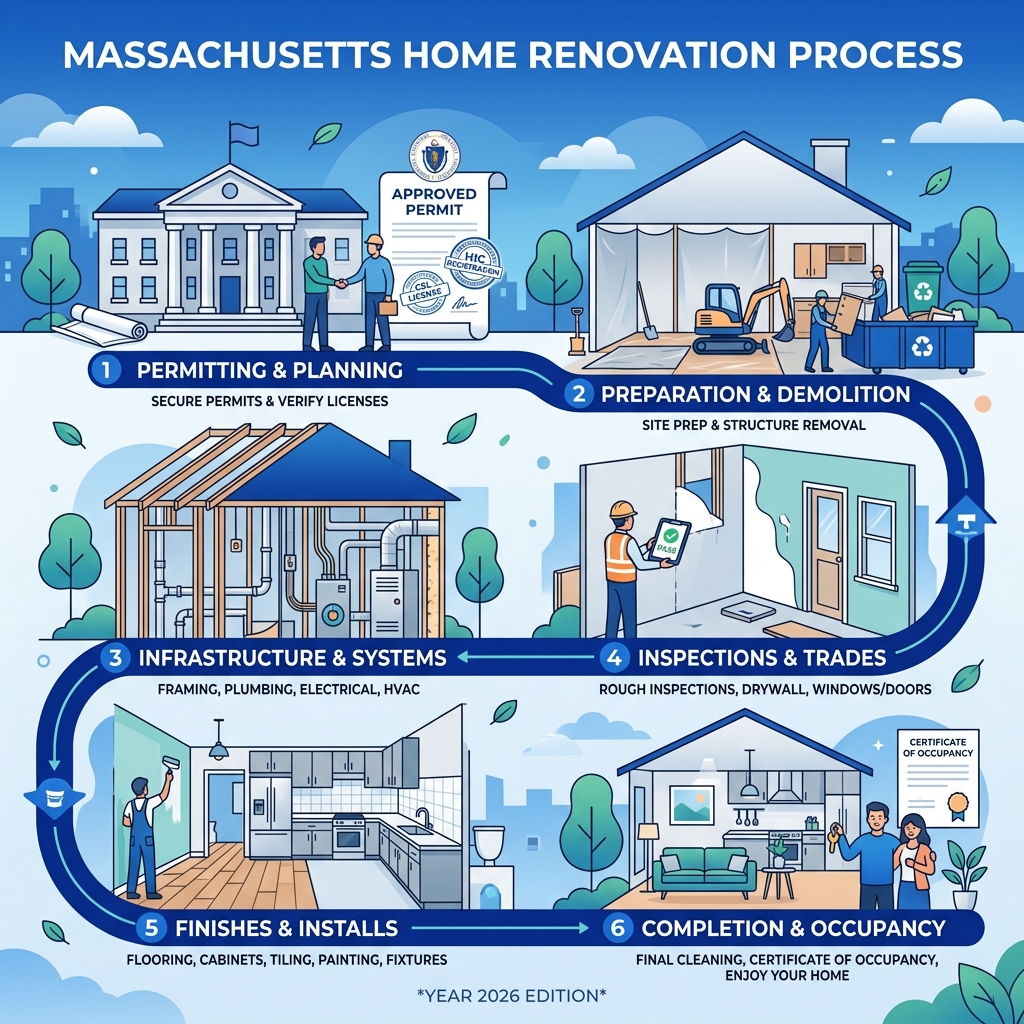
Are You Registered and Licensed for Home Renovation Massachusetts Projects?
The first and most critical question is about legal authority. In the Commonwealth, “licensed” and “registered” mean two different things, and you need a contractor who has both. Anyone performing home renovation Massachusetts work on an existing one-to-four unit, owner-occupied primary residence must be registered as a Home Improvement Contractor (HIC).
However, registration is just the beginning. If your project involves structural work—like home additions or moving load-bearing walls—the person in charge must also hold a Construction Supervisor License (CSL). Think of it this way: the HIC registration is for consumer protection and the “business” side, while the CSL proves the individual has the technical expertise to follow the building code.
Beyond licenses, we always emphasize the “Big Three” of insurance:
- General Liability Insurance: This protects your property if a pipe bursts or a ladder falls through a window.
- Worker’s Compensation: This is non-negotiable. If a worker gets hurt on your property and the contractor doesn’t have this, you could be held liable for their medical bills.
- Guaranteed Workmanship: At MB Construction, LLC, we believe a license is the bare minimum; a guarantee is what gives you peace of mind.
Before you dive into aesthetics, check out these 10 Questions to Ask Before Hiring a Custom Home Builder Near Me to ensure your home remodeling contractor is the real deal.

How to Verify a Home Renovation Massachusetts Contractor’s Credentials
Don’t just take a salesperson’s word for it. You can verify any contractor through the Massachusetts law about home improvement resources provided by the Office of Consumer Affairs and Business Regulation (OCABR).
Use the MA Contractor Hub to look up a company’s HIC registration. This portal allows you to see if their registration is active and, more importantly, if there is a history of complaints or disciplinary actions. A clean record in the Greater Boston area is a strong indicator of a professional who respects both the law and their clients.
The Importance of Local Expertise in Middlesex County
Why does it matter if your contractor is based in Billerica or Burlington? Because Massachusetts is a “Home Rule” state. While there is a state building code, individual towns have their own zoning bylaws and historical commission requirements.
For example, a home renovation Billerica MA project might have different setback requirements than one in Lexington or Carlisle. We’ve found that home remodeling Billerica MA homeowners benefit immensely from contractors who already have a rapport with local inspectors. It speeds up the process and ensures your project doesn’t get red-flagged halfway through.
Does the Contract Comply with Massachusetts Home Improvement Law?
In Massachusetts, if your project costs more than $1,000, the law (MGL c. 142A) requires a written contract. If a contractor tries to start a home renovation Burlington MA project with just a handshake or a one-page “estimate,” walk away.
A legal contract is your primary defense. It must include a clear payment schedule. By law, a contractor cannot demand a deposit of more than one-third of the total project price upfront (unless special-order materials are required). If you are doing home remodeling Burlington MA, ensure your contract also includes a “3-day cancellation clause,” which gives you the right to change your mind shortly after signing.
Understanding the Home Improvement Contractor Guaranty Fund
One of the best reasons to hire a registered home renovation Massachusetts professional is the Guaranty Fund. This is a “safety net” for homeowners. If you hire a registered contractor and they vanish or do shoddy work, and you win a legal judgment against them that they can’t pay, you may be eligible for up to $10,000 from this state-managed fund. If you hire an unregistered contractor? You’re on your own. This is why verifying your home remodeling contractor is so vital.
Essential Clauses for a Home Renovation Massachusetts Agreement
A solid agreement for remodeling services should be detailed enough to leave no room for “he said, she said.” It should include:
- Detailed Scope of Work: Exactly what is being done, down to the brand of fixtures.
- Start and Completion Dates: Don’t accept “sometime in the fall.”
- Permit Responsibility: The contract should explicitly state that the contractor is responsible for obtaining all necessary permits.
- Change Order Procedures: How will extra costs be handled if you decide to change the tile or if we find rot behind a wall?
What Permits and Building Codes Apply to My Project?
Massachusetts recently transitioned to the 10th Edition of the State Building Code (780 CMR), which is based on the 2021 International Construction Codes. This code is rigorous, especially regarding structural integrity and energy use.
Whether you are planning home additions or a simple kitchen refresh, you need to know which permits are being pulled. A professional contractor will handle the “Building Department dance” for you. If a contractor asks you to pull the permit as a “homeowner,” be careful—this often means they aren’t registered or are trying to avoid being held responsible for the work.
DIY Limitations for Home Renovation Massachusetts Electrical and Plumbing Work
We love a good DIY project, but Massachusetts law is very strict about what a homeowner can do. While you can paint and hang shelves to your heart’s content, you generally cannot perform your own electrical or plumbing work if it requires a permit.
- Plumbing: All plumbing work (beyond fixing a leaky faucet) must be done by a licensed master or journeyman plumber.
- Electrical: Must be performed by a licensed electrician.
- Structural: If you’re building garage additions, you must follow the 10th edition codes for wind and snow loads—things that require professional engineering.
Navigating Kitchen and Bathroom Permit Requirements
Kitchen remodeling is the most popular type of home renovation Massachusetts project, but it’s also the most permit-heavy. You’ll likely need a building permit, an electrical permit (for those new outlets and recessed lights), and a plumbing permit (for the sink and dishwasher). Each of these requires a separate inspection. A reputable contractor coordinates these so you aren’t stuck with a hole in your kitchen for three weeks waiting for an inspector to show up.
How Will You Maximize Energy Efficiency and Mass Save Incentives?
In Massachusetts, “going green” isn’t just about the environment; it’s about your wallet. The Mass Save program offers some of the most aggressive incentives in the country for renovations and additions.
If you are doing a major renovation, you could qualify for incentives of up to $60,000 for all-electric, high-performance renovations. This is especially relevant for new home construction or “gut” renovations where you can significantly improve the building envelope.
Achieving Level 1 and Level 2 Performance Standards
Mass Save categorizes renovations into different “Levels” based on energy savings.
- Level 1: Requires a HERS (Home Energy Rating System) score of 55 or less.
- Level 2: Requires a HERS score of 45 or less and very low air infiltration (meaning a very “tight” house). To hit these numbers, we focus on advanced air sealing, high-R-value insulation, and moving away from fossil fuels toward heat pumps for heating and cooling.
Sustainable Materials for the New England Climate
Living in Middlesex County means preparing for 90-degree summers and sub-zero winters. When choosing materials, we recommend:
- Energy-efficient windows: Look for triple-pane options if you’re near a busy road in Greater Boston.
- Smart Thermostats: A must-have for managing New England’s fluctuating temperatures.
- Low-VOC Paints: Better for your indoor air quality during those long winters when the windows are shut. For more on modern building standards, read everything you need to know about new home construction.
What is the Realistic Budget and Timeline for My Remodel?
Let’s talk numbers. A home renovation Massachusetts project is rarely “cheap” if done correctly. According to research, high-end whole-home remodels in the Boston area can range from $500,000 to over $1 million, depending on the scale. However, a well-planned project should have a very low “change order” rate. While the industry average for cost overruns is 20%, a meticulous design-build process can keep that under 3%.
Comparing Design-Build Firms vs. General Contractors
You have two main paths:
- The Traditional Way: You hire an architect to draw plans, then “bid” those plans out to various general contractors.
- The Design-Build Way: You hire one firm (like us!) that handles everything from the first sketch to the final coat of paint. In Billerica, MA, and surrounding towns, the design-build model is becoming the gold standard because it eliminates the “blame game” between the architect and the builder, leading to more accurate budgets and faster timelines for home additions.
Financing Options and Budget Contingencies
How are you paying for this? Most Massachusetts homeowners utilize:
- HELOC (Home Equity Line of Credit): Popular due to the high property values in Middlesex County.
- Cash-Out Refinance: Can be effective if rates are favorable.
- Renovation Loans: Specific products like the FHA 203(k) for “fixer-uppers.” Always set aside a 10-15% contingency fund. Even the best contractors can’t see through walls; if we find 100-year-old knob-and-tube wiring behind your plaster, you’ll be glad you have that budget cushion.
Frequently Asked Questions about Massachusetts Renovations
What is the difference between remodeling and renovation?
While people use them interchangeably, there is a technical difference. Renovation usually means “restoring” something to a good state of repair (painting, new floors, updating cabinets). Remodeling involves changing the use or structure of a space (knocking down a wall to create an open-concept kitchen or turning an attic into a bedroom). Both fall under the umbrella of “home improvement” in Massachusetts law.
How long does a whole-home remodel typically take?
In the Greater Boston area, a full-scale renovation typically takes between 3 to 9 months. Factors that influence this include the speed of the local building department (some towns are faster than others!), the complexity of the structural changes, and the availability of specialized materials like custom cabinetry.
Can I live in my home during a major renovation?
It is possible, but it’s a challenge. We use dust mitigation systems and can often set up “temporary kitchens” to keep you functional. However, for kitchen remodeling or whole-house projects, many families find it less stressful to move out for the most intensive 4-8 weeks of construction.
Conclusion
Embarking on a home renovation Massachusetts journey is an exciting way to turn your current house into your dream home. Whether you are in Andover, Billerica, or Lexington, the key to success is hiring a partner who understands the local landscape, respects the state’s rigorous building codes, and prioritizes quality above all else.
At MB Construction, LLC, we pride ourselves on being a quality-driven, time-sensitive team. Based in Billerica, MA, we serve Middlesex County and the Greater Boston area with expert craftsmen and premium materials. From new home construction to complex home additions, our workmanship is guaranteed.
Ready to start your transformation? Review everything you need to know about new home construction and let’s build something spectacular together.
