
What Does It Actually Cost to Add a Garage to Your Home?
The average cost of adding a garage to a house typically falls between $19,450 and $42,377, with most homeowners spending around $29,000–$31,000 for a standard build. That said, your final number depends heavily on size, type, location, and finishes.
Here’s a quick-reference breakdown to answer the most common questions upfront:
| Garage Type | Typical Cost Range | Cost Per Sq. Ft. |
|---|---|---|
| Attached single-car | $14,750 – $28,550 | $30 – $55 |
| Attached double-car | $18,000 – $38,000 | $30 – $55 |
| Detached single-car | $22,125 – $35,000 | $40 – $70 |
| Detached double-car | $27,000 – $44,100 | $40 – $70 |
| Detached with loft | $35,000 – $90,000 | $60 – $150 |
For homeowners in Middlesex County and Greater Boston, expect costs to run toward the higher end of these ranges — labor and permitting costs in the Northeast push totals up by roughly 15–30% compared to national averages.
Adding a garage is one of the most practical investments you can make in a suburban Massachusetts home. It protects vehicles, adds usable space, and boosts resale value. But the total price tag can surprise people once permits, site prep, and finishes enter the picture.
This guide breaks down every cost component — from foundation to electrical — so you can plan your project with confidence and avoid the hidden expenses that catch many homeowners off guard.
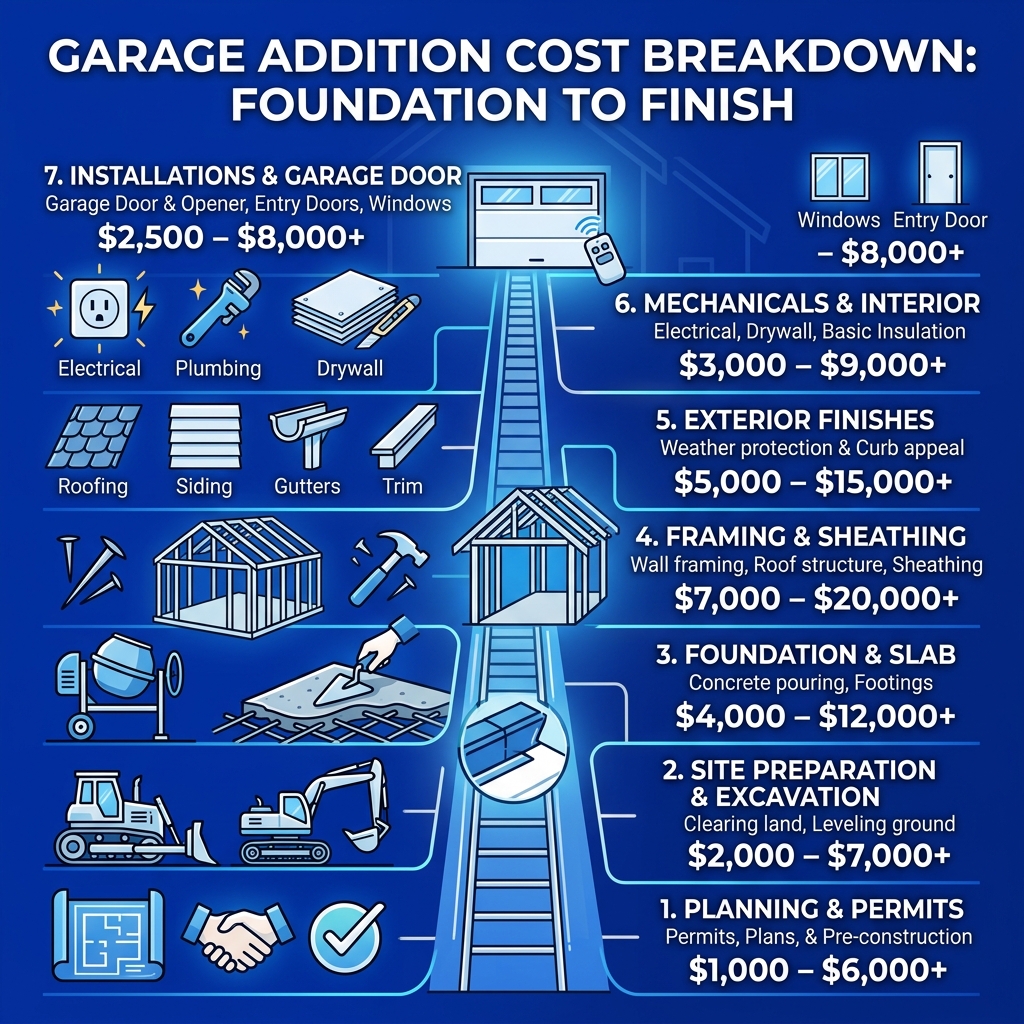
Important average cost of adding a garage to a house terms:
Average Cost of Adding a Garage to a House: 2025-2026 Price Guide

As we move into 2025 and 2026, the construction landscape continues to evolve. While the national average remains centered around $30,914, local variables in the Northeast often push a standard two-car garage closer to the $40,000–$55,000 range when using premium materials and expert labor.
When we look at the average cost of adding a garage to a house, the price per square foot is the most reliable metric for early budgeting. Nationally, this ranges from $35 to $70 per square foot for basic structures. However, for a high-quality build that matches the aesthetic of a New England colonial or craftsman home, you should budget between $80 and $120 per square foot.
The choice between an attached or detached structure is the first major financial fork in the road. According to data from Pricing Guide: How Much Does it Cost to Build a Garage?, attached garages are generally more cost-effective because they leverage an existing wall of your home, reducing the amount of siding and framing required.
| Feature | Attached Garage | Detached Garage |
|---|---|---|
| Foundation | Integrated or Slab | Independent Slab/Frost Wall |
| Utilities | Easier to extend from house | Requires trenching/new lines |
| Framing | Shares one home wall | Four independent walls |
| Permits | Often part of home addition | Accessory structure permit |
| Average Total | $15,000 – $35,000 | $22,000 – $55,000+ |
Average cost of adding a garage to a house by size and capacity
Size is the most obvious driver of cost. We typically categorize these by the number of vehicles they can accommodate:
- Single-Car Garage (12’ x 20’ or 14’ x 22’): These usually span 240 to 380 square feet. For a basic attached version, costs range from $12,720 to $20,140. If you are looking for a turnkey finish with insulation and basic electrical, expect to spend closer to $27,000.
- Double-Car Garage (20’ x 20’ or 24’ x 24’): This is our most requested size in towns like Reading and Billerica. A standard 400 to 576 square foot garage costs between $18,000 and $45,000. This size provides enough room for two vehicles plus a small workbench or storage area.
- Three-Car Custom Garage: For homeowners with multiple vehicles or those needing a dedicated workshop, a three-car garage (typically 24’ x 36’) can exceed 800 square feet. Costs for these projects often start at $50,000 and can climb over $75,000 depending on the roof pitch and interior finishes.
For more detailed specs on how we handle these different scales, you can explore more info about garage additions.
Regional factors affecting the average cost of adding a garage to a house
Living in the Northeast comes with specific construction requirements that influence the average cost of adding a garage to a house. In Middlesex County and Greater Boston, we don’t just build for aesthetics; we build for the elements.
- Labor Rates: The Northeast has some of the highest labor rates in the country. Skilled craftsmen—including licensed electricians and structural framers—are in high demand, which can add 15% to 25% to the total labor budget compared to the Midwest or South.
- Climate Requirements: Our foundations must be built to withstand the freeze-thaw cycle. This means pouring concrete footings below the frost line (usually 4 feet deep in MA) or using engineered monolithic slabs, which are more expensive than the simple slabs used in warmer climates.
- Zoning and Codes: Towns like Lexington and Carlisle have strict zoning bylaws regarding “lot coverage” and “setbacks.” Navigating these requirements often requires professional site plans, which adds to the pre-construction cost.
According to How Much Does It Cost to Build a Garage? (2025), regional variations can swing a project’s price by thousands of dollars based on local building codes alone.
Key Construction Components and Hidden Expenses
When we provide an estimate for a garage addition, we break it down into several core components. Understanding these helps you see where your money is going:
- Foundation (10-20% of budget): This is the most critical part of the build. A standard concrete slab for a two-car garage costs between $4,000 and $11,000. In Massachusetts, we often recommend a “T-foundation” or “frost wall” to ensure the structure doesn’t shift during winter.
- Framing ($4 – $9 per sq. ft.): Most residential garages use traditional wood framing. This includes the wall studs and the roof trusses. If you want a “clear span” (no middle support pillars) for a large double garage, we use engineered beams which cost slightly more but provide much better functionality.
- Roofing ($10 – $13 per sq. ft.): To maintain your home’s curb appeal, we always recommend matching the garage shingles to your house. This ensures the addition looks like it was always there.
- Electrical Wiring ($1,500 – $3,000): A basic setup includes a few overhead lights, a couple of outlets, and the garage door opener. However, if you plan on using the space as a workshop or charging an EV, this cost will increase.
- Building Permits ($200 – $1,500): Permit fees vary by municipality. In Middlesex County, fees are often calculated based on the project’s estimated value or square footage.
For a deeper look at how we integrate these components seamlessly with your existing home, check out The Perfect Match: Adding an Attached Garage Successfully.
Site Preparation and Municipal Requirements
Before the first shovel hits the ground, site preparation must be completed. This is often where “hidden” costs reside.
- Land Surveying: Most towns require a certified plot plan to prove the garage won’t encroach on setbacks. This can cost between $500 and $1,500.
- Excavation and Grading: If your yard isn’t perfectly level, we may need to move significant amounts of dirt or bring in structural fill. Proper drainage is also essential to prevent water from pooling against the new foundation.
- Setback Requirements: Every town has rules about how close a structure can be to the property line. If you have a tight lot, you might need a “Zoning Variance,” which involves public hearings and additional legal fees.
These factors are highlighted in How Much Does It Cost to Build a Garage? [2026 Data] | Angi, which notes that site prep can account for up to 10% of the total project cost.
High-Value Upgrades: Lofts, Living Spaces, and EV Charging
Many of our clients in Andover and North Reading are looking for more than just a place to park. They want a multi-functional space.
- Storage Lofts ($35,000 – $50,000): Adding a simple, unfinished attic space above the garage is a cost-effective way to gain massive storage. This requires reinforced roof trusses but avoids the high cost of interior finishing.
- Living Space Conversions ($125 – $250 per sq. ft.): Turning the area above the garage into an office, gym, or “in-law suite” is a major project. This involves insulation, HVAC, plumbing, and egress windows. While expensive—adding $60,000 to $100,000+ to the project—it significantly increases the home’s square footage.
- HVAC Integration: If you want a climate-controlled workshop, we can install a “mini-split” system. These are highly efficient and provide both heating and cooling for about $3,000 to $5,000.
- EV Charging Stations: With the rise of electric vehicles, installing a Level 2 charging station during construction is a smart move. Doing it while the walls are open saves hundreds in later electrical labor.
To see how a second story can transform your property, read The Dream Suite: Adding a Bedroom Over Your Garage.
Return on Investment and Property Value Impact
Is the average cost of adding a garage to a house worth it? The data says yes. On average, a garage addition recoups 60% to 80% of its cost in immediate home value.
Beyond the numbers, a garage adds “market desirability.” In the Greater Boston area, homes without garages often sit on the market longer. Buyers view a garage as a necessity for protecting their vehicles from snow and salt. A well-designed garage that matches the home’s architecture improves curb appeal, making the entire property look more substantial and well-maintained.
Functional upgrades, such as built-in storage systems or a finished floor coating, can further push that ROI toward the higher end. As noted in Average Cost to Add a Garage to a House: Comprehensive Guide for Homeowners 2026 – LatestCost – Real-Time Price Insights, garages are consistently ranked as one of the top three additions for boosting resale value.
Frequently Asked Questions about Garage Additions
Is it cheaper to build an attached or detached garage?
Generally, an attached garage is cheaper. It shares at least one structural wall with the house, which saves on framing and siding materials. Additionally, extending electrical and heating systems from the main house is much simpler and less expensive than trenching new lines across a yard for a detached structure.
How long does it take to build a garage addition?
Once the permits are approved—which can take 2 to 4 weeks depending on the town—the actual construction typically takes 6 to 8 weeks. This timeline includes foundation curing, framing, roofing, and electrical rough-ins. Weather delays, especially during New England winters, can extend this window.
Do I need a permit for a garage in Massachusetts?
Absolutely. Any structural addition in Massachusetts requires a building permit. This ensures the structure meets the state’s strict building codes for wind and snow loads. You will also likely need separate electrical and plumbing permits. If you’re in Wilmington, you can find specific details on garage additions in Wilmington, MA.
Planning Your Garage Project in Middlesex County
At MB Construction, LLC, we understand that adding a garage is a significant investment. Based in Billerica, MA, we have spent decades helping homeowners in Reading, North Reading, Tewksbury, and the surrounding areas expand their homes with quality and precision.
Our team of expert craftsmen uses only premium materials to ensure your garage stands up to the toughest Massachusetts winters. We pride ourselves on being time-sensitive and quality-driven, offering guaranteed workmanship on every project. Whether you need a simple single-car attached garage or a custom detached workshop with a living suite above, we have the experience to bring your vision to life.
Ready to take the next step? Get Your Free Estimate today and let us help you calculate the exact average cost of adding a garage to a house for your specific property.
