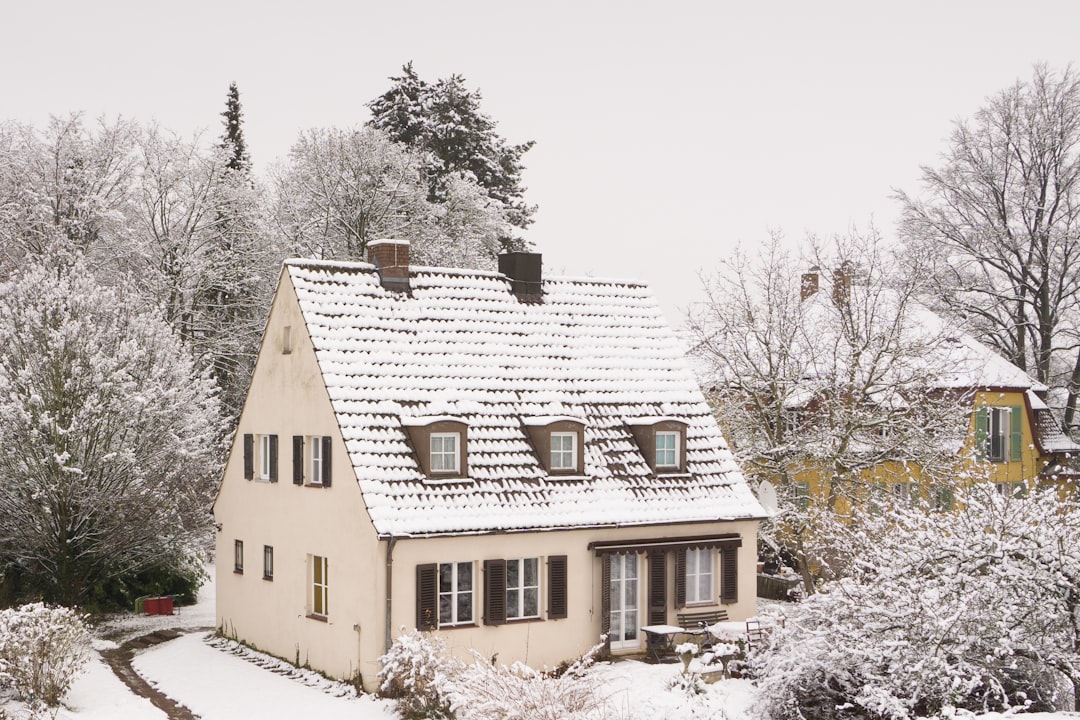
What Does a 4 Season Room Addition Actually Cost?
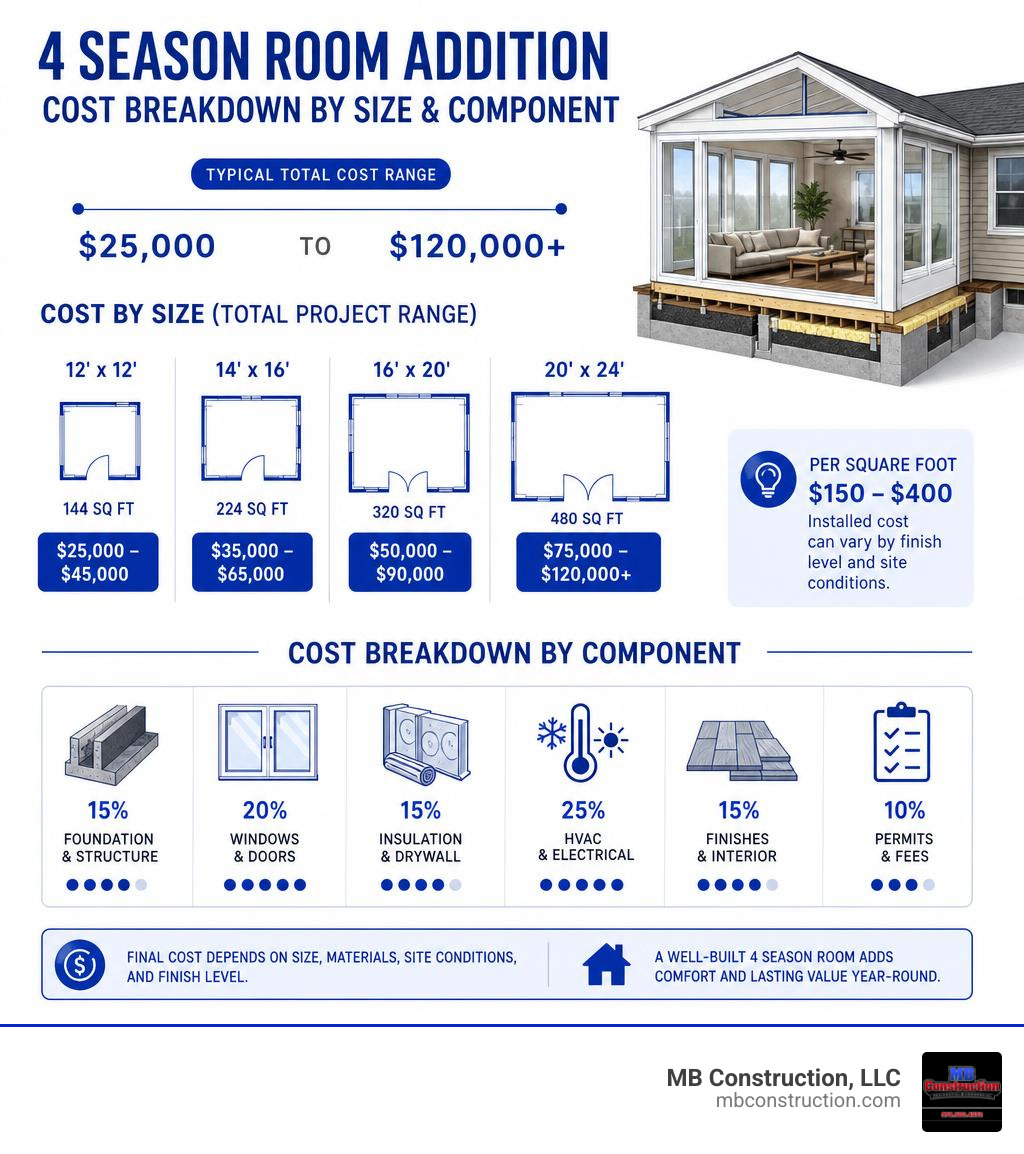
The cost of a 4 season room addition typically falls between $25,000 and $120,000, depending on size, materials, foundation type, and HVAC setup. Based on average internet data, here is a quick snapshot:
| Build Level | Typical Cost Range |
|---|---|
| Basic / Prefab | $25,000 – $35,000 |
| Mid-Range Custom | $35,000 – $75,000 |
| Premium Custom | $75,000 – $120,000+ |
| Cost Per Square Foot | $150 – $400 |
These are average ranges based on internet data. Your actual cost in Middlesex County or Greater Boston, MA may vary based on lot conditions, local permitting, and contractor rates.
So you want to add a 4-season room. Maybe you picture morning coffee with a view of your backyard in January, or a real home office that doesn’t feel like a closet. It’s a genuinely great addition for suburban Massachusetts homeowners — but the price range is wide, and the gap between a room that performs and one that disappoints often comes down to decisions most contractors won’t walk you through upfront.
Unlike a 3-season porch, a true 4-season room has to meet residential building codes: insulated foundation, thermally broken windows, proper HVAC, and full wall and ceiling insulation. Skip any one of those, and you end up with a space that feels cold in February and costs a fortune to heat.
This guide walks you through every major cost factor — foundation, windows, HVAC, permits, and finishes — so you can plan your project with realistic numbers and no surprises.
Cost of 4 season room addition vocabulary:
Understanding the Average Cost of 4 Season Room Addition

When researching the cost of 4 season room addition on the internet, you will find a massive spread of numbers. Based on average internet data, a standard four-season sunroom addition averages around $47,000. However, to account for the actual reality of custom home remodeling in areas like Lexington, Burlington, or Carlisle, MA, the real-world cost can range from a modest $25,000 to over $470,000+ for ultra-premium, architecturally integrated structures with high-end glass, radiant heating, and custom masonry.
This wide range reflects the massive difference between a basic prefabricated kit assembled on a pre-existing concrete patio and a fully custom, stick-built architectural extension.
To help put these numbers into context, we can look at the typical investment tiers:
- Basic Prefabricated Kits ($25,000 – $35,000): These are modular systems with aluminum or vinyl frames and pre-insulated panels. While cost-effective, they offer limited design flexibility and may struggle to blend seamlessly with the traditional colonial or craftsman architecture found in Greater Boston.
- Mid-Range Custom Builds ($35,000 – $75,000): A custom stick-built room featuring high-quality vinyl or composite frames, double-pane Low-E glass, full insulation, and a dedicated heating/cooling system. It looks and feels like a natural extension of your home.
- Premium Custom Builds ($75,000 – $470,000+): These are high-end home additions featuring cathedral ceilings, custom wood interior framing, triple-pane glass, heated stone flooring, and seamless roofline integration.
Understanding these differences is crucial when budgeting. If you want to dive deeper into how these projects compare to standard home expansions, read our guide on Breaking Down the Average Cost of Home Addition in Massachusetts.
To help you calculate your potential investment based on internet data, here is how different dimensions typically price out:
| Dimensions | Total Square Footage | Estimated Cost Range (Internet-Based Averages) |
|---|---|---|
| 12×12 (Compact) | 144 sq ft | $22,000 – $58,000 |
| 12×16 (Value Sweet Spot) | 192 sq ft | $30,000 – $77,000 |
| 16×20 (Spacious Family Room) | 320 sq ft | $48,000 – $128,000 |
| 20×20 (Large Luxury Addition) | 400 sq ft | $60,000 – $160,000+ |
Key Cost Components of an All-Season Sunroom
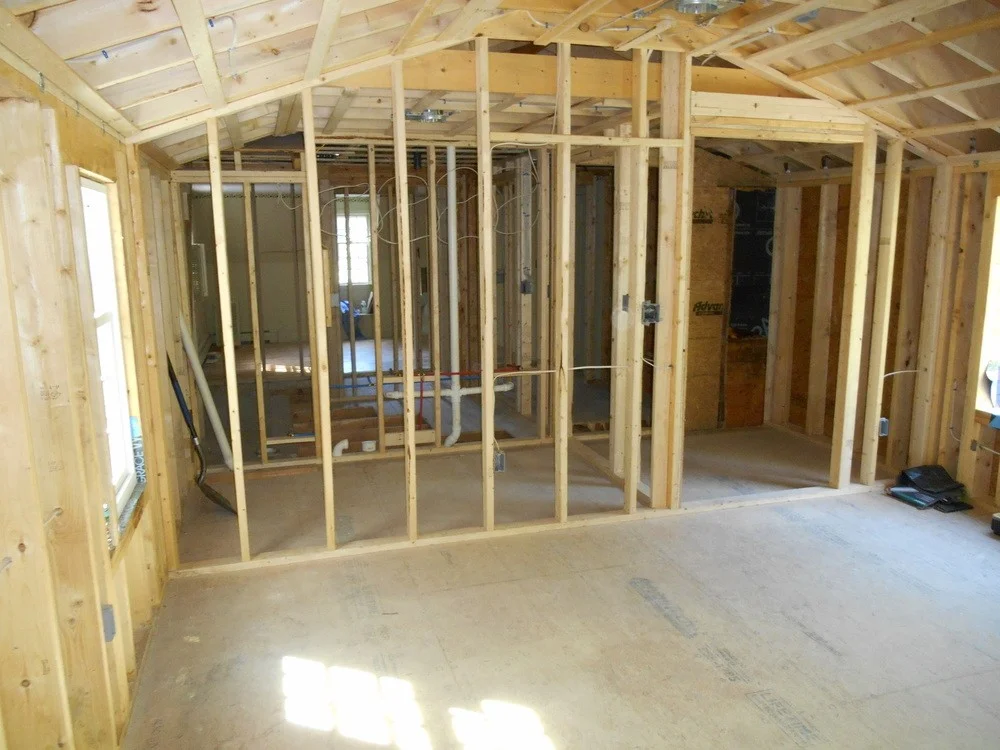
Building a room that remains perfectly comfortable when it is 95°F and humid in July, or a freezing 10°F in January, requires precise engineering. Labor typically accounts for 40% to 60% of the total project cost because you need several distinct trades: excavation crews, framers, insulation specialists, electricians, and HVAC technicians.
Before diving into the materials, you should review our House Addition Cost Complete Guide to see how these structural components fit into a broader home construction budget.
Foundation and Framing Requirements
Every true 4-season room must sit on a permanent, code-compliant foundation. In Massachusetts, this means the foundation must extend below the local frost line (typically 4 feet deep) to prevent the structure from shifting during winter freeze-and-thaw cycles.
- Concrete Slab on Footings ($4,000 – $8,000): The most common option. It provides a solid, durable base but requires extensive excavation and curing time.
- Frost-Wall Foundation ($6,000 – $12,000): A traditional foundation wall that creates a crawl space under the addition. This is ideal for running plumbing, electrical, and HVAC ductwork beneath the floor.
- Helical Piers with Insulated Subfloor ($2,500 – $5,000): Large steel screws drilled deep into the ground. This is often the most cost-effective foundation option because it requires minimal digging and leaves your backyard landscaping largely untouched.
Ensuring your foundation is engineered correctly is the first step to protecting your investment. For a detailed breakdown of structural math, check out Math for Homeowners: Calculate Your Addition Cost Like a Pro.
Windows, Doors, and Insulation
Because a sunroom is primarily made of glass, your choice of windows will directly dictate both your upfront construction costs and your monthly energy bills. Cheap windows will turn your beautiful new room into a glassy, unusable greenhouse in summer and an icebox in winter.
- Thermally Broken Frames: This is the most critical detail that cheap builders skip. Standard aluminum frames conduct heat rapidly. A thermally broken frame uses a non-conductive barrier (like polyurethane or vinyl composite) inside the frame to stop heat from escaping or entering.
- Double-Pane Low-E Glass: This is the baseline standard. The Low-E (low-emissivity) coating reflects infrared heat, keeping summer sun out and indoor heating in.
- Triple-Pane Argon-Filled Glass: If you live in colder towns like Andover or Carlisle, upgrading to triple-pane glass can reduce heat loss by up to 30%, though it increases window costs by 20% to 40%.
- Insulation (R-Value): To meet residential energy codes, the solid walls must have at least R-13 insulation, while the ceiling requires R-30 to R-49.
To learn more about selecting the right glass systems and avoiding common design traps, see our article on Sunroom Addition 101 and How to Avoid a Glassy Mess. You can also read more about structural engineering details in the Four Season Room Addition: Cost & Design Guide (2026) .
HVAC Options and the True Cost of 4 Season Room Addition Climate Control
How do you heat and cool a room that is 70% glass? You have a few main options:
- Ductless Mini-Split Systems ($3,000 – $7,000): This is the gold standard for 4-season rooms. A mini-split provides dedicated, zoned heating and cooling without forcing your existing home furnace to work overtime. They are incredibly quiet and energy-efficient.
- Extending Existing Ductwork ($1,500 – $4,000): If your current HVAC system has excess capacity, a technician can run ductwork into the new room. However, you must perform an ACCA Manual J load calculation first. If your system is undersized, extending the ducts will result in uneven temperatures throughout your entire house.
- Radiant Floor Heating ($10 – $20 per sq ft): Installing electric or hydronic heating coils beneath tile or luxury vinyl plank flooring is highly recommended. Because heat rises, radiant floors keep your feet warm and make the room feel incredibly cozy in the dead of winter.
- PTAC Units ($1,500 – $3,500): These are the self-contained wall units commonly seen in hotels. While functional and relatively cheap to install, they can be noisy and visually obtrusive.
To compare these options in detail, refer to the Sunroom Addition Cost: Three-Season, Four-Season, and Solarium – D and G Flooring .
3-Season vs. 4-Season Rooms: Construction and Price Differences
The decision between a 3-season and a 4-season room usually comes down to budget and how you plan to use the space. In Middlesex County, MA, where winters are long, snowy, and dark, a 3-season room is generally unusable from November through late March.
If you want a room that can comfortably host Christmas dinner or serve as a permanent home office, a 4-season room is your only viable choice. For a complete comparison of scale and pricing, read our 300 Sq Ft Addition Cost Complete Guide.
Structural and Permitting Differences
The physical differences in how these two spaces are built are substantial, which is why the permitting processes are entirely different.
- 3-Season Rooms: Typically treated by local building departments as enclosed porch additions. They often sit on simple deck-style concrete piers, use single- or double-pane non-insulated windows, and do not require heating systems.
- 4-Season Rooms: Reviewed, permitted, and inspected exactly like a standard home addition. They must meet the International Energy Conservation Code (IECC) for conditioned spaces, which requires continuous insulation, a frost-protected foundation, and a permanent HVAC connection.
Getting these permits in towns like Billerica, Reading, or Tewksbury requires detailed architectural plans and structural engineering stamps, which typically cost between $500 and $2,500.
Comparing the Cost of 4 Season Room Addition vs. 3-Season Spaces
Based on average internet data, a 3-season room typically costs between $15,000 and $40,000 to build from scratch. In contrast, a true 4-season room of the same size will run $30,000 to $120,000+ due to the added foundation depth, framing thermal breaks, insulation, and HVAC integration.
If you already have a well-built screened porch or deck, you might consider converting it. Converting a porch into a sunroom typically costs $41,500 to $46,000, assuming the existing structure can handle the weight of double-pane glass and a solid insulated roof. If the existing deck framing requires structural reinforcement, those costs can rise quickly. For more details on local remodeling costs, see the Cost of a Four Season | Screen Room | Single Room Additions .
Return on Investment and Home Value Impact
Does a 4-season room add real value to your home? Yes, but only if it is built to code.
Because a 4-season room is fully insulated, heated, and accessible via a standard interior doorway, real estate appraisers can count it as official, heated living square footage. A 3-season room, on the other hand, is usually valued at only 25% of that rate because it cannot be used year-round.
- Resale ROI: According to national real estate data, a properly permitted, code-compliant 4-season room yields an average return on investment of 50% to 80% of its initial cost at resale.
- Climate Advantage: In cold climates like New England, the ROI of a 4-season room is often higher than in warmer climates. Buyers actively look for bright, light-filled spaces to escape the winter blues, making your home significantly more marketable.
For more information on how home additions impact long-term property values, you can read the How Much Does a Sunroom Addition Cost? [2026 Data] .
Frequently Asked Questions
Does a 4-season room count toward official home square footage?
Yes, but only if it meets three strict criteria: it must have a permanent, code-compliant foundation; it must be fully insulated to meet local energy codes; and it must have a permanent heating and cooling source (like a mini-split or ducted connection). If it meets these standards, it will be appraised as finished, conditioned living space, directly increasing your home’s official square footage and market value.
Is it cheaper to convert an existing deck or build from scratch?
Converting an existing deck or porch can save you $5,000 to $10,000 on foundation and framing costs, but only if the existing structure is structurally sound. A licensed builder or structural engineer must verify that the existing footings extend below the frost line and can support the immense weight of double-pane glass walls. If the deck needs to be completely rebuilt or reinforced, building from scratch is often cleaner and more cost-effective.
What is the best heating and cooling option for a year-round sunroom?
A ductless mini-split system is widely considered the best option. It operates on its own thermostat, allowing you to heat or cool the sunroom only when you are using it. This prevents the glass-heavy room from draining energy from your main home HVAC system and keeps your monthly utility bills manageable.
Conclusion
Adding a 4-season room is a fantastic way to flood your home with natural light and create a versatile, year-round space for relaxing, working, or entertaining. While the upfront investment is higher than a seasonal porch, the long-term comfort, energy efficiency, and boost to your home’s resale value make it a highly rewarding project.
At MB Construction, LLC, based in Billerica, MA, we specialize in delivering quality-driven, time-sensitive home additions using premium materials and expert craftsmen. Whether you are in Lexington, Bedford, Burlington, or anywhere in Middlesex County and Greater Boston, we are committed to building beautiful, code-compliant spaces that stand up to harsh New England winters.
Ready to start planning your dream sunroom? Learn more about our process and explore your options on our MB Construction Home Additions page, and let’s build something beautiful together.