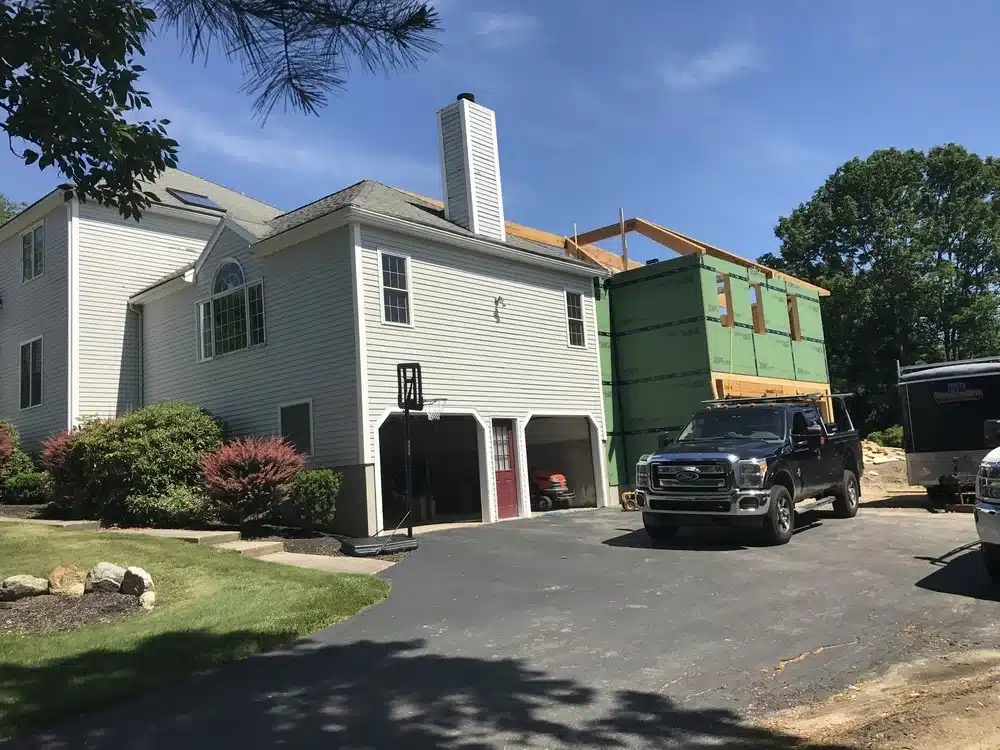
Is Adding a Second Story to a Detached Garage Worth It?
Adding a second story to a detached garage is one of the smartest ways to gain living space without touching your home’s footprint. For homeowners in Middlesex County and Greater Boston, it can mean the difference between moving to a bigger house and making the home you love actually work for you.
Here’s a quick snapshot of what’s involved:
| Factor | Key Details |
|---|---|
| Typical cost | $300–$500 per sq ft ($35,000–$100,000+) |
| Space gained | Up to 500 sq ft from a two-car garage |
| Home value increase | Up to 20% |
| Permits required | Yes — always |
| Structural assessment | Required before any work begins |
| Common uses | Guest suite, home office, rental unit, gym |
| Timeline | Several months, depending on complexity |
The idea is simple: your detached garage already has a foundation and four walls. Adding a floor above it costs far less than building a brand-new structure from scratch. But it’s not a simple project. It touches zoning laws, structural engineering, utilities, and design — all at once.
Most homeowners start this journey because they’re feeling cramped. A growing family, a new need for a home office, or an aging parent who needs their own space — these are the moments when the empty air above your garage starts looking like opportunity.
This guide walks you through every step, from the first permit question to the final coat of paint.
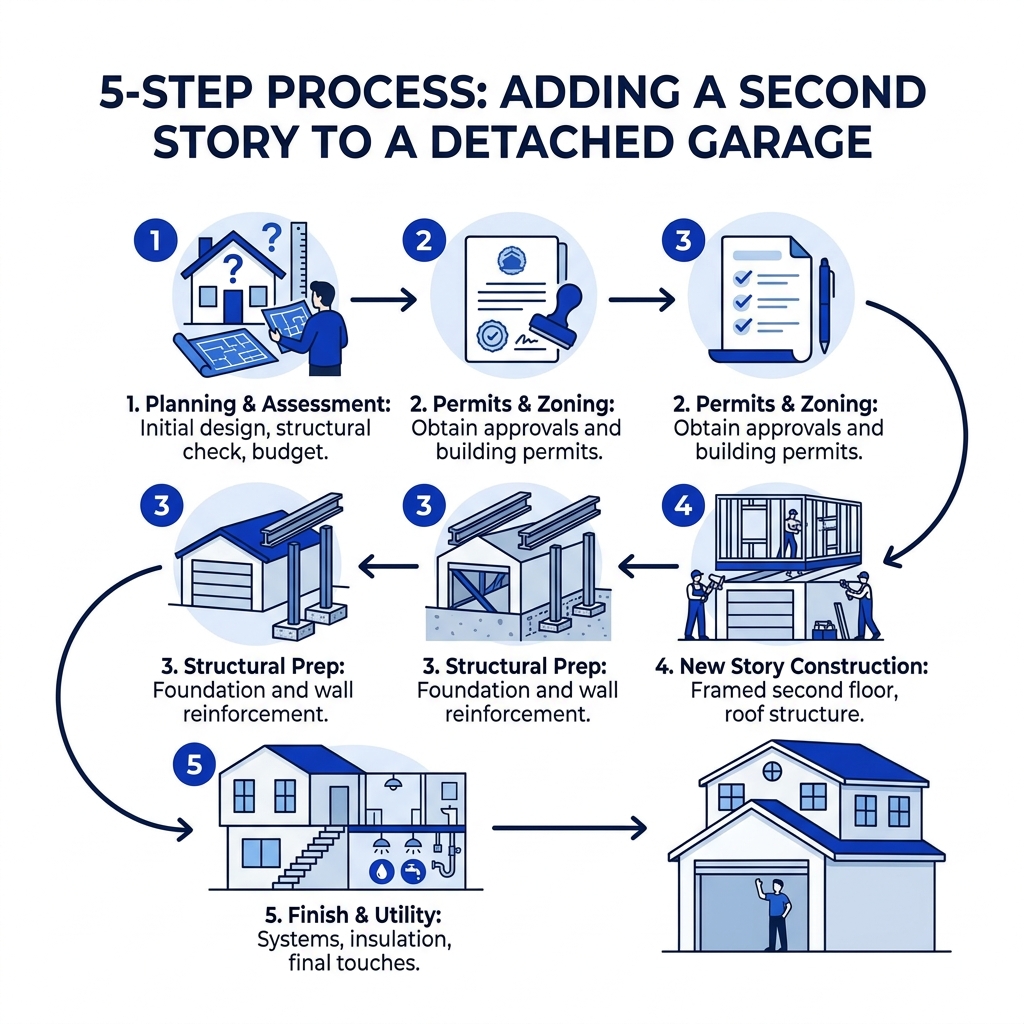
Planning and Regulations for Adding a Second Story to a Detached Garage
Before we pick up a hammer, we have to pick up a pen. Planning is the most critical phase of adding second story to detached garage. Because a garage is often built with the sole intention of housing cars and lawnmowers, it wasn’t originally designed to carry the weight of a furnished living suite, a bathtub full of water, or a group of people.
In towns like Billerica, Reading, and Lexington, the local building departments have very specific ideas about what you can and cannot do with a detached structure. We start by looking at the “bones” of the existing building and the legal boundaries of your property.

Structural Integrity and Foundation Assessment
The biggest question we hear is: “Can my garage actually hold another floor?” Most garages are built with a basic slab or a foundation meant for a single story. To add a second level, a structural engineer must inspect the site. They look at the footing depth and the thickness of the concrete.
If the foundation isn’t strong enough, we don’t just give up. We use techniques like underpinning—adding more concrete support under the existing foundation—to ensure it can handle the new load. We also look at the wall framing. Standard 2×4 studs might need to be reinforced or replaced with 2×6 framing or even steel beams to support the floor joists of the new room. For more details on how we handle these technical builds, check out our page on Garage Additions.
Navigating Local Zoning and Permits
In Middlesex County, “zoning” is the word that determines your project’s fate. Every municipality, from Burlington to Chelmsford, has its own rules regarding:
- Setbacks: How close the building can be to your neighbor’s fence or the street.
- Height Restrictions: Many towns limit detached structures to a certain height (often 15 to 25 feet).
- Use Cases: Some areas allow a “bonus room” but forbid a full “apartment” with a kitchen.
Obtaining building permits is non-negotiable. Attempting to build without one can lead to massive fines or a legal requirement to tear the addition down when you try to sell your home. We handle the heavy lifting here, ensuring your plans meet all local codes and represent a seamless aesthetic addition to your neighborhood.
Design and Functional Uses for New Living Space
What are you going to do with all that new square footage? A standard two-car garage is about 20′ x 20′ or 24′ x 24′, which gives you roughly 400 to 500 square feet of brand-new living space. That is enough for a very comfortable studio apartment or a sprawling executive office.
Popular uses we see in the Greater Boston area include:
- The Executive Home Office: A quiet, detached space away from the noise of the main house.
- The Guest Suite: A private area for visiting in-laws or friends.
- The Rental Unit (ADU): An Accessory Dwelling Unit can provide a steady stream of monthly income, often recouping the construction costs over time.
- The Hobby Hub: Whether it’s an art studio, a music room, or a home gym, having a dedicated space makes a huge difference.
If you are dealing with sloped ceilings or odd corners, there are plenty of 25 solutions for unusual spaces that can turn a “cramped” attic feel into a cozy, functional retreat.
Access and Interior Layout for a Second Story to Detached Garage
How you get upstairs is a major design choice.
- Interior Stairs: These take up space inside the garage (about 30-40 square feet) but keep you out of the rain and snow when moving between levels.
- Exterior Stairs: These save space inside the garage and are ideal if you plan to rent the unit, as they provide a private entrance. However, in Massachusetts, you’ll need to consider snow removal and safety during our icy winters.
To make the space feel larger, we often recommend dormer windows or skylights. These break up the roofline and flood the room with natural light, preventing that “dark attic” vibe.
Aesthetic Integration and the “Fourth Wall”
A common mistake is making the addition look like a “box” stuck on top of a garage. We strive for aesthetic cohesion. This means matching the siding, the trim color, and the roof pitch to your main residence.
We also pay close attention to the “fourth wall”—the garage door. If you are heating and cooling the space above, an uninsulated, drafty garage door will make your energy bills skyrocket. Upgrading to a high-R-value, insulated garage door not only looks better but acts as a thermal barrier for the room above. For tips on blending your structures perfectly, see our guide on The Perfect Match: Adding an Attached Garage Successfully.
Structural Integrity and Utility Integration
Adding a room is one thing; making it livable is another. You need light, heat, and—if you’re planning a suite—water. Since the garage is detached, we have to run these lines from the main house or establish new, independent connections.
| Feature | Best Option for Detached Garages | Why? |
|---|---|---|
| Heating/Cooling | Mini-Split Heat Pump | Highly efficient, no ductwork needed, provides both heat and AC. |
| Plumbing | Extension from Main Drain | Cost-effective if the garage is close to the house sewer line. |
| Electrical | New Sub-panel | Ensures the new space has enough “juice” for appliances and electronics. |
| Internet | Hardwired Ethernet or Mesh | WiFi signals often struggle to penetrate exterior garage walls. |
Insulation, Soundproofing, and Fire Safety
Safety is our top priority. Because you have cars (and potentially gasoline or chemicals) stored below a living space, fire separation is vital. We use Type X fire-rated drywall on the garage ceiling to provide a safety barrier.
For comfort, we highly recommend spray foam insulation. Unlike traditional fiberglass batts, spray foam seals every nook and cranny, preventing the cold air of a Massachusetts winter from seeping through the floor. It also acts as an excellent sound dampener, so you won’t hear the garage door opening while you’re trying to sleep or work upstairs.
Plumbing and Electrical Considerations
If you want a bathroom, we need to talk about drains. The location of your home’s main wastewater drain is a huge factor. If the garage is on a slope or far from the main line, we might need a sewer ejector pump. We always suggest “future-proofing”—even if you don’t want a full bathroom now, running the rough-in plumbing during the initial build can save you $10,000 or more in future renovation costs.
Investment, Costs, and Construction Timelines
Let’s talk numbers. Adding second story to detached garage is a significant investment. While it is generally more affordable than a ground-up addition because the foundation is already there, the structural reinforcements and utility runs add up.
Budgeting for Your Second Story to Detached Garage
In the current Greater Boston market, you should expect to spend between $300 and $500 per square foot. For a standard 500-square-foot addition, this puts the budget in the $150,000 to $250,000 range for a high-quality, fully finished space.
Factors that influence the price include:
- Structural Reinforcement: If we need to underpin the foundation, costs go up.
- Finishes: Hardwood floors and custom cabinetry cost more than laminate and stock shelving.
- Utilities: Adding a full bathroom can add $15,000 to $25,000 to the project.
The good news? This project can boost your home’s value by up to 20%, and if used as a rental, it can pay for itself over several years.
Construction Timeline and Professional Hiring
A typical project takes 3 to 6 months from the day we break ground.
- Phase 1 (Weeks 1-2): Site prep and structural reinforcement.
- Phase 2 (Weeks 3-5): Roof removal and framing the new walls and roof.
- Phase 3 (Weeks 6-10): “Rough-ins” (plumbing, electrical, HVAC) and roofing.
- Phase 4 (Weeks 11-16+): Insulation, drywall, flooring, and interior finishes.
Choosing the right team is essential. You need a licensed contractor who understands the specific soil and weather conditions of Middlesex County. At MB Construction, LLC, we pride ourselves on being time-sensitive and quality-driven, ensuring your backyard doesn’t look like a construction zone for a year.
Frequently Asked Questions
Can my existing garage foundation support a second story?
It depends on how it was originally poured. Most standard garage slabs are not thick enough to support a second floor. However, we can often reinforce the structure using footings or underpinning. A structural engineer’s assessment is the first step we take for every client in towns like Andover or North Reading.
How much value does a second-story garage addition add?
On average, you can see a value boost of up to 20%. In high-demand areas like Greater Boston, adding “living square footage” is one of the most reliable ways to increase appraisal value. Buyers love the flexibility of an ADU or a private office.
Do I need a separate permit for plumbing and electrical?
Yes. In addition to the general building permit, licensed tradespeople (plumbers and electricians) must pull “trade permits” and have their work inspected by the city or town (e.g., the Billerica or Wilmington building inspector) to ensure everything is up to safety codes.
Conclusion
Adding second story to detached garage is a transformative journey. It turns a simple storage building into a high-value asset that grows with your family. Whether you are in Bedford, Carlisle, or any of our other service areas in Middlesex County, this project requires a blend of engineering precision and architectural vision.
At MB Construction, LLC, based right here in Billerica, MA, we specialize in these complex additions. Our mission is to provide quality-driven, time-sensitive projects using premium materials and expert craftsmen. We don’t just build rooms; we build space for your life to expand, all backed by our guaranteed workmanship.
Ready to see what’s possible above your garage? Start your garage addition project today and let’s build something incredible together.