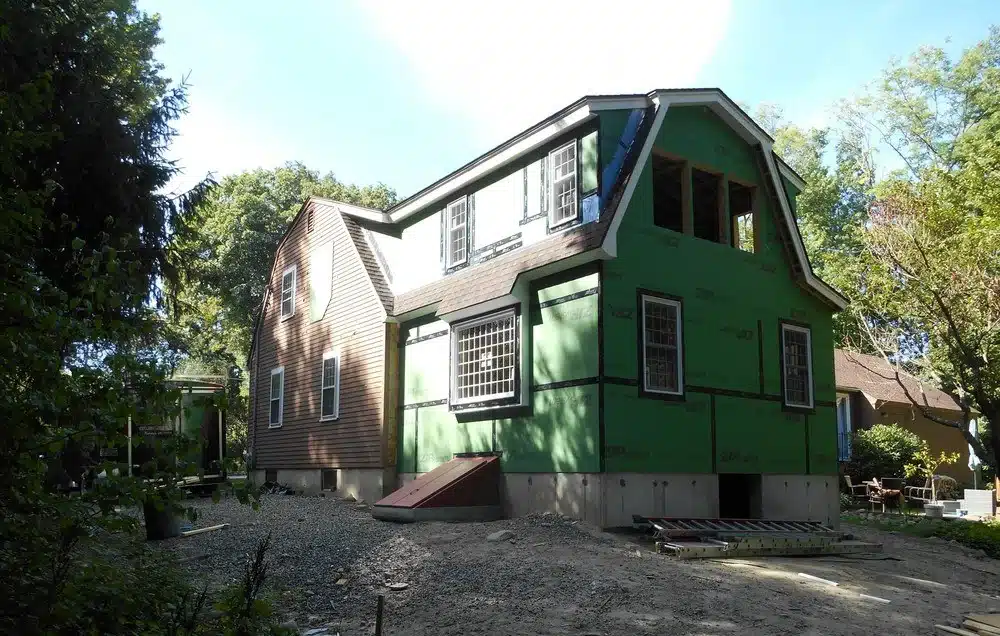
What Does an Addition with Basement Actually Cost?
The cost of an addition with basement typically ranges from $50,000 to over $350,000, depending on size, finish level, and location. Here’s a quick overview based on average internet data:
| Scenario | Estimated Cost Range |
|---|---|
| Basic unfinished basement under addition | $50,000 – $1,000,000 |
| Standard finished basement under addition | $100,000 – $2,000,000 |
| Premium finished basement under addition | $200,000 – $3,500,000+ |
| Per square foot (rough-in only) | $40 – $700/sq ft |
| Per square foot (standard finished) | $100 – $1,500/sq ft |
| Per square foot (premium finished) | $180 – $3,500+/sq ft |
Note: These are average cost ranges based on internet data. Actual costs vary by region, soil conditions, and project scope.
Planning a home addition is already a big decision. Adding a basement beneath it makes the project significantly more complex — and more expensive.
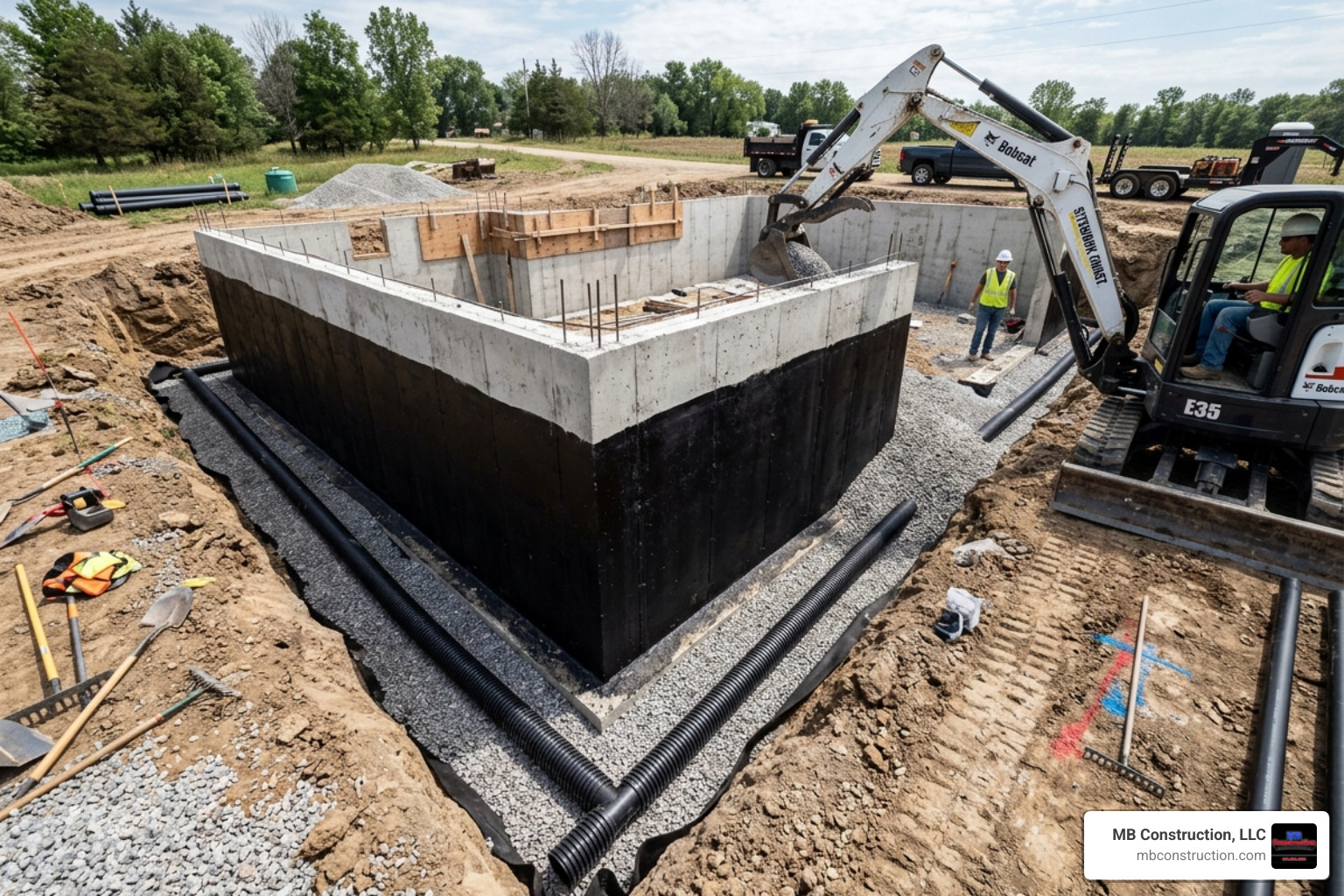
Here’s why: a basement under a new addition isn’t just “digging a hole.” It involves excavation, soil removal and disposal, concrete foundation walls, waterproofing, structural integration with your existing home, and utility rough-ins — before a single interior wall goes up.
For homeowners in suburban Massachusetts — places like Lexington, Billerica, or Burlington — this type of project also means navigating local permitting, frost-depth requirements, and variable soil conditions that can shift costs significantly.
The good news? When done right, a basement addition adds meaningful square footage and long-term property value. This guide walks you through exactly what to budget for, what drives costs up or down, and what to expect at every stage.
Average Cost of an Addition with Basement in 2026
As we look at the construction landscape in April 2026, the cost of an addition with basement remains a significant but rewarding investment. When we talk about “building down” while “building out,” we are essentially creating two levels of living space simultaneously. This is often more cost-effective than building a massive single-story footprint because you are sharing the same roof and foundation footprint.
Based on current internet data averages, a standard 1,000-square-foot basement addition can range anywhere from $120,000 to $2,000,000 depending on the level of luxury. While a crawlspace foundation might save you $50,000 upfront, you lose out on the massive utility of a full-height basement. According to How Much Does a Home Addition Cost in 2025? , the foundation alone is one of the most variable components of any build.
Understanding the Cost of an Addition with Basement per Square Foot
When calculating the cost of an addition with basement per square foot, we have to look at two distinct phases: the “rough-in” and the “finish.”
- Rough-in Costs: This covers the “dirty work.” You are looking at $40 to $700 per square foot for excavation, pouring the footings, setting the foundation walls, and installing the slab. In Middlesex County, these costs can lean toward the higher end due to the specialized equipment needed for our often-rocky soil.
- Finished Space: If you want that basement to be a playroom, a home office, or an in-law suite, the costs jump. Standard finishes usually land between $100 and $1,500 per square foot.
- Luxury Finishes: If you are dreaming of a climate-controlled wine cellar, a sound-proofed home theater, or a high-end wet bar, premium finishes can easily exceed $3,500 per square foot.
We’ve explored the nuances of these structural choices in our guide on The Lowdown on Building Down When You Build Out, where we discuss why the foundation is the one place you never want to cut corners.
Total Project Estimates for New Construction
For a completely new addition that includes a basement, your site preparation is the first major hurdle. This isn’t just about moving dirt; it’s about structural integration. We have to ensure that the new basement foundation ties seamlessly into your existing home’s foundation without causing settling or structural cracks.
Total project estimates for these comprehensive builds in 2026 typically fall into the $50,000 to $1,500,000+ range. The depth of the foundation is a major factor here. A standard 8-foot ceiling requires a deeper dig than a 7-foot ceiling, but the difference in feel and resale value is night and day.
Primary Factors Affecting Basement Addition Expenses
Why does one project cost $100,000 while another identical-looking one costs double? It usually comes down to what’s happening beneath the surface.

The Types of Home Additions | Cost Guide & Comparison (2026) notes that foundation complexity is the number one “hidden” cost in home expansions.
Regional Pricing for a Cost of an Addition with Basement in Massachusetts
Location is everything. In Billerica, Lexington, and Burlington, we face specific challenges. Labor rates in Greater Boston are among the highest in the country, but you’re also paying for craftsmen who understand New England’s unique building codes.
In Middlesex County, we have to account for the frost line. Foundations must be deep enough to prevent the ground’s freeze-thaw cycle from shifting your home. We’ve detailed these local nuances in our article Breaking Down the Average Cost of Home Addition in Massachusetts.
Impact of Soil Conditions and Excavation Complexity
If you live in Andover or North Reading, you might have sandy soil that’s a dream to dig. However, if you’re in Chelmsford or North Andover and hit “ledge” (solid New England granite), your excavation costs will skyrocket. Ledge removal requires specialized hydraulic hammers or even blasting, which can add $10,000 to $100,000 to a budget instantly.
Furthermore, shoring requirements—the structural supports used to keep the existing house from falling into the new hole—are critical. If the water table is high, we also have to install advanced drainage systems and heavy-duty waterproofing to ensure your new investment stays dry.
Detailed Breakdown of Construction and Finishing Costs
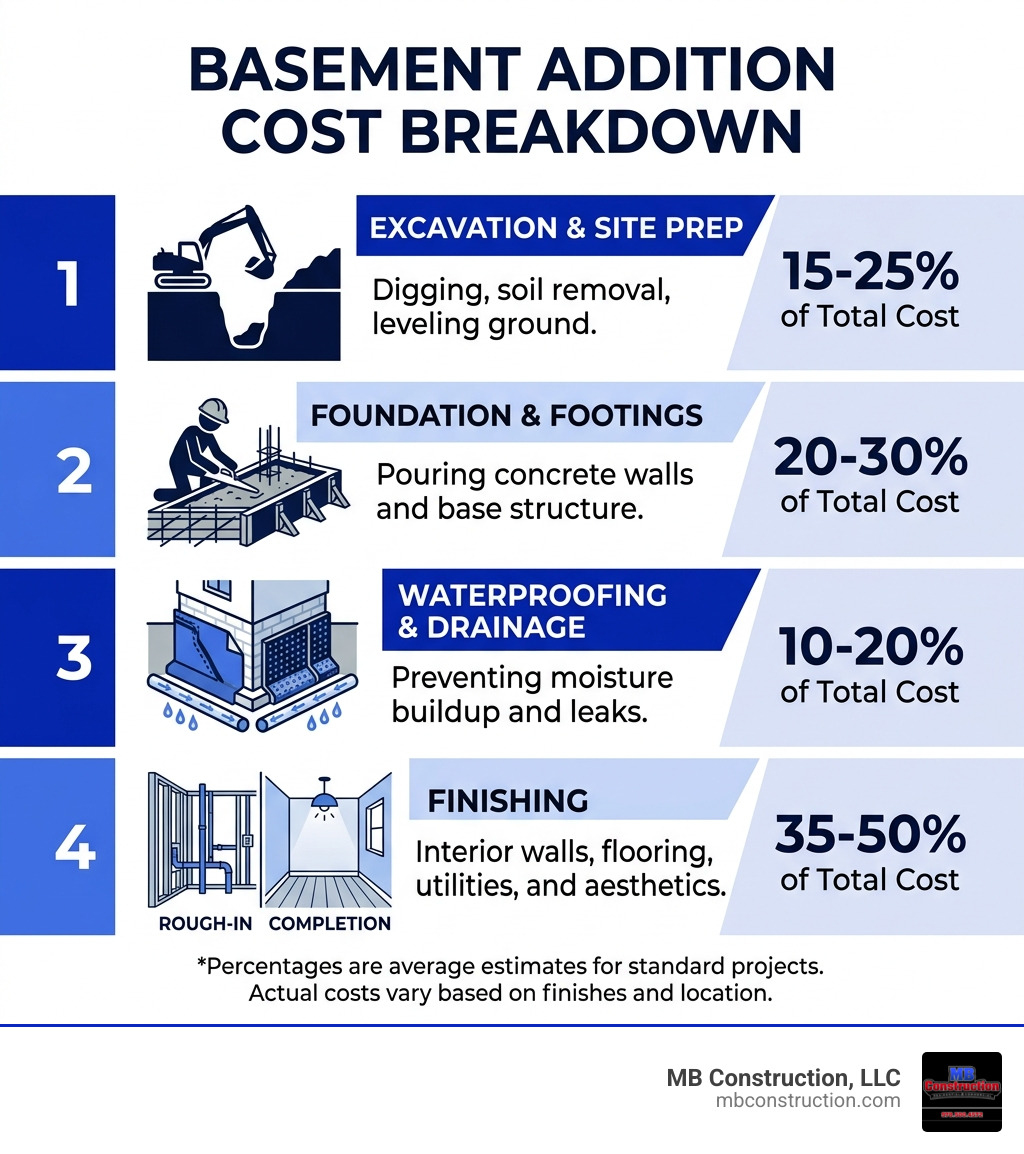
To help you budget, let’s look at where the money actually goes. Labor typically accounts for 40% to 60% of the total cost of an addition with basement, while materials take up the rest.
For a deeper look at budgeting for these specific components, check out our resource on Budgeting for Your Bay State Build.
Foundation and Waterproofing Requirements
You cannot over-waterproof a basement in Massachusetts. The Cost of Adding a Basement to a New Build – LatestCost – Real-Time Price Insights highlights that structural waterproofing is the most critical phase.
- Excavation: For a 400 sq ft space, excavation alone can cost over $20,000, including soil removal.
- Concrete Work: Footings, walls, and the slab for that same 400 sq ft space often total around $19,000 to $190,000.
- Waterproofing: This includes vapor barriers, French drains, and high-quality sump pumps. Expect to pay $5,000 to $50,000 for a comprehensive system.
- Egress Windows: If you plan on having a bedroom in the basement, Massachusetts code requires an egress window (a window large enough to climb out of in an emergency). These typically cost $3,000 to $30,000 each, including the window well.
Utilities and Interior Finishing
Once the shell is dry, we bring in the trades.
- HVAC: You’ll need to decide if your current furnace can handle the extra square footage or if you need a separate zone. Zoning can cost $5,000 to $50,000.
- Plumbing: Adding a bathroom in a basement is more expensive than on a ground floor because we often have to install a sewage ejector pump to move waste “up” to the main line.
- Electrical: From recessed lighting to specialized outlets for a home gym, electrical work in towns like Reading or Wilmington must strictly adhere to current 2026 codes.
Even in other regions like Ohio, as noted in How Much Does a Home Addition Cost in Ohio? , these utility rough-ins represent a significant portion of the “hidden” budget.
Evaluating ROI and Long-Term Property Value
Is the cost of an addition with basement worth it? From a lifestyle perspective, the answer is almost always yes. From a financial perspective, it’s one of the smartest ways to add value in high-demand areas like Bedford and Carlisle.
Resale Value and Market Desirability
A finished basement addition typically offers a Return on Investment (ROI) of 50% to 70%. In North Andover and Eastern MA, where lot sizes can be restrictive, “building down” is often the only way to get that extra 1,000 square feet of living space without eating up your entire backyard.
Prospective buyers in Greater Boston highly prize finished basements. They see a “bonus” space that can evolve with their needs—from a playroom for toddlers to a hangout for teenagers, and eventually, a private guest suite. We discuss the specific value of these multi-generational spaces in our guide: Budgeting for the Best: What an In-Law Addition Really Costs.
Cost-Saving Strategies for Homeowners
If the numbers are looking a bit daunting, there are ways to manage the cost of an addition with basement without sacrificing quality:
- Phased Construction: Build the “shell” (the basement and the addition above it) now, and finish the interior of the basement in a year or two when your budget allows.
- Standard Finishes: Choose high-quality but standard-sized windows, doors, and flooring. Custom work is where the “10x” price jumps happen.
- Open Layouts: Fewer walls mean less framing, less drywall, and less electrical labor. An open floor plan is cheaper to build and often feels larger.
- Utility Placement: Keep your new basement bathroom close to existing plumbing lines to minimize the amount of concrete that needs to be jackhammered.
Frequently Asked Questions about Basement Additions
How long does it take to complete an addition with a basement?
Typically, a full addition with a basement takes 4 to 9 months. The planning and permitting phase takes 1-2 months, excavation and foundation work take 1-2 months, and the remaining 2-5 months are for framing, roofing, and interior finishing. Weather in Massachusetts can certainly play a role—we try to get the “hole” dug and the foundation poured before the deep freeze of winter or the “mud season” of spring.
What permits and inspections are required in Massachusetts?
You will need a structural building permit, as well as separate permits for electrical, plumbing, and gas work. In towns like Lexington or Billerica, you may also need a board of health review if you are adding a bedroom (to ensure your septic system or sewer connection can handle the load) and potentially a conservation commission review if you are near wetlands.
Is it cheaper to build up or add a basement?
Generally, “building out” with a basement is more expensive than “building up” (adding a second story) because of the intensive excavation and concrete work involved. However, building up requires us to reinforce your existing first-floor walls and foundation to hold the new weight, which can also be costly. The best choice usually depends on your lot size and your specific space needs.
Conclusion
At MB Construction, LLC, we know that the cost of an addition with basement is a major consideration for your family’s future. Based in Billerica, MA, we specialize in navigating the complex soil conditions and strict building codes of Middlesex County and Greater Boston.
Our approach is quality-driven and time-sensitive. We use premium materials and expert craftsmen to ensure that your new foundation is bone-dry and your new living space is seamless. Whether you are in Andover, Tewksbury, or Wilmington, we provide guaranteed workmanship that stands the test of time.
Ready to stop dreaming and start digging? Contact us for a home addition consultation and let’s build something incredible together.