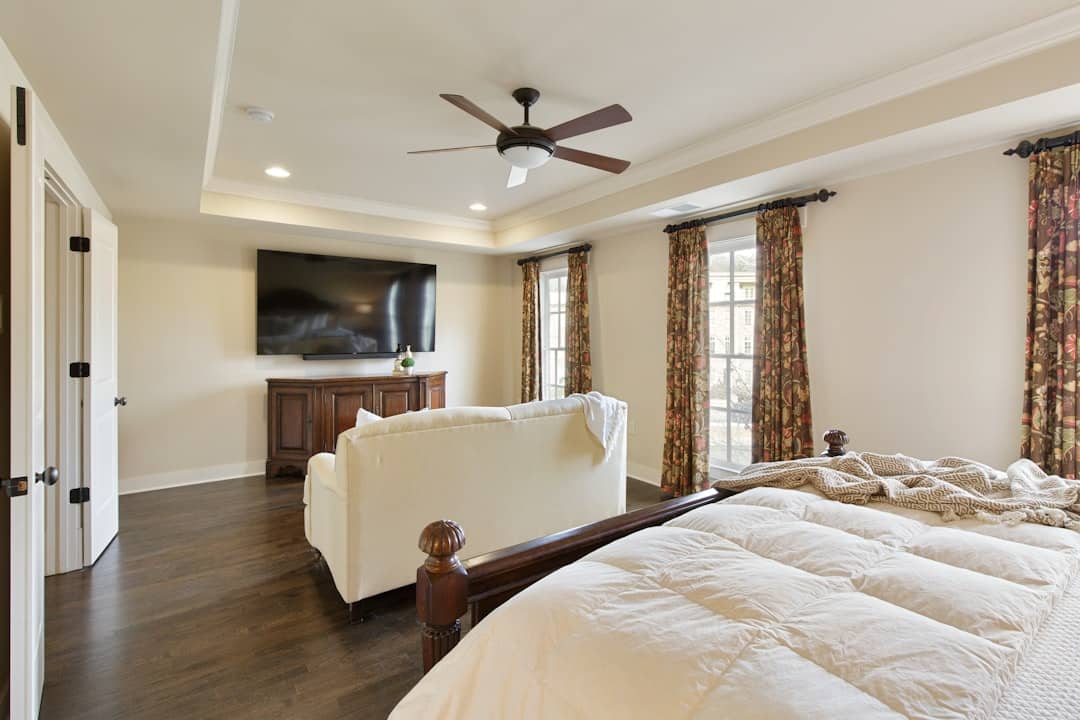
How Much Does It Cost to Add a Master Suite in 2026?
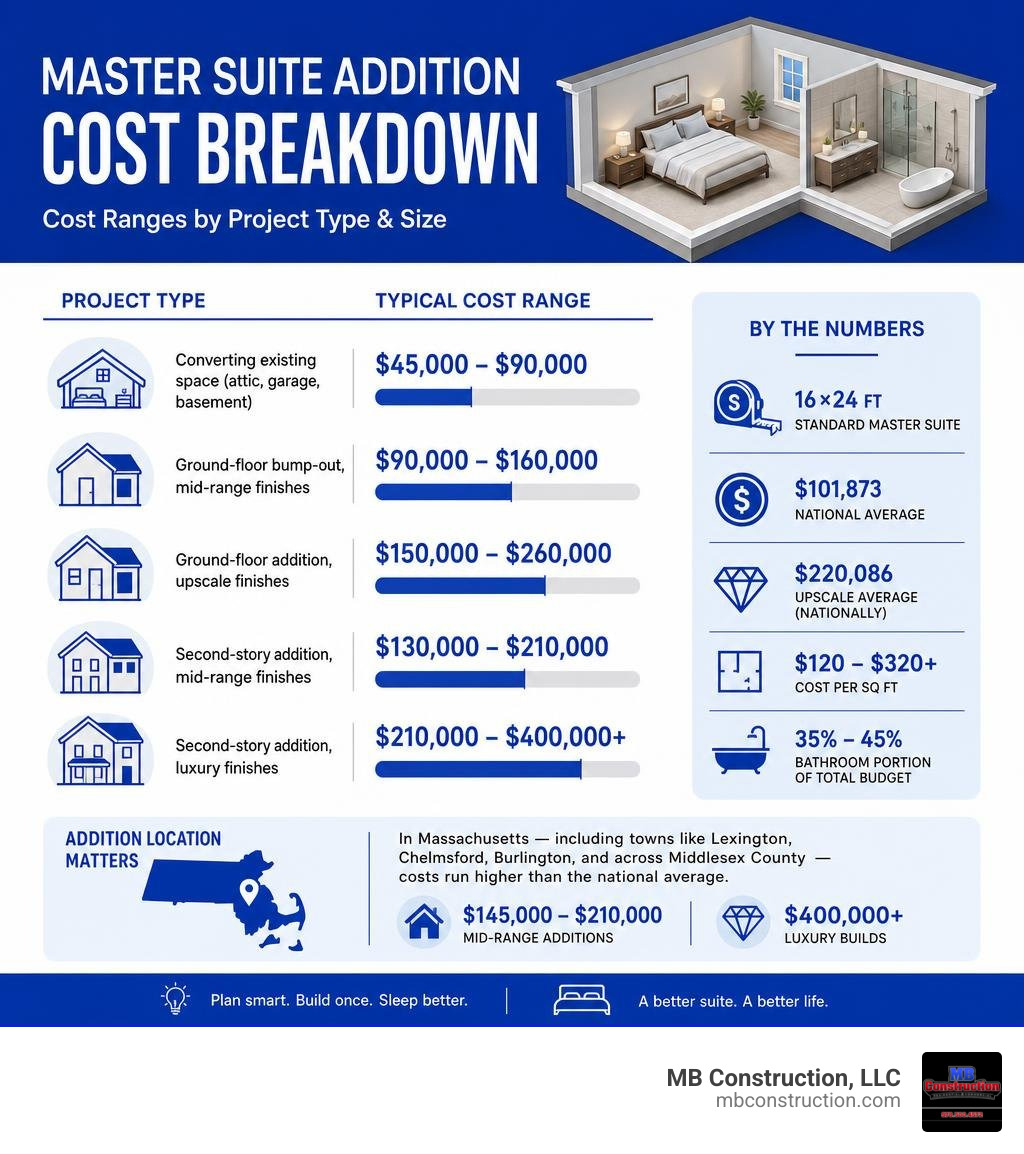
The cost to add a master suite typically ranges from $50,000 to over $1,500,000 based on internet data averages, depending on size, finish level, structural approach, and where you live. Here is a quick overview based on average costs from internet data:
| Project Type | Typical Cost Range |
|---|---|
| Converting existing space (attic, garage, basement) | $45,000 – $450,000+ |
| Ground-floor bump-out, mid-range finishes | $90,000 – $900,000+ |
| Ground-floor addition, upscale finishes | $150,000 – $1,500,000+ |
| Second-story addition, mid-range finishes | $130,000 – $1,300,000+ |
| Second-story addition, luxury finishes | $210,000 – $2,100,000+ |
In Massachusetts — including towns like Lexington, Chelmsford, Burlington, and across Middlesex County — costs run higher than the national average. Mid-range master suite additions here typically fall between $145,000 and $210,000, while luxury builds can range from $150,000 to over $2,100,000+ based on internet data averages.
A few key numbers to keep in mind:
- The national average for a standard 16×24 ft master suite is around $101,873, with overall project costs spanning a wide range from $30,000 to $1,100,000+ based on internet data averages
- Upscale versions average closer to $220,086 nationally, with high-end custom builds ranging from $50,000 to $2,300,000+ based on internet data averages
- Per square foot, expect $120 on the low end to $1,200 or more for premium builds based on internet data averages
- The bathroom alone can account for 35–45% of the total budget
This guide breaks down every cost factor — from foundation to finish — so you can plan your project with confidence and avoid the surprises that send budgets off track.
Glossary for cost to add a master suite:
- addition price per square foot
- cost of an addition with basement
- cost of adding an addition to a house
Understanding the Total Cost to Add a Master Suite
When we look at the overall financial picture of adding a primary retreat, the numbers can seem incredibly broad. Based on internet data averages, the total cost to add a master suite can range from a low-end budget conversion of $50,000 to a sprawling, ultra-luxury custom addition that reaches $1,500,000+.
The reason for this dramatic price spread lies in the vast difference between mid-range and upscale projects:
- Mid-Range Primary Suites ($145,000 – $210,000 in MA): This tier typically includes a comfortable 400-square-foot bedroom over a crawlspace or slab foundation, a walk-in closet, and a master bathroom featuring a double-bowl vanity, solid-surface countertops, and a 3×4-foot ceramic tile shower. Flooring usually consists of quality carpet in the bedroom and durable tile in the bathroom.
- Upscale and Luxury Suites ($250,000 – $2,500,000+ in MA based on internet data averages): In this premium tier, the suite expands to 500 or 600+ square feet and features high-end architectural details. The bathroom becomes a spa-like sanctuary with custom tiled walk-in steam showers, freestanding soaking tubs, heated natural stone floors, custom double vanities, and high-efficiency smart fixtures. It also includes professional closet organization systems, custom millwork, and advanced lighting.
Understanding where your project falls on this spectrum is the first step toward building a realistic budget.
Cost Breakdown by Major Construction Components
A master suite addition is essentially three projects in one: a structural home addition, a complex bathroom remodel, and a bedroom/closet build-out. To keep your budget on track, it helps to understand how every dollar is allocated.
Here is a typical component breakdown based on internet data averages:
- Foundation and Framing (30% to 40%): $30,000 to $300,000+
- En-Suite Bathroom (35% to 45%): $30,000 to $300,000+
- Interior Finishes & Closet (15% to 20%): $15,000 to $150,000+
- Mechanical Systems (HVAC, Plumbing, Electrical) (10% to 15%): $12,000 to $120,000+
- Design, Engineering, & Permits (5% to 10%): $8,000 to $80,000+
Before diving into the details, you can learn how to estimate these variables yourself using our guide on Math for Homeowners: Calculate Your Addition Cost Like a Pro.
Structural and Foundation Costs
The foundation and structural shell represent the physical bones of your addition. Excavation and pouring a concrete slab or crawlspace typically cost between $12,000 and $120,000+ based on internet data averages. If you decide to pour a full basement foundation under the addition to match your existing home, expect to add an extra $30,000 to $300,000+ based on internet data averages to the structural budget. Framing the walls, installing structural steel headers to open up the existing house, and tying the new roofline into your current roof will require another $18,000 to $180,000+ based on internet data averages.
Plumbing, Electrical, and HVAC Extensions
Extending your home’s infrastructure into the new wing requires skilled tradespeople.
- Plumbing: Running new hot and cold water lines and tying into your main sewer stack costs between $1,500 and $15,000+ based on internet data averages, depending on the distance from existing plumbing lines.
- Electrical: Wiring the new suite costs $3 to $30+ per square foot based on internet data averages. However, if your home’s existing electrical panel is fully loaded, upgrading to a 200-amp service will add $3,000 to $30,000+ based on internet data averages.
- HVAC: Extending your existing ductwork can cost $1,000 to $10,000+ based on internet data averages. If your current heating and cooling system lacks the capacity to service the extra square footage, installing a dedicated ductless mini-split system is a highly efficient alternative that typically costs $4,500 to $45,000+ based on internet data averages.
Bathroom and Finish Selections
The bathroom is the single biggest budget driver. Based on internet data averages, a standard en-suite bathroom addition costs between $25,000 and $250,000+ for high-end luxury layouts.
A double-bowl vanity with a stone countertop ranges from $500 to $5,000+ based on internet data averages. A custom tiled walk-in shower costs $4,000 to $40,000+ based on internet data averages, while a freestanding soaking tub adds $1,500 to $15,000+ based on internet data averages. For flooring, ceramic tile runs $3 to $30+ per square foot based on internet data averages for materials, while premium natural stone can exceed $30 to $300+ per square foot based on internet data averages. Finally, building out a functional walk-in closet with custom shelving and drawers averages $5,000 to $50,000+ based on internet data averages.
Structural Approaches: Ground-Floor Bump-Outs vs. Second-Story Additions
One of the most important decisions we will make during the planning phase is whether to build out (expanding your home’s footprint on the ground) or build up (adding a second story).
Ground-Floor Bump-Outs and Conversions
Building out on the ground floor is generally the most straightforward and cost-effective approach. Ground-floor extensions typically range from $200 to $2,000+ per square foot based on internet data averages. If you have a classic New England ranch house, a ground-floor bump-out is a natural choice that preserves single-level living and integrates seamlessly. You can read more about this in our guide on The Ranch House Upgrade: Adding a Master Suite to Your Home.
Alternatively, you can save significant money by staying within your existing footprint. Converting an underutilized garage, attic, or basement into a master suite can trim 20% to 60% from your construction budget because the foundation and roof are already in place.
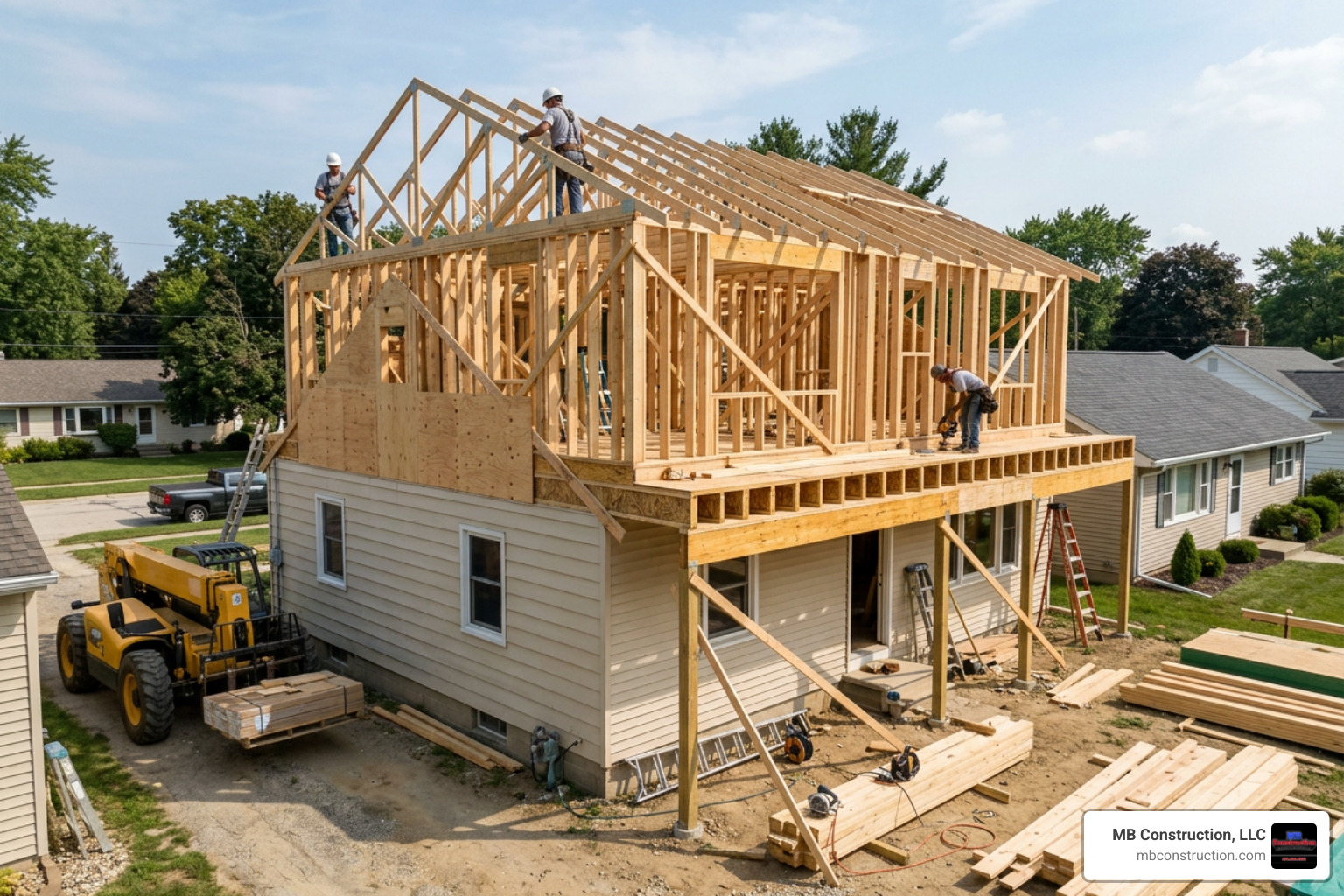
Second-Story Pop-Up Additions
When lot constraints, zoning setbacks, or a desire to preserve yard space prevent you from building outward, building up is the way to go. However, second-story additions typically cost 25% to 50% more than ground-floor builds, averaging $250 to $2,500+ per square foot based on internet data averages.
This premium is driven by structural necessity. We must hire a structural engineer to evaluate if your existing foundation and first-floor framing can support the weight of a second story. If not, foundation reinforcement and structural steel retrofitting can add $15,000 to $150,000+ based on internet data averages. Additionally, you must factor in the loss of first-floor square footage to accommodate a new staircase installation ($3,000 to $30,000+ based on internet data averages). To explore this vertical route further, see our article on how to Level Up Your Home by Adding a Second Story Master Suite.
Key Cost Drivers and Budgeting Strategies
To prevent your dream suite from turning into a financial headache, it is crucial to recognize the primary cost drivers and implement smart design strategies early. Mid-project change orders are the leading cause of budget overruns, which is why locking down your scope, layout, and material selections before construction starts is the single best way to control costs.
To look at general pricing guidelines for additions, check out our House Addition Cost: Complete Guide.
How Size and Layout Affect the Cost to Add a Master Suite
The total square footage of your addition naturally dictates the material and labor requirements. However, certain fixed costs – such as design, permits, and tying into the existing roof – remain relatively constant whether you build a compact or spacious room.
- 300 Sq Ft Suite: A tight, efficient layout that accommodates a queen bed, a modest walk-in closet, and a standard 5×8-foot bathroom. Based on internet data averages, a 300-square-foot addition typically ranges from $75,000 to $750,000+. Learn more in our 300 Sq Ft Addition Cost: Complete Guide.
- 400 Sq Ft Suite: The most common size, allowing for a king bed, a spacious walk-in closet, and a master bath with a double vanity and walk-in shower. This size typically ranges from $100,000 to $1,000,000+ based on internet data averages.
- 500+ Sq Ft Suite: A luxury footprint that can accommodate a sitting area, a fireplace, a five-piece spa bathroom, and a massive dressing room. These premium additions typically range from $150,000 to $1,500,000+ based on internet data averages.
Regional Factors and the Cost to Add a Master Suite in Massachusetts
Building in Middlesex County and the Greater Boston area introduces local challenges that directly impact construction costs.
- The Frost Line: Massachusetts building codes require all structural foundations to extend at least 4 feet deep to get below the local frost line. This increases excavation and concrete costs compared to warmer climates.
- Stretch Energy Code: Many towns in our service area, such as Lexington, Burlington, and Bedford, enforce the strict Massachusetts Stretch Energy Code. These requirements are part of the broader Massachusetts building energy code framework and may require a certified Home Energy Rating System (HERS) rater to evaluate the addition, along with high-performance insulation, advanced air-sealing, and stamped architectural drawings to secure a permit.
- Winter Construction: Building during New England winters often requires temporary tenting and ground-heating equipment, which can add 2 to 4 weeks to the timeline and increase labor costs.
For a deeper dive into regional pricing, you can review our guide on Breaking Down the Average Cost of Home Addition in Massachusetts.
Return on Investment and Resale Value
While adding a primary suite is a major lifestyle upgrade, it is also a significant financial investment. Fortunately, a well-designed master suite addition consistently ranks high on homebuyers’ wish lists, helping your home stand out in competitive Massachusetts real estate markets.
According to Remodeling Magazine’s Cost vs. Value Report, a mid-range primary bedroom and bath addition returns approximately 50% to 57% of its cost at resale nationally. In high-demand Greater Boston suburbs like Andover, Reading, and North Andover, the local return on investment (ROI) often trends higher, recovering 65% to 75% of the project cost.
The resale value is strongest under two conditions:
- Correcting a Deficiency: If your home is a four-bedroom house with only one or one-and-a-half bathrooms, adding a dedicated master suite brings your property in line with neighborhood comps, significantly boosting marketability.
- Future-Proofing and Accessibility: Designing a first-floor master suite with universal design principles — such as 36-inch-wide doorways, lever-style handles, and a zero-threshold walk-in shower — provides invaluable aging-in-place benefits. This appeals directly to the growing demographic of buyers planning for long-term, single-level living.
Frequently Asked Questions about Master Suite Additions
How long does it take to build a master suite addition?
A typical master suite addition takes 3 to 6 months from the start of construction to final walkthrough. The process begins with 4 to 6 weeks of design and feasibility planning, followed by 4 to 12 weeks for local zoning and permit approvals. Once the foundation is poured, physical construction usually takes 16 to 24 weeks.
Do I need a zoning variance or special permits in Massachusetts?
Yes. Any structural addition requires building, electrical, and plumbing permits. If your proposed ground-floor addition extends into your town’s property setback limits (the minimum distance required between your home and the property line), you will need to apply for a Zoning Variance. This process involves public hearings and can add several months to your pre-construction timeline.
Is it cheaper to build up or build out for a master suite?
Building out (a ground-floor bump-out) is almost always cheaper than building up (a second-story addition). Building up requires extensive structural engineering, foundation reinforcement, first-floor ceiling demolition, and the installation of a staircase, which typically makes a second-story pop-up 25% to 50% more expensive than a ground-floor addition of the same size.
Conclusion
Adding a master suite to your home is a major undertaking, but with careful planning, clear budgeting, and the right team, it is a highly rewarding investment. By understanding the structural options, preparing for regional Massachusetts building codes, and locking in your material selections early, you can enjoy a smooth, predictable construction process.
At MB Construction, LLC, based in Billerica, MA, we specialize in high-quality, time-sensitive home additions across Middlesex County and the Greater Boston area. Our team of expert craftsmen uses premium materials to deliver beautiful, functional spaces with guaranteed workmanship. Whether you are looking to build a ground-floor bump-out in Tewksbury, a second-story suite in Wilmington, or a structural conversion in Carlisle, we are here to bring your vision to life.
Ready to start planning your dream retreat? Contact MB Construction, LLC for Home Additions today to schedule an on-site consultation.