Why Finding the Right Excavation Services Near Me Matters for Your Project
If you’re looking for excavation services near me, here’s a quick summary of what you need to know:
What local excavation services typically include:
- Site preparation and grading
- Foundation and footing excavation
- Drainage systems (French drains, dry wells, swales)
- Utility trenching (water, sewer, electric conduit)
- Driveway base preparation
- Septic system prep
- Land clearing and stump removal
- Crawl space and basement excavation
How to find a reliable local excavation contractor:
- Verify they are licensed, bonded, and insured in Massachusetts
- Confirm they own appropriate equipment for your project size
- Ask for a written estimate with scope, timeline, and cleanup terms
- Check local reviews and ask for references from similar projects
- Make sure they handle utility locates (811) and permit coordination
Most homeowners don’t think about excavation until they’re already deep into planning a home addition, drainage fix, or new driveway. Then the questions pile up fast: Who does this kind of work? How much will it cost? Will they tear up my whole yard?
The good news is that most residential excavation projects — especially smaller ones — are more straightforward than they seem. The right contractor brings compact equipment, local knowledge, and a clear process that gets the job done without turning your property into a construction zone for weeks.
In towns across Middlesex County and the Greater Boston area — from Billerica and Burlington to Lexington and Wilmington — soil conditions, frost depth, and local permit requirements all shape how excavation work gets done. That local context matters more than most homeowners realize.
Over 80% of residential and commercial construction projects require some form of professional excavation, whether for site prep, foundation work, or utility installation. And according to industry data, approximately 70% of homeowners searching for excavation help use the phrase “excavation services near me” — which tells you exactly how common this search is.
This guide walks you through everything: what small-job excavation actually covers, how to evaluate and hire a qualified contractor, what to expect on-site, and what these projects typically cost based on average internet data.
What Are Excavation Services Near Me and What Small Projects Do They Cover?
When you begin searching for excavation services near me, you might picture massive, yellow bulldozers tearing down hillsides or digging out multi-story commercial basements. While that is certainly one side of the industry, residential and light commercial excavation is a completely different animal.
For the average homeowner in Eastern Massachusetts, excavation services are focused on precision, property protection, and preparing a stable foundation for smaller-scale projects. Residential excavation covers a wide array of specialized services, including site preparation, foundation digging, grading, utility trenching, drainage planning, septic preparation, and driveway base creation. Whether you need to clear a small patch of land or prepare a crawl space, these services require a mix of specialized compact machinery and deep structural expertise.
Small Job Excavating vs. Full-Scale Excavation
The primary difference between small-job excavation and full-scale commercial excavation comes down to scale, equipment, and access. Large-scale excavation relies on massive, heavy machinery that requires wide-open spaces and can cause significant ground disruption.
On the other hand, small-job or “mini” excavation relies on compact equipment like mini excavators, skid steers, and compact track loaders.

These smaller machines offer several key advantages for residential yards:
- Narrow Access: Many mini excavators can fit through a standard backyard gate, allowing operators to work in tight spaces between homes or near mature landscaping.
- Lower Disruption: Lighter machines exert much less ground pressure, meaning they won’t crush your lawn, crack your driveway, or disturb nearby tree roots as easily as heavy equipment.
- Smaller Crews and Faster Scheduling: Small jobs typically require fewer operators and support vehicles, making them easier to schedule and complete quickly.
- Precision Digging: Compact equipment allows for surgical precision, which is crucial when digging near existing utility lines, patios, or home foundations.
Common Residential Excavation Services
Residential excavating is rarely just about moving dirt from point A to point B. It is the literal foundation for almost every outdoor home improvement project. Some of the most common residential services we handle include:
- Foundation Excavation: Digging out precise footprints for home additions, garages, porches, and sheds.
- Crawl Space and Basement Work: Excavating or expanding low-clearance spaces beneath a home. To learn more about this specialized process, read about digging into the costs and benefits of crawl space excavation.
- Drainage and Erosion Control: Installing French drains, dry wells, drainage swales, and grading land to prevent water from pooling near your foundation. For a look at our full range of earthmoving capabilities, visit our excavation services page.
- Trenching for Utilities: Digging narrow, precise trenches for underground electrical conduits, water lines, sewer hookups, and gas lines.
- Driveway and Patio Prep: Excavating unstable topsoil, grading the subgrade, and compacting a sturdy gravel base to prevent future cracking or settling.
- Septic System Preparation: Digging out areas for new septic tanks or leach fields, which requires strict adherence to local environmental codes.
When Excavation Is Needed for Additions and Remodeling
If you are planning to expand your footprint in towns like Billerica, MA or Bedford, MA, professional excavation is your very first step. Before a single piece of wood is framed, the ground must be prepared to support the weight of the new structure.
When adding a room or a garage, you cannot simply pour concrete on top of the grass. We must excavate down below the local frost line—which is typically 4 feet deep in Massachusetts—to prevent the new foundation from shifting during winter freeze-thaw cycles.
Additionally, if you are looking to maximize space without expanding your home’s footprint outward, you might consider building down. This involves excavating beneath your existing structure to create deeper basements or crawl spaces. For a detailed comparison of your expansion options, check out the lowdown on building down when you build out and explore our guide on planning home additions.
How to Find Reliable Excavation Contractors in Your Area
Finding a contractor with a truck and a rented excavator is easy; finding a skilled, licensed, and insured excavation professional who respects your property requires more care. Because excavation involves digging near expensive utility lines and changing the drainage patterns of your land, hiring an unqualified operator can lead to serious and costly problems.
How to Compare Excavation Services Near Me Before Hiring
When evaluating different local contractors, it helps to look past the cheapest price and compare their actual qualifications. Here is a quick breakdown of what separates a professional excavation contractor from an unqualified low-bid operator:
| Feature / Qualification | Professional Excavation Contractor | Unqualified Low-Bid Operator |
|---|---|---|
| Licensing & Permits | Fully licensed; coordinates required municipal and grading permits. | Unlicensed; expects the homeowner to handle permits or works without them. |
| Insurance Coverage | Carries liability insurance and active workers’ compensation coverage. | Has minimal or no insurance, leaving the homeowner exposed to risk. |
| Utility Coordination | Coordinates 811 utility markings and verifies the site before digging. | May skip utility coordination or dig without proper markings. |
| Equipment & Precision | Uses appropriate compact equipment for residential access and precise digging. | Relies on poorly suited, oversized, or rented equipment. |
| Drainage Knowledge | Plans for slope, soil runoff, and stormwater management. | Ignores drainage, which can cause water pooling or basement moisture. |
| Written Contracts | Provides a detailed scope of work, payment schedule, and cleanup terms. | Uses vague verbal agreements or non-specific quotes. |
Key Factors to Evaluate
When you interview potential excavation companies, pay close attention to these key indicators of professionalism:
- Experience with Local Terrain: New England soil is known for hidden glacial boulders, heavy clay, and high water tables. A contractor with local experience will know how to handle these challenges.
- Modern, Right-Sized Equipment: Make sure the contractor has compact machinery suited for residential work, rather than large commercial equipment that may cause unnecessary disruption.
- Stormwater and Erosion Control Planning: A qualified excavator will not just dig a hole; they will have a plan to protect your yard from erosion if heavy rain hits mid-project.
- Guaranteed Workmanship: Look for a contractor that stands behind grading, backfilling, and excavation work with clear written terms.
Service Areas to Check for Local Availability
Because local building codes, soil types, and permitting processes vary from town to town, it is best to hire a contractor who regularly operates in your municipality. MB Construction, LLC provides professional excavation and site preparation services throughout Middlesex County and the Greater Boston area, including:
- Billerica, MA
- Burlington, MA
- Carlisle, MA
- Chelmsford, MA
- Andover, MA
- North Andover, MA
- Bedford, MA
- Lexington, MA
- North Reading, MA
- Reading, MA
- Tewksbury, MA
- Wilmington, MA
- Eastern MA and Greater Boston
What to Expect During a Residential Excavation Project
A successful excavation project is built on careful planning and clear communication. Understanding the step-by-step process can help ease any anxiety you have about heavy machinery rolling onto your grass.
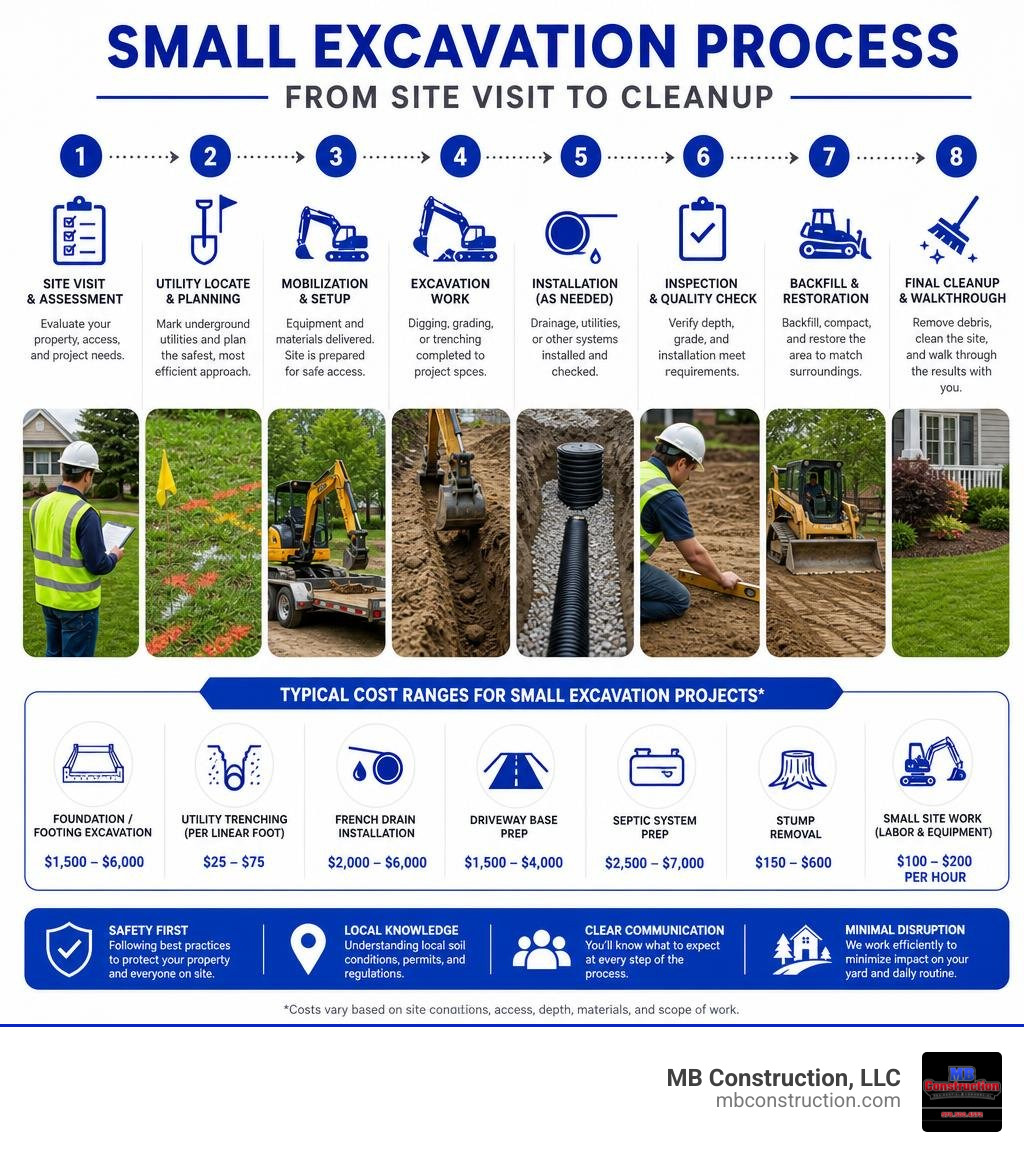
Step 1: Site Assessment and Planning
Before any dirt is moved, a professional contractor must perform a thorough physical assessment of your property.

During this phase, we evaluate:
- Property Access: Can our compact machines safely navigate around fences, overhead branches, and septic lines to reach the work area?
- Slope and Drainage: Where will rainwater flow once the ground is reshaped?
- Soil Conditions: Are we dealing with soft sand, heavy clay, or solid ledge rock?
- Staging Areas: Where will we temporarily stockpile excavated soil, and where will we park our support vehicles?
Step 2: Permits, Utility Locates, and Pre-Dig Coordination
Once we have a solid plan, the administrative work begins. Digging blindly is both unsafe and noncompliant with standard excavation practice.
First, we coordinate through the 811 utility locate process so underground utility lines, including gas, electric, water, sewer, and telecommunications, can be identified and marked before excavation begins.
Next, we determine what municipal permits are required. Depending on your town, whether it is Burlington, Carlisle, or Lexington, and the scope of your project, you may need a local grading permit, a stormwater management review, or Conservation Commission approval if you live near wetlands. A professional contractor will guide you through this paperwork to help your project comply with applicable local building codes.
Step 3: Excavation, Grading, Backfilling, and Cleanup
With permits in hand and utilities marked, the physical work begins:
- Site Prep: We install erosion control barriers, such as silt fences or straw wattles, to prevent dirt from washing away.
- The Dig: Using compact excavators, we carefully dig to the precise depth and dimensions required for your project.
- Subgrade Compaction: We compact the exposed dirt to prevent future settling.
- Gravel Base & Drainage Pitch: If we are preparing a driveway, patio, or foundation pad, we lay down a crushed stone base and use laser levels to establish the correct slope for water runoff.
- Backfilling & Final Grade: Once the foundation or utility lines are installed, we backfill the surrounding areas with clean soil, compact it in layers, and perform a final grading sweep.
- Cleanup: We haul away excess debris, stones, or unwanted dirt, leaving your site tidy and ready for the next phase of construction.
Excavation Costs, Timelines, and Pricing Factors
It is the question every homeowner wants answered: How much is this going to cost? Because every piece of land has unique terrain, soil, and access challenges, excavation pricing is highly customized.
Average Small Excavation Costs Based on Internet Data
Based on average costs from internet data, residential excavation can range widely from about $1,500 for very limited work to $250,000+ for complex deep excavation, structural preparation, rock removal, extensive hauling, or difficult access. The high end is intentionally broad because challenging site conditions can push costs to more than 10 times the cost of a basic small excavation project.
Common pricing ranges based on average internet data include:
- Small or Limited Residential Projects ($1,500 to $15,000+): This range can include short utility trenches, small lawn grading projects, compact drainage work, small shed pads, or limited driveway base preparation. Costs move higher when hauling, imported stone, tight access, or added drainage work is required.
- Medium to Larger Site Preparation ($8,000 to $80,000+): This can include excavation for a home addition foundation, garage pad preparation, longer driveway grading, more extensive drainage systems, land clearing, or septic-related site preparation.
- Complex, Deep, or Extensive Projects ($25,000 to $250,000+): Projects at this level may involve basement or crawl space excavation, major rock removal, difficult groundwater conditions, structural support requirements, hillside stabilization, retaining wall preparation, or extensive hauling and disposal.
For a deeper dive into how excavation fits into your overall home improvement budget, read our house addition cost complete guide.
What Influences the Final Price
Several variables can cause your final estimate to shift:
- Site Access: If our machines can drive straight into your backyard, the job will go quickly. If we have to navigate tight gates, steep slopes, or work around delicate historical stone walls, the extra time and care will increase labor costs.
- Soil Composition: Digging in soft, sandy loam is fast and straightforward. Digging into dense clay, buried tree stumps, or solid Massachusetts ledge rock requires specialized attachments and more machine hours.
- Disposal and Hauling Fees: Dirt is heavy. If we have to haul away multiple dump truck loads of old concrete, stumps, or unsuitable soil, dump fees and trucking costs will add up.
- Imported Materials: If your project requires us to bring in washed crushed stone, gravel, or clean structural fill, the cost of these materials will be reflected in your estimate.
How Long Small Excavation Projects Usually Take
Most small-job residential excavation projects are surprisingly fast once the machinery is on-site.
- Trenching and Minor Grading: Often completed in 1 day.
- Standard Foundation or Driveway Prep: Typically takes 1 to 5 days.
- Large Additions or Complex Drainage Systems: Can take 1 to 2 weeks.
However, the physical digging is only part of the timeline. You should factor in 1 to 2 weeks of lead time before the project starts for utility markings and municipal permit approvals.
Local Soil, Terrain, and Weather Considerations in Massachusetts
Our local geography in Eastern Massachusetts is beautiful, but it presents some unique challenges when it comes to digging. From the rocky soils of Carlisle to the coastal clay in parts of the Greater Boston area, local conditions dictate how we approach every project.
How Soil Conditions Affect Excavation
In Middlesex County, we deal with a wide mix of soil types. Clay soils hold onto moisture, making them expand when wet and shrink when dry. This can put immense pressure on foundation walls. Sandy soils drain beautifully but can easily collapse into a trench during excavation, requiring specialized shoring to keep workers safe.
Then, of course, there is the legendary New England glacial till. This soil is packed with rocks of all sizes, from small gravel to massive boulders that can stop a standard excavator in its tracks. Knowing how to safely extract these rocks without damaging surrounding structures is what separates experienced local operators from amateurs.
How Weather Changes the Excavation Schedule
In Massachusetts, our weather is anything but predictable.
Seasonal weather changes affect excavation in several ways:
- The Spring Mud Season: When winter snow melts, the ground becomes saturated and highly unstable. Operating heavy machinery on mud can ruin your lawn’s structure and make precise grading nearly impossible.
- Winter Frost: By late winter, the ground can freeze solid up to 3 to 4 feet deep. While we can excavate in winter using specialized frost teeth and hydraulic hammers, it is generally faster and more cost-effective to schedule major digging during the warmer months.
- Heavy Rain: A sudden downpour can quickly turn a freshly dug trench into a muddy swimming pool. We constantly monitor the weather to ensure we stabilize slopes and install temporary pumps to protect your open excavation site.
Why Drainage and Grading Matter
Proper grading is the single most important factor in protecting your home from water damage. If your yard slopes toward your foundation rather than away from it, heavy rains will inevitably find their way into your basement or crawl space.
When we perform site grading, we aim for a minimum slope of 6 inches of drop within the first 10 feet away from your home’s foundation. We also design custom drainage solutions—such as French drains, dry wells, and swales—to safely collect and disperse stormwater runoff on your property.
To learn more about budgeting for these essential regional site preparations, explore our guide on budgeting for your Bay State build.
Frequently Asked Questions About Excavation Services Near Me
Do excavation contractors near me handle permits and utility locates?
Yes, a professional, full-service contractor should coordinate utility locates through the 811 process before any digging begins. While the homeowner is the property owner, we work closely with you to submit the necessary site plans and structural drawings to your local municipal building department to secure grading, trenching, or foundation permits when required.
What questions should I ask before hiring excavation services near me?
Before signing a contract, protect your property by asking these essential questions:
- Are you fully licensed and registered as a contractor in Massachusetts?
- Do you carry active liability insurance and workers’ compensation? Ask for a certificate of insurance.
- What size and type of equipment will you use, and how will you protect my lawn and driveway?
- Will you handle the 811 utility markings and municipal permits?
- How will you manage stormwater runoff and erosion control during the dig?
- Does your written estimate include final grading, soil compaction, and debris cleanup?
- Do you offer a warranty on your grading and structural backfilling work?
Will small excavation damage my yard or landscaping?
While some ground disruption is inevitable when moving earth, a professional contractor takes extensive steps to minimize the impact on your property. We use compact, rubber-tracked machines that distribute weight evenly to help prevent lawn ruts. We also lay down heavy-duty protective mats over delicate turf and driveways, protect nearby trees when needed, and carefully stockpile excavated soil on protective tarps.
Conclusion
Whether you are preparing the ground for a beautiful new home addition, clearing space for a garage, or fixing a soggy backyard with a custom drainage system, professional excavation is the critical first step.
At MB Construction, LLC, we are proud to be Middlesex County’s go-to choice for quality-driven, time-sensitive excavation and site preparation. Based in Billerica, MA, our expert craftsmen use premium materials and modern, compact equipment to deliver precise, guaranteed workmanship with minimal disruption to your daily life.
From the initial site assessment and permit coordination to the final grading and meticulous cleanup, we treat your property with the same care and respect we would show our own. Ready to get your next project off the ground? Schedule excavation services with our team today, and let’s build something great together!