
Why Attaching a Garage to an Existing House Is One of the Smartest Home Investments You Can Make
Attaching a garage to an existing house is a major home improvement project — but it’s one that pays off in real, measurable ways.
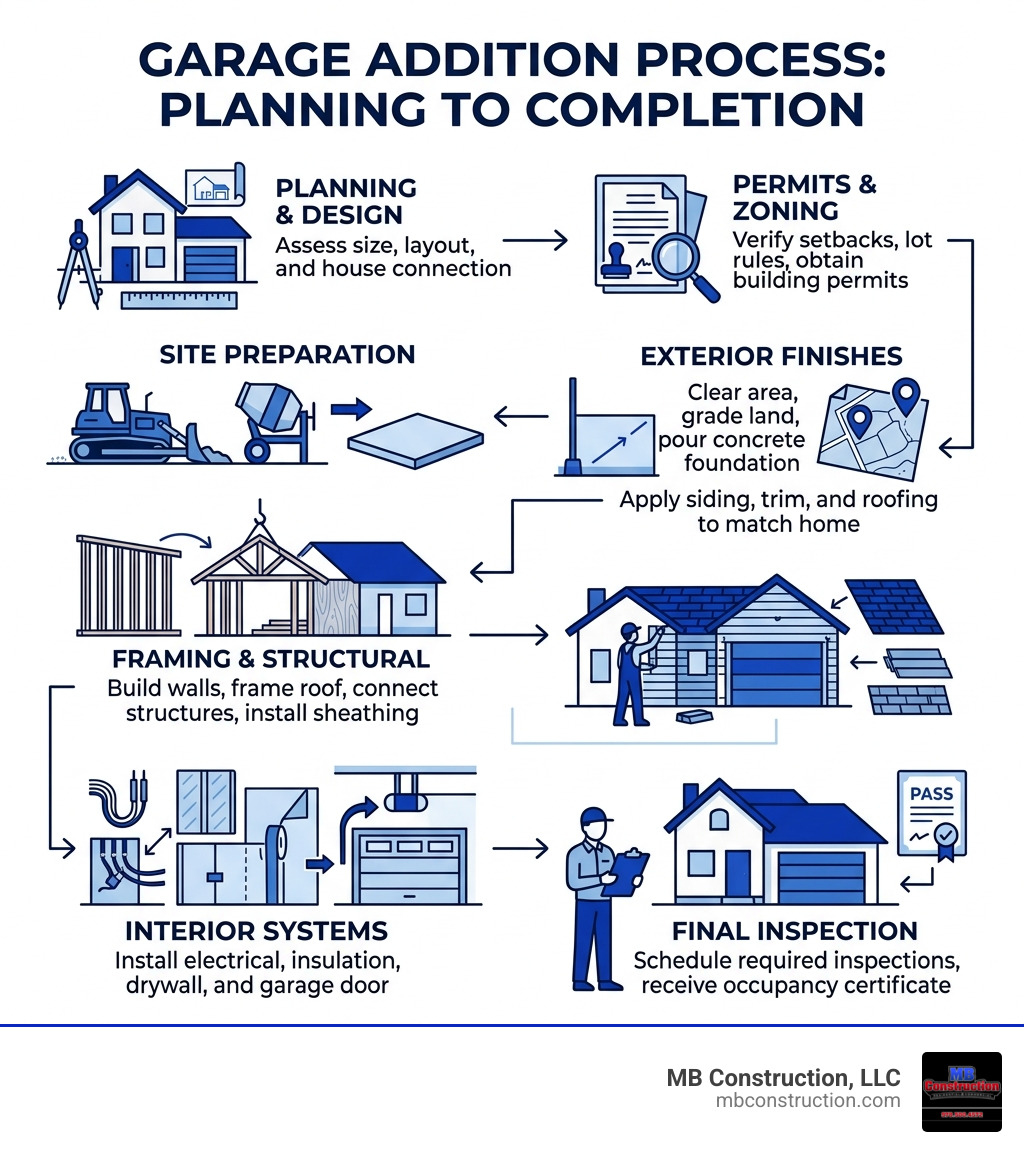
Here’s a quick overview of what the process involves:
- Plan and design — Determine size, layout, and how the garage will connect to your home
- Check zoning and permits — Verify local setbacks, lot coverage rules, and apply for building permits
- Prepare the site — Clear the area, grade the land, and pour the foundation
- Frame and roof — Build walls, tie the roof into the existing structure, and install sheathing
- Finish the exterior — Match siding, trim, and roofing materials to your existing home
- Complete the interior — Install electrical, insulation, drywall, and the garage door
- Pass inspections — Schedule required inspections and obtain a certificate of occupancy
For homeowners in suburban Massachusetts — including towns like Andover, Lexington, and Wilmington — a well-built attached garage does more than just shelter your car. It adds daily convenience, boosts curb appeal, and can increase your home’s value by $20,000 to $35,000, with an average return on investment of 78–81%.
But the project isn’t simple. It involves structural engineering, fire-safety requirements, zoning laws, and careful design to make the addition look like it was always part of the house — not bolted on as an afterthought.
This guide walks you through everything you need to know before breaking ground.
Key attaching a garage to an existing house vocabulary:
Key Considerations for Attaching a Garage to an Existing House
When we sit down with homeowners in Middlesex County to discuss a new project, the first question is usually whether the garage should be attached or detached. While both have merits, attaching a garage to an existing house is often the preferred choice for those of us living through New England winters. No one wants to trek through three feet of snow in Carlisle or Bedford just to get into a cold car.
An attached garage leverages one of your home’s existing walls, which can make it more cost-effective and convenient. However, it also means we have to deal with stricter building codes, particularly regarding fire separation and structural integration.
| Feature | Attached Garage | Detached Garage |
|---|---|---|
| Convenience | Direct access to the home; no weather exposure. | Requires walking outside to reach the house. |
| Cost | Often lower due to shared wall and foundation. | Higher due to four new walls and separate utilities. |
| ROI | Typically 64–81% return on investment. | Slightly lower, though adds flexibility. |
| Safety | Requires strict fire-rated walls and CO detectors. | Fewer fire-code restrictions for the main home. |
| Zoning | Must meet specific setback and lot coverage rules. | Often has different setback requirements. |
Beyond convenience, you need to consider your property layout. In towns like Reading or North Andover, lot sizes vary wildly. We have to ensure the new footprint doesn’t violate local “setbacks” — the mandatory distance between your structure and the property line. The Perfect Match: Adding an Attached Garage Successfully involves balancing these legal requirements with your personal needs for storage and space.
Determining the Ideal Size for Attaching a Garage to an Existing House
Size matters, but bigger isn’t always better if it overwhelms your existing architecture. According to internet data, a standard single-car garage is typically 12 feet wide and 20 to 24 feet long. For those with multiple vehicles or a growing family in Chelmsford or Tewksbury, a two-car garage usually ranges from 18 to 24 feet wide.
When planning your dimensions, don’t just think about the cars. Consider:
- Storage requirements: Do you need space for snowblowers, lawnmowers, or holiday decorations?
- Ceiling height: A standard door is 7 feet tall, but if you have a large SUV with a roof rack, you might want 8-foot doors and 10-foot ceilings.
- Workshop space: If you’re a DIY enthusiast, adding an extra 4 to 6 feet of depth can provide a perfect area for a workbench.
A How to Attach a Garage to Existing House: Comprehensive Guide suggests that the most common mistake is building too small. It is much cheaper to add an extra two feet during the framing phase than it is to realize your car doors hit the wall every time you park three years from now.
Design Integration and Aesthetic Cohesion
The goal of any addition we build at MB Construction, LLC is for it to look like it was built in the same year as the original house. This is especially important in historic or well-established neighborhoods in Lexington or Concord.
To achieve a seamless look, we focus on several key design elements:
- Roof Pitch: The slope of your garage roof should match or complement the main house. If your home has a steep gable roof, a flat-roofed garage will look out of place.
- Siding and Trim: We source premium materials to match your existing vinyl, cedar, or fiber cement siding. Even the width of the trim around the windows should be identical.
- Window Placement: Adding windows to the side or front of the garage helps it feel like a living space rather than a utility box.
- Color Schemes: Matching the paint or stain exactly is non-negotiable for high-end curb appeal.
Our team specializes in Garage Additions that enhance the overall silhouette of your property. By mirroring the architectural style — whether it’s a classic New England Cape or a modern Colonial — we ensure your home remains the star of the street.
Structural Requirements and Safety Standards
Attaching a garage to an existing house is more than just a framing job; it’s a structural marriage. In Massachusetts, the foundation is the most critical component. Because of our cold climate, foundations must be “frost-proof.” This typically means digging footings 42 to 48 inches deep to prevent the ground from “heaving” and cracking your new structure during a freeze-thaw cycle.
When we tie the new roof into your existing one, we have to ensure the load is distributed correctly. This often requires a structural engineer to sign off on the plans, especially if we are removing part of a load-bearing exterior wall to create a doorway into the house. According to Building a garage attached to a house | Garaga Inc., ensuring the connection is watertight is equally important to prevent rot in the shared wall.
Safety Features for Attaching a Garage to an Existing House
Because an attached garage shares a wall with your living quarters, safety standards are incredibly strict. We follow the International Residential Code (IRC) to protect your family from fire and fumes:
- Fire-Rated Walls: The shared wall must be covered in 5/8-inch Type X gypsum board (fire-rated drywall). This provides a critical time barrier in the event of a fire.
- Self-Closing Doors: The door leading from the garage to the house must be fire-rated and equipped with self-closing hinges.
- Carbon Monoxide Protection: Since cars produce CO, the seal between the garage and the house must be airtight. We also recommend installing CO detectors in the adjacent rooms.
- GFCI Protection: All electrical outlets in the garage must be Ground Fault Circuit Interrupter (GFCI) protected to prevent shocks in a damp environment.
- Ventilation: Proper airflow is essential to prevent the buildup of paint fumes, gasoline vapors, or exhaust.
Project Timeline and Cost Analysis
We know that living in a construction zone can be stressful. That’s why we pride ourselves on being time-sensitive and quality-driven. A typical timeline for attaching a garage to an existing house in April 2026 looks like this:
- Weeks 1-4: Planning, architectural drawings, and local permit approval in towns like Billerica or Burlington.
- Week 5: Site preparation and foundation pouring.
- Week 6: Foundation curing (concrete needs about a week to reach full strength).
- Weeks 7-8: Framing the walls and roof.
- Weeks 9-10: Roofing, siding, and window installation.
- Weeks 11-12: Interior electrical, insulation, drywall, and garage door installation.
The total duration is usually 10 to 12 weeks, depending on weather and the complexity of the tie-in.
Budgeting for Your Garage Addition
When it comes to cost, transparency is key. Based on internet data, the average cost for a garage addition is approximately $26,000. However, because every home in Eastern Massachusetts is unique, we see a wide range of pricing. A simple, no-frills single-car addition might start around $15,000, while a custom, three-car garage with a luxury suite above and premium stone siding can exceed $150,000.
Factors that influence your final price include:
- Foundation type: Slab-on-grade vs. a full frost-protected foundation.
- Material quality: Standard vinyl siding vs. high-end stone veneer or cedar.
- Utilities: Adding heat, cooling, or plumbing for a utility sink.
- Driveway modifications: You may need to expand or repave your existing driveway to reach the new entrance.
- Permit fees: These vary significantly by town in Middlesex County.
For a deeper dive into the numbers, check out How Much Does a New Garage Addition Really Cost?.
Conclusion
At MB Construction, LLC, we understand that attaching a garage to an existing house is an investment in your family’s future. Based in Billerica, MA, we serve the entire Greater Boston area with a commitment to expert craftsmanship and premium materials. Whether you are in North Reading or Carlisle, our goal is to provide a stress-free experience that results in a beautiful, functional addition to your home.
If you’re ready to stop scraping ice off your windshield and start enjoying the convenience of an attached garage, we are here to help. For More info about home additions, reach out to our team today for a consultation.
Does an attached garage increase home value?
Absolutely. In the current 2026 market, a garage is often a “must-have” for buyers in Massachusetts. Statistics show that adding a garage can boost your property value by $20,000 to $35,000. Beyond the raw numbers, it increases “market desirability.” A home with an attached garage will almost always sell faster than a similar home without one, especially in areas like Lexington or Andover where families value convenience and vehicle protection.
How long does it typically take to complete an attached garage addition?
Most projects take between 8 and 12 weeks from the day we break ground. The biggest variables are the permit approval process — which can take a few weeks in busy Middlesex County building departments — and the weather. Since we start with foundation work, a particularly rainy spring or a late-season snowstorm can shift the schedule. However, once the structure is “dried-in” (roof and siding on), we can work through almost any weather to finish the interior.
Can I add living space above the new garage?
This is one of our favorite ways to help homeowners maximize their property. If you are already pouring a foundation and building walls, adding a second story is a very cost-effective way to get a new master suite, home office, or guest apartment. This vertical expansion is often called an Accessory Dwelling Unit (ADU).
However, building up requires even stronger structural support. We have to ensure the foundation and the garage ceiling joists can handle the “live load” of a living space. You can learn more about this in our guide to The Dream Suite: Adding a Bedroom Over Your Garage. It’s a fantastic way to level up your property without losing any more of your backyard.
