
Structural Feasibility and Value of Second-Story Additions for Split-Level Homes
Adding a second story to a split level house is possible, and for many Massachusetts homeowners, it’s one of the smartest ways to gain space without moving or sacrificing your yard.
Here’s a quick overview of what’s involved:
- It’s feasible — but requires a structural engineer to assess your foundation and load-bearing walls first
- Common addition types include over-garage suites, master bedrooms, pop-top expansions, and dormer additions
- Costs vary widely — average estimates based on internet data range from roughly $150,000 to $1,500,000 depending on size, complexity, and materials
- Permits are required — local zoning rules in towns like Billerica, Chelmsford, and Burlington govern height limits, setbacks, and lot coverage
- Timeline — most projects run 3 to 6 months of construction, plus additional time for design and permitting
Split-level homes were built by the millions after World War II. They were clever for their time — staggered floors meant you could fit more livable space on a smaller lot. But what worked for a 1950s family doesn’t always work for a busy modern household in suburban Massachusetts.
The staggered levels that make split-levels charming are also what make adding on to them genuinely tricky. Load-bearing walls sit at unusual heights. Rooflines don’t always line up. Staircases need rethinking. These aren’t dealbreakers — but they do mean this isn’t a project for a general handyman.
The good news: with the right planning and an experienced contractor, a well-executed second-story addition can transform an outdated tri-level into a spacious, modern home that works for your family for decades to come.
Simple guide to adding a second story to a split level house:
Understanding the Unique Architecture of Split-Level Homes
To successfully plan for adding a second story to a split level house, we first have to look at what makes these homes so unique. Emerging in the 1940s and reaching peak popularity between the 1950s and 1970s, the split-level was the “it” house of the post-WWII era. It offered a middle ground between the compact ranch and the traditional two-story colonial.
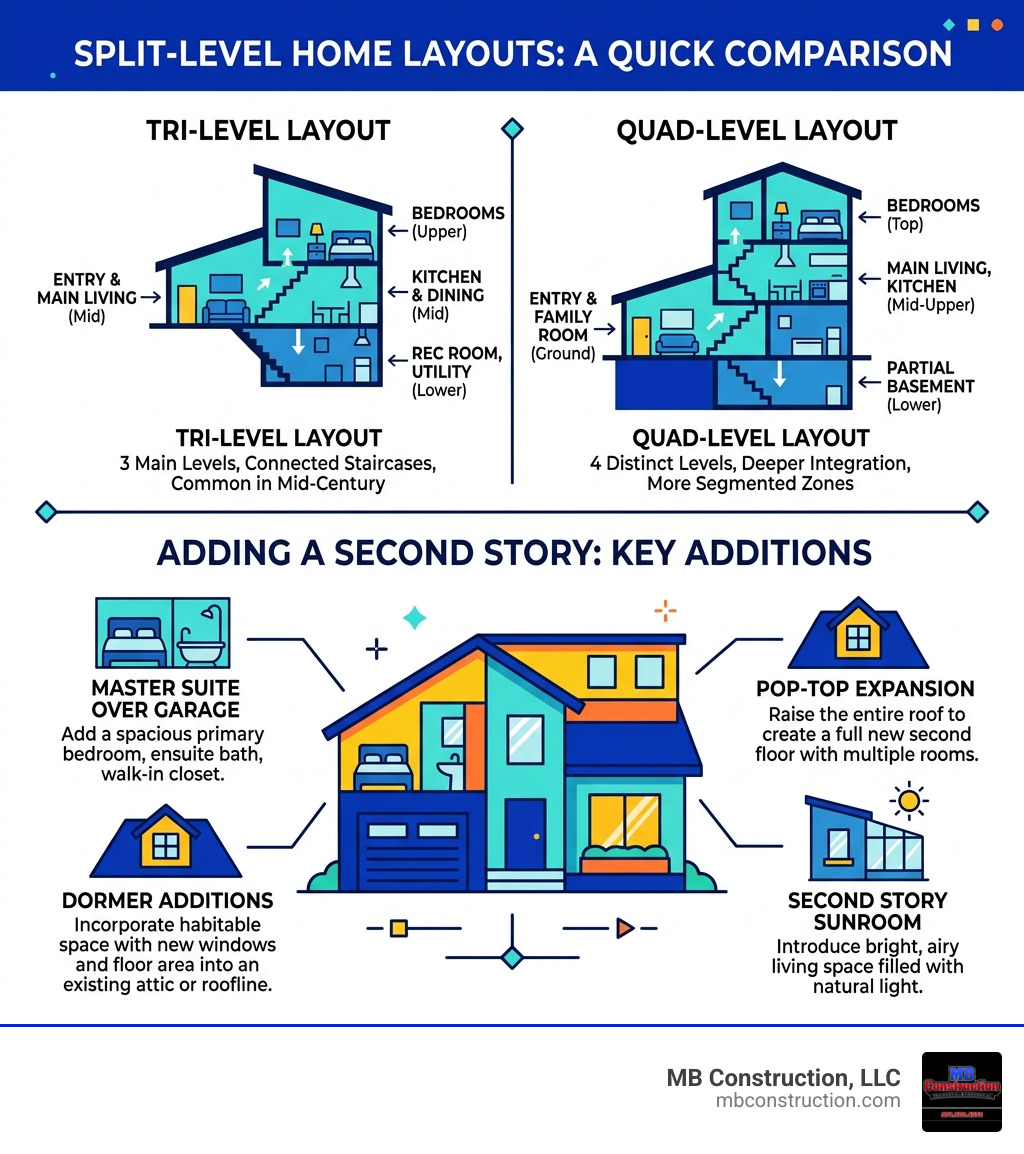
The defining feature of a split-level is its staggered floor plan. Unlike a standard house where floors are stacked directly on top of each other, a split-level uses half-flights of stairs to separate living zones.
- Tri-level layouts: These typically feature three distinct levels. You might enter into a main living area (kitchen and dining), walk up a half-flight to the bedrooms, or walk down a half-flight to a “den” or family room.
- Quad-level designs: These add a fourth level, often a basement or sub-basement located directly beneath the main living area.
While this layout was a masterclass in space optimization for small lots in towns like Lexington and Reading, it creates unique architectural challenges. The interior flow can feel compartmentalized, and the exterior often suffers from a lack of curb appeal, sometimes described as having a “mushroom” effect where the upper level overshoots the lower one. When we talk about adding a second story to a split level house, our goal is often to fix these flow issues while gaining much-needed square footage.
Feasibility and Structural Requirements for Adding a Second Story to a Split Level House
Can you actually build up? The answer is usually yes, but it isn’t as simple as just “popping the top.” Because split-levels have staggered rooflines and varying floor heights, the structural demands are higher than a standard ranch-to-colonial conversion.
Before a single board is cut, we must address the structural integrity of the existing building. In Middlesex County, building codes are strict regarding how much weight an older home can support. This is why we always start with a professional assessment, ensuring compliance with the Massachusetts State Building Code. You can also learn more about the general process of Home Additions to see how these pieces fit together.
One of the first questions homeowners ask is whether they can add a second story to their Massachusetts home. The answer depends on three main pillars: the foundation, the load-bearing walls, and the local zoning laws.
Assessing Foundation Strength for a Second Story Addition
The foundation is the most critical component. A split-level foundation is unique because it sits at different depths. The section under the “lower level” might be a deep concrete pour, while the section under the “main level” might be a shallower crawlspace or slab.
- Soil Capacity: We have to ensure the Massachusetts soil beneath your home can handle the increased “pounds per square foot.”
- Concrete Footings: In many 1950s builds, footings were designed only to support the weight of the original structure.
- Underpinning: If the foundation is insufficient, we may need to perform underpinning — essentially strengthening and deepening the existing foundation with more concrete and steel.
Ensuring your home meets Billerica or Bedford zoning compliance for structural weight is a non-negotiable step in maintaining the long-term safety of your investment.
Navigating Load-Bearing Walls and Staircase Relocation
In a split-level, identifying load-bearing walls is a bit like solving a puzzle. Because the floors are staggered, a wall that is load-bearing on the upper bedroom level may not align with a wall on the lower family room level.
When adding a second story to a split level house, we often need to:
- Establish Point Loads: We may need to install steel beams or reinforced columns that travel through multiple levels to reach the foundation.
- Rethink Vertical Circulation: One of the biggest headaches in a split-level is the stairs. Adding another level often requires relocating the existing staircase to ensure the new floor is accessible without walking through a bedroom or a cramped hallway.
- Upgrade Floor Joists: Older homes often used 2×8 or 2×10 joists. Modern codes for living spaces usually require beefier joists to prevent “bouncy” floors.
- Ductwork and Electric: We have to figure out how to snake HVAC and electrical lines through staggered levels, which often involves creative bulkheads or rerouting through the attic space.
Popular Design Options for Split-Level Expansions
Once the “boring” structural stuff is handled, we get to the fun part: design. There are several ways to approach adding a second story to a split level house, depending on your budget and how much space you need.
Adding a Second Story to a Split Level House Over the Garage
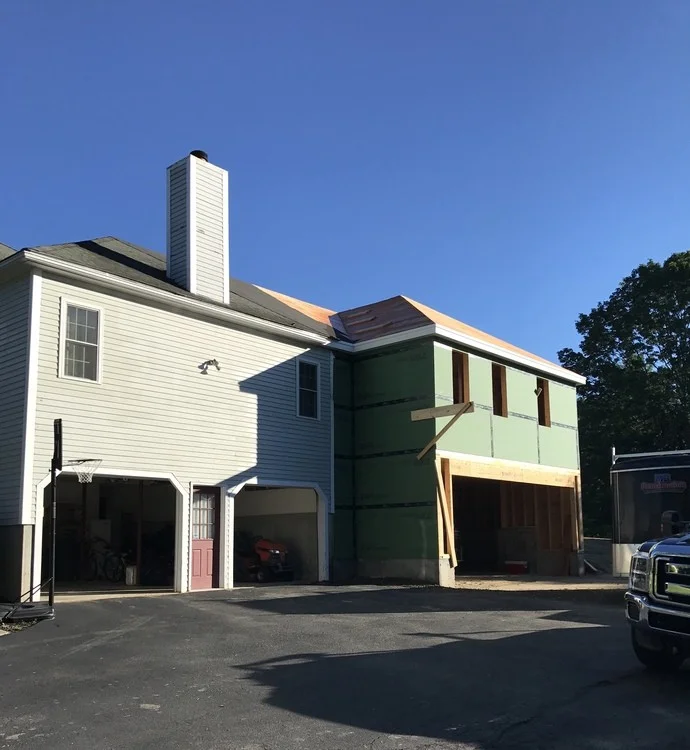
This is perhaps the most popular expansion for split-levels in towns like North Andover and Wilmington. Most split-levels have an attached garage that sits lower than the main bedroom level. By “filling in” the space above the garage, you can create a seamless transition from your existing upper floor.
This is an excellent way to add:
- A Master Suite: Complete with a walk-in closet and luxury bath.
- Guest Quarters: Perfect for multi-generational living.
- A Bonus Room: Ideal for a playroom or home office.
We specialize in Garage Additions and can help you navigate the specific insulation needs and foundation verification required when building living space over a vehicle area.
Creating a Master Suite by Adding a Second Story to a Split Level House
If your current bedrooms are tiny (a common complaint for 1960s homes), a full “pop-top” addition might be the answer. This involves removing the roof over the existing bedroom wing and adding a full new level above it.
This allows for:
- Privacy Zones: You can move the primary bedroom to the new top floor, leaving the original bedrooms for the kids or guests.
- Luxury Bathrooms: You finally have the footprint for that soaking tub or double vanity.
- Increased Natural Light: New construction allows for larger, energy-efficient windows that the original 1950s design lacked.
For those with detached structures, we even offer guidance on Adding a Second Story to a Detached Garage to create a separate studio or “ADU” (Accessory Dwelling Unit).
Investment and Planning: Costs, Zoning, and Timelines
Let’s talk numbers. Adding a second story to a split level house is a significant investment. It is essentially like building a new home on top of your existing one, with the added complexity of “marrying” the two structures together.
Based on internet data, here is a look at the average cost ranges you might encounter:
| Addition Type | Estimated Cost Range (Average) |
|---|---|
| Partial Addition (e.g., over garage) | $150,000 – $1,500,000 |
| Full Second Story (Pop-Top) | $350,000 – $3,500,000 |
| Dormer Addition | $75,000 – $750,000 |
Note: These are average costs based on internet data. Final pricing depends heavily on the condition of your existing foundation, the finishes you choose, and local Massachusetts labor rates.
Beyond the budget, we have to navigate the “Red Tape”:
- Setbacks: How close can your new, taller house be to the neighbor’s property line?
- Height Limits: Towns like Lexington and Carlisle have strict limits on how high a residential building can be.
- Lot Coverage: Even though you are building “up,” some towns count the total square footage against your lot size.
- Permitting: This process can take 2-4 months in Middlesex County before a single hammer is swung.
- Construction Duration: Once started, expect a 3 to 6-month timeline for the actual build.
Frequently Asked Questions about Split-Level Additions
Is it cheaper to build up or build out on a split-level?
This is the age-old question. Generally, building “out” (a ground-level addition) requires excavation, new foundation footings, and takes up yard space. Building “up” avoids the excavation costs but requires significant structural reinforcement of the existing walls and foundation.
In Massachusetts, where lot sizes are often tight, building up is frequently the only option. While the structural reinforcement can be pricey, it often provides a better Return on Investment (ROI) because you aren’t sacrificing your outdoor living space.
How does a second-story addition impact home value?
In high-demand areas like Greater Boston, adding a second story can significantly boost your resale appeal. Most split-levels are “stuck” at 3 bedrooms and 1.5 baths. By adding a second story, you can move into the 4 or 5-bedroom category with 2.5 or 3 baths. This puts your home in a different league for buyers and can often yield a higher ROI than a simple kitchen remodel.
Can I live in my home during a second-story addition?
We’ll be honest: it’s tough. When we remove the roof to add a second story, your home is temporarily exposed to the elements (though we use heavy-duty tarping). There will be significant construction dust, noise, and utility interruptions. For a full pop-top, we usually recommend that families find temporary housing for at least the “framing and roofing” phase of the project. For a smaller addition over a garage, you may be able to stay in the home, though it will still be a bit of a “camping” experience.
Conclusion
Adding a second story to a split level house is a journey that requires a expert team. From the initial foundation check to the final coat of paint, every step must be handled with precision to ensure your new space is safe, beautiful, and adds real value to your property.
At MB Construction, LLC, we pride ourselves on being quality-driven and time-sensitive. We understand the unique architectural quirks of homes in Billerica, Chelmsford, and the Greater Boston area. Our expert craftsmen use premium materials to ensure that your new addition looks like it was always part of the original design — not just something tacked on.
If you are ready to stop feeling cramped and start enjoying the home of your dreams, we are here to help. Our workmanship is guaranteed, and we have the local experience to navigate the complex zoning and structural needs of Middlesex County.
Start your home addition project today and let us help you reach new heights with your split-level home.
