
Why a 2 Car Garage Addition Is One of the Smartest Moves You Can Make as a Homeowner
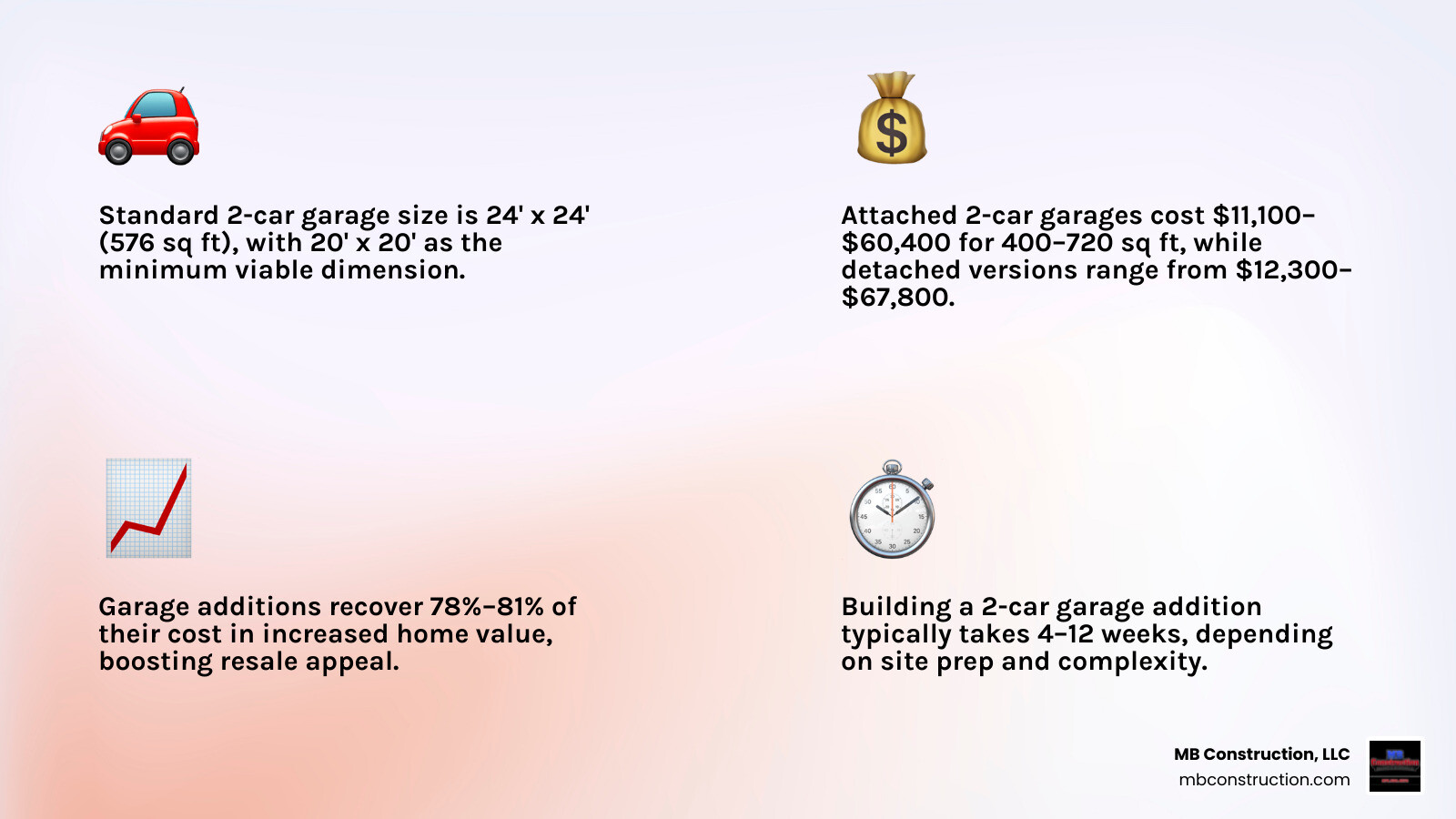
A 2 car garage addition is one of the highest-value improvements you can make to your home — protecting your vehicles, adding usable space, and recovering 78%–81% of the cost in added home value.
Here’s what you need to know at a glance:
- Standard size: 24′ x 24′ (576 sq ft) is the most common; 20′ x 20′ is the minimum
- Attached garage cost: $11,100–$60,400 for 400–720 sq ft
- Detached garage cost: $12,300–$67,800 for the same range
- Prefab metal alternative: $6,215–$9,540 (foundation not included)
- Time to build: Typically 4–12 weeks depending on complexity
- Permits required: Yes — always, in Massachusetts and everywhere else
- ROI: 78%–81% of project cost recovered in home value
If you own a home in suburban Massachusetts — think Lexington, Billerica, or North Andover — you already know the pain of a New England winter without a garage. Scraping ice off windshields at 7 a.m., watching your car take a beating from snow and salt, losing weekends to a cluttered driveway. It adds up fast.
Beyond the daily convenience, the numbers make a compelling case. About one in three American homes still lacks a garage, according to the U.S. Census Bureau’s American Housing Survey. That gap represents a real opportunity for homeowners who add one — both in livability and resale value.
Whether you’re planning a straightforward attached garage or a two-story detached structure with a bonus room above, this guide walks you through everything: costs, permits, design decisions, and what to expect from the building process.
Basic 2 car garage addition vocab:
The Strategic Benefits of a 2 Car Garage Addition
When we talk to homeowners in Middlesex County about a 2 car garage addition, the conversation usually starts with “I’m tired of shoveling my car out of the snow.” While weather protection is a massive perk, the strategic benefits go much deeper.
A garage isn’t just a box for your cars; it’s a multi-layered asset. First, there is the undeniable security factor. Vehicles kept in a locked garage are significantly less likely to be targeted for theft or vandalism. Furthermore, shielding your car from the elements—UV rays in the summer and road salt in the winter—preserves the paint and resale value of the vehicle itself.
Then there is the sheer organizational power. Most of us have “stuff” that doesn’t belong in the living room but needs a home: lawnmowers, snow blowers, holiday decorations, and bicycles. A well-planned garage provides a dedicated zone for these items, freeing up your basement or attic for more living space. If you want to dive deeper into how these structures transform a property, check out our comprehensive look at garage additions.
Maximizing ROI with a 2 Car Garage Addition
Is a 2 car garage addition a good investment? The data says yes. On average, homeowners can expect a return on investment (ROI) of 78% to 81%. This means that if you spend $50,000 on a high-quality garage, your home’s market value could increase by roughly $40,000 immediately.
In competitive Massachusetts markets like Bedford or Reading, a garage is often a “make or break” feature for buyers. If two identical houses are on the market, but one has a 2-car garage and the other doesn’t, the house with the garage will almost always sell faster and for a higher price. Appraisers look at “comparables” in your neighborhood; if most homes have garages and yours doesn’t, your property is at a distinct disadvantage. By adding those square feet, you aren’t just adding storage—you’re boosting your home’s equity and market desirability.
Attached vs. Detached: Choosing Your Configuration
One of the first big decisions we help our clients make is whether the garage should be attached to the house or stand alone. Both have distinct advantages, and the right choice often depends on your lot size and how you plan to use the space.
Attached Garages: These are the most popular choice for a reason. They offer the ultimate convenience: you can walk from your kitchen to your car without ever stepping outside. From a budget perspective, attached garages are often about 12% cheaper to build because they share at least one existing wall with your home. However, they do require strict fire-rated drywall on the shared wall and careful carbon monoxide sealing to keep exhaust out of your living quarters. Learn more about the perfect match: adding an attached garage successfully.
Detached Garages: A detached 2 car garage addition offers more flexibility. If you have a narrow lot or a unique backyard layout, a detached structure can be tucked away to maximize yard space. They are also ideal for workshops or “man caves” because the noise and fumes stay away from the main house. Plus, if you’re looking to build “up,” a detached garage is often easier to permit for a second-story guest suite. Explore your options for the detached garage upgrade: going up a level.
Design Integration for an Attached 2 Car Garage Addition
The “secret sauce” of a successful attached garage is making it look like it was always there. There is nothing worse than a garage that looks like an awkward “box” tacked onto a beautiful colonial or craftsman home.
To achieve a seamless look, we focus on three things:
- Roof Lines: We match the pitch (angle) of your existing roof. If your home has gables, the garage should too.
- Siding and Trim: Using the exact same materials—whether it’s vinyl, cedar shingles, or fiber cement—is non-negotiable for curb appeal.
- Foundation Alignment: We ensure the concrete slab and stem walls sit at a height that complements your home’s elevation, preventing the garage from looking “sunken” or overly perched.
Many homeowners also choose to include a mudroom or “breezeway” connection. This transition space serves as a landing zone for boots, coats, and groceries, keeping the mess out of the main house.
Planning Your 2 Car Garage Addition: Size, Permits, and Design

Before we pour a drop of concrete, we have to get the “math” right. While you might think “a garage is a garage,” the dimensions make a huge difference in how you’ll feel about the space five years from now.
Standard Dimensions:
- 20′ x 20′ (400 sq ft): This is the bare minimum. You can fit two mid-sized cars, but you won’t have much room for trash cans or a workbench.
- 24′ x 24′ (576 sq ft): This is our “sweet spot” recommendation. It allows for two vehicles plus room for storage cabinets and a comfortable walking path around the cars.
- 26′ x 24′ or larger: If you drive large SUVs or trucks, or if you want a dedicated workshop area, going slightly larger is a decision you will never regret.
We’ve helped homeowners navigate these specifics across the region, from a garage addition in Billerica, MA to a custom garage addition in Lexington, MA.
Essential Permits for a 2 Car Garage Addition
In Massachusetts, you cannot—and should not—build a garage without a permit. Local building departments in towns like Chelmsford or Wilmington are strict about safety and zoning.
Key considerations include:
- Setbacks: Most towns have rules about how close a structure can be to the property line. If your yard is wedge-shaped, this might dictate whether you build attached or detached.
- Impervious Surface Limits: Some areas limit how much of your lot can be covered by “hard” surfaces (roofs and driveways) to manage rainwater runoff.
- Electrical and Plumbing: If you’re adding lights, an automatic opener, or a utility sink, you’ll need specific trade permits.
- Middlesex County Regulations: Depending on your specific town, there may be historical district requirements or specific snow load ratings that the roof must meet.
2025 Cost Breakdown and Material Selection
Budgeting for a 2 car garage addition in 2025 requires looking at current material costs and labor trends. While prices can vary based on the “fancy factor” of your finishes, here is a general breakdown of what to expect.
| Garage Type | Estimated Cost Range (400-720 sq ft) | Key Cost Factors |
|---|---|---|
| Attached Garage | $11,100 – $60,400 | Shared wall savings, fireproofing needs |
| Detached Garage | $12,300 – $67,800 | Four new walls, separate utility lines |
| Prefab Metal | $6,215 – $9,540* | Lower material cost, faster install |
| 2-Story Custom | $80,000 – $150,000+ | Staircases, flooring, HVAC, plumbing |
*Note: Prefab prices usually exclude the foundation, which can add $5,000–$10,000.
We provide detailed estimates for projects like a garage addition in Andover, MA and garage addition in North Reading, MA, ensuring homeowners understand where every dollar is going.
Budgeting for a 2 Car Garage Addition
Beyond the shell of the building, several “invisible” costs can impact your bottom line:
- Foundation ($1.25–$13 per sq ft): A standard “slab-on-grade” is cheaper, but if you have sloped terrain (common in towns like Carlisle), you may need a frost wall or a thickened slab, which increases the price.
- Garage Doors: A basic steel door might cost $1,000, but a high-end carriage-house style door with insulation and windows can run $3,000 to $5,000.
- Insulation: If you plan to spend time in the garage, R-value matters. Insulating the walls and ceiling helps maintain temperature and reduces noise.
- Excavation: Clearing trees, removing old asphalt, or leveling the ground can add several thousand dollars before the first brick is laid.
Creative Multi-Functional Garage Spaces
Why stop at just parking cars? One of the biggest trends we see in 2025 is the “multi-functional” garage. Homeowners are realizing that the footprint of a 2-car garage is the perfect size for an Accessory Dwelling Unit (ADU) or a high-end hobby space.
Garage Apartments: Adding a studio or one-bedroom apartment above the garage is a brilliant way to house a returning college student, an aging parent, or even generate rental income (where local zoning allows). Check out the ultimate guide to building a garage apartment for more ideas.
Workshops and Gyms: If you don’t need a full apartment, a simple finished room above the garage makes an excellent home office or gym. This keeps the noisy treadmill or the messy woodworking tools out of the main house. For more on this, read about the dream suite: adding a bedroom over your garage.
Adding a Second Story to Your 2 Car Garage Addition
If you are considering a second story, planning must start at the foundation. A standard garage slab isn’t designed to hold the weight of a living space above it. We have to engineer the “footings” to be deeper and wider to support the extra load.
Other key considerations for a 2-story build:
- Staircase Placement: Do you want the stairs inside the garage (saving exterior space) or an outside entrance (for better privacy if renting)?
- Plumbing Rough-ins: Even if you can’t afford a full bathroom now, it is much cheaper to run the pipes through the slab during the initial pour than to jackhammer the concrete later.
- Dormers: Adding “doghouse” or “shed” dormers to the roof creates more usable floor space and lets in natural light.
For a deep dive into the structural side, see the upwardly mobile garage: adding a second story.
Frequently Asked Questions about Garage Additions
How long does it take to build a 2-car garage addition?
The timeline generally spans 4 to 12 weeks.
- Weeks 1-2: Site prep and excavation.
- Weeks 2-3: Foundation pouring and curing (concrete needs time to reach full strength!).
- Weeks 4-6: Framing the walls and roof.
- Weeks 7-12: Roofing, siding, electrical, and interior finishes. Weather in Eastern MA can play a role, so we always build a little “buffer” into our schedules.
Do I need a permit for a garage addition in Massachusetts?
Yes, absolutely. Any structural addition requires a building permit. This ensures that the garage is built to withstand local snow loads, has proper fire separation from the house, and meets electrical safety codes. Building without a permit can lead to heavy fines and major headaches when you try to sell your home.
Is a 2-car garage addition a good DIY project?
While “sweat equity” sounds great, a garage is a major structural undertaking. If you’re a skilled hobbyist, you might be able to handle the interior painting or shelving. However, we strongly recommend hiring professionals for the foundation, structural framing, and electrical work. A mistake in the foundation can lead to a cracked slab in two years, and incorrect framing can be a serious safety hazard under a heavy Massachusetts snow load.
Conclusion
A 2 car garage addition is more than just a place to park; it’s an investment in your home’s future and your daily sanity. Whether you’re protecting your car from the next Middlesex County blizzard or creating a dream workshop, the value added is undeniable.
At MB Construction, LLC, based in Billerica, MA, we pride ourselves on delivering quality-driven, time-sensitive projects. We use premium materials and expert craftsmen to ensure your new garage looks like a seamless part of your home. From the initial permit pull to the final coat of paint, our workmanship is guaranteed.
Ready to stop scraping ice and start building equity? Start your 2-car garage addition project today with a team that knows the local landscape and cares about the details.
