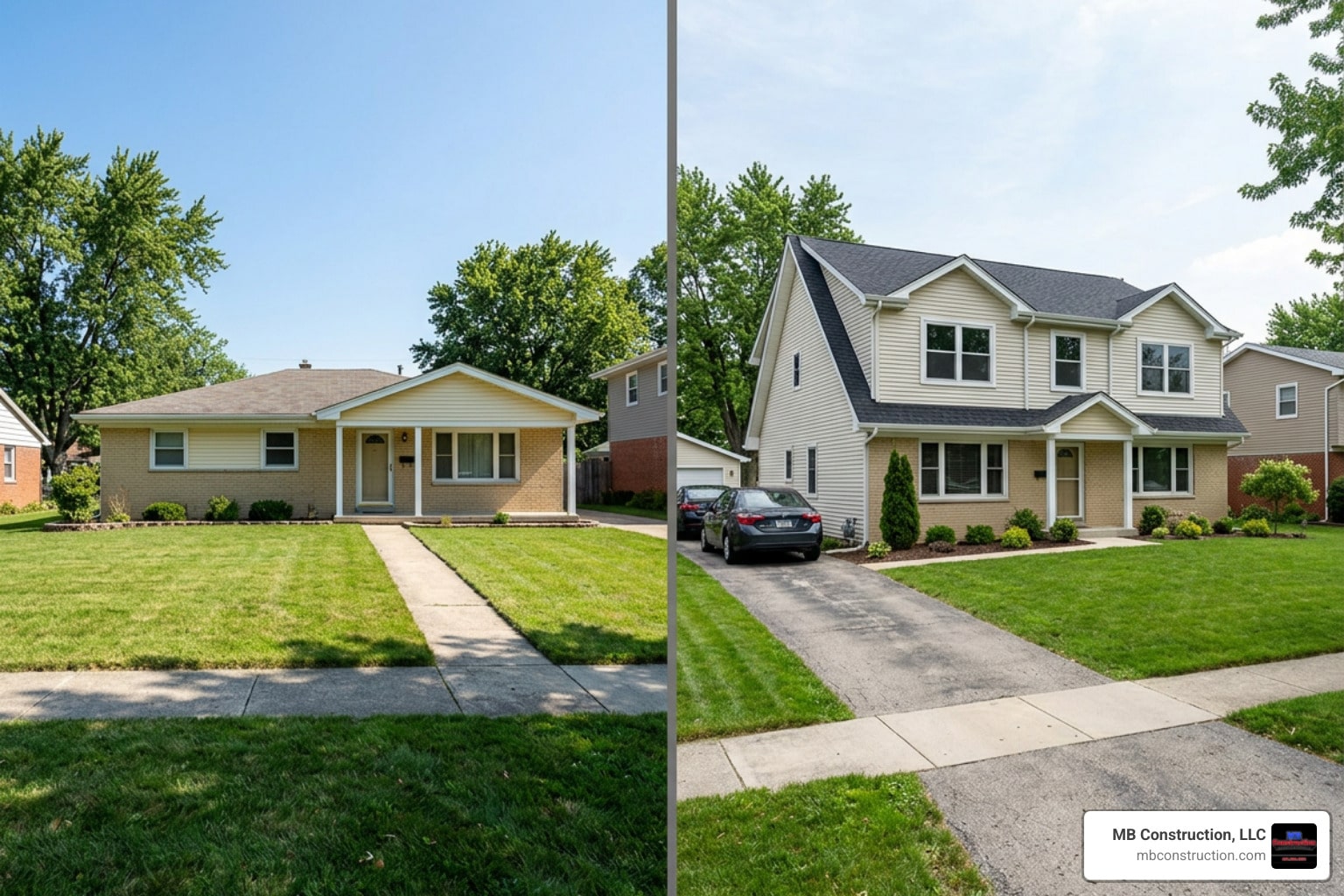
Adding a Second Story to a Ranch House: Key Considerations
Adding a 2nd story to a ranch house is one of the most effective ways to double your living space without losing your yard or moving to a new neighborhood. If you’ve outgrown your single-story home but love where you live, building up — not out — may be exactly the right move.
Here’s a quick overview of what the process involves:
- Foundation assessment — A structural engineer evaluates whether your existing foundation, footings, and framing can support the added weight
- Design selection — Choose from a full second story, partial addition, or modular build
- Permits and zoning — Every Massachusetts town has its own building codes and height restrictions you’ll need to satisfy
- Construction — Expect 6 to 12 months from design to move-in, with temporary relocation likely required
- Cost — Based on internet-based average data, a basic partial addition averages around $65,000, while a full custom second-story addition can reach a high end of $650,000 or more (which is 10 times the average basic cost), with square footage costs averaging $100 to $300 per square foot
For homeowners in towns like Andover, Lexington, Burlington, or Billerica, this type of project is increasingly common — and when done right, it can increase your home’s value by an estimated 65%.
But the biggest question most homeowners have first is simple: will the house actually hold up? That’s exactly what this guide covers.
Ranch homes were designed for single-story living. Their foundations, wall framing, and ceiling joists weren’t built to carry a second floor. Before any design decisions happen, a structural assessment isn’t optional — it’s the foundation (literally) of the entire project.
One real-world example makes this clear: during one second-floor addition assessment, a contractor discovered that a foundation corner had crumbled into loose gravel when poked. That kind of surprise can derail a project entirely — or worse, create serious safety risks — if it’s caught too late.
This guide walks you through everything: structural feasibility, design options, costs, permits, and the full construction process for adding a second story to your Massachusetts ranch home.
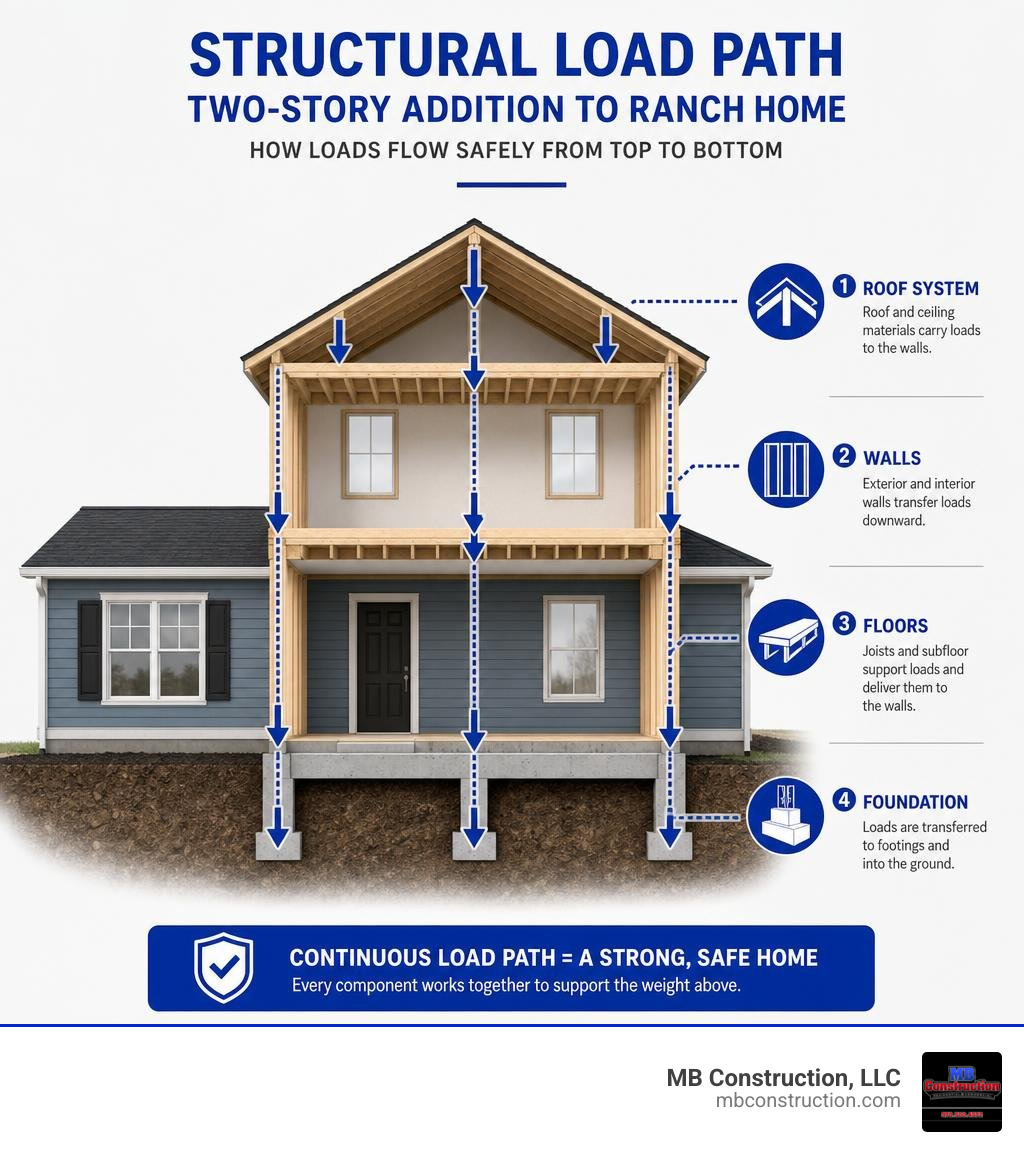
Add 2nd story to ranch house basics:
Structural Feasibility of Adding a Second Story to a Ranch House
When you decide to add 2nd story to ranch house structures, you are essentially asking your existing home to hold up tens of thousands of pounds of new materials, furniture, and people. A single-story ranch is built to transfer only the weight of its own walls and its roof down to the earth.
To prevent your home from bowing, cracking, or collapsing under this new load, we must perform a complete structural feasibility assessment. Before you hire an architect or draw up dream layouts, you should consult an expert to evaluate your home’s underlying bones. You can learn more about the early phases of this process by watching Second Story Additions: What to Consider Before You Get Started.
Every home has a unique load path. This path is the continuous route that structural weight travels from the highest point of the roof down through the rafters, the walls, the floor joists, the sills, and finally into the foundation footings and the soil below. If there is a single weak link in this chain, the entire addition is compromised. For a deeper look at how these structural realities play out in different architectural styles, see our guide on The Highs and Lows of Adding a Second Story to Your Split-Level Home.
Evaluating the Existing Foundation and Footings
The foundation of your ranch house is the absolute starting point. In Massachusetts, most mid-century and modern ranch homes feature one of three foundation types:
- Full Basements: Common in Billerica and Chelmsford, these concrete walls offer the easiest path to reinforcement because the footings are easily accessible.
- Crawl Spaces: These provide some access to structural elements but require careful inspection of the piers and perimeter footings.
- Concrete Slabs: Popular in certain post-war neighborhoods, slab-on-grade foundations must be carefully evaluated to ensure they can handle the concentrated point loads of a second story.
A licensed structural engineer will perform a soil analysis and concrete inspection. They will determine if your existing concrete footings (the wide concrete pads beneath your foundation walls) are wide enough and deep enough to distribute the new vertical load. If the footings are too shallow or rest on poorly compacted soil, we may need to perform underpinning. Underpinning involves pouring new concrete underneath or alongside your existing footings to increase their load-bearing capacity and prevent settling.
Reinforcing the Framing and Load-Bearing Walls
Once we know the foundation is secure, we look at the framing. The existing ceiling joists in your ranch house are almost certainly too weak to act as floor joists for a second level. In a one-story home, ceiling joists are designed only to hold up drywall and insulation. To support a second-floor living space, we must replace or reinforce them with much larger, stronger floor joists (such as 2×10 or 2×12 lumber, or engineered I-joists).
Additionally, the vertical studs inside your first-floor walls must be reinforced to prevent buckling. This is often achieved by:
- Sistering Studs: Adding a second wooden stud directly alongside each existing wall stud to double its strength.
- Shear Panels: Installing structural plywood or OSB sheets on first-floor walls to help the home resist lateral forces, such as wind and seismic activity.
- Steel Columns: Placing hidden steel support posts inside the walls or basement to carry heavy point loads directly down to the foundation.
This careful engineering ensures a continuous load path, meaning every pound of weight added upstairs is safely channeled directly into the earth without putting stress on your existing first-floor living spaces.
Design Options for a Ranch House Second-Story Addition
Once the structural plan is in place, you can move on to the exciting part: designing your new space. Adding a second story completely changes the character of a ranch house. It allows you to transform a simple, horizontal mid-century footprint into a grand, balanced home.
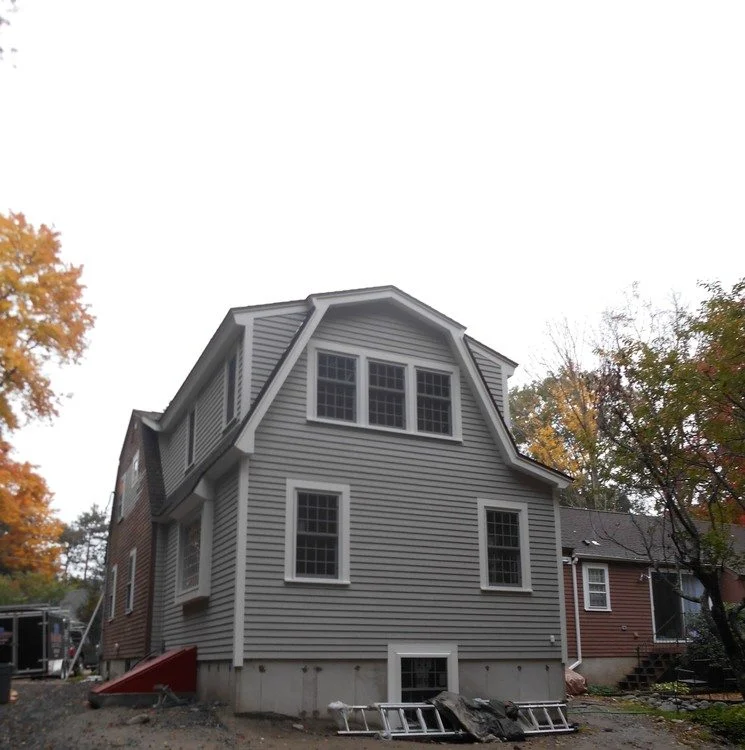
When designing, you want to avoid a “top-heavy” or “boxy” look. Proper architectural massing, roofline transitions, and window placements are essential to make the new level look like it was always meant to be there. For visual inspiration and layout layouts, you can browse 12 Adding a second floor to a ranch house ideas – Pinterest or read our complete breakdown on Level Up Your Home by Adding a Second Story Master Suite.
Full Second-Story Additions
A full second-story addition — often called a “pop-top” — involves removing the entire existing roof of your ranch house, extending the first-floor walls upward, and building a completely new second level across the entire footprint.
This option is highly popular because it essentially doubles your square footage. It allows you to move all your bedrooms upstairs, creating a clear division between your public living areas downstairs and private spaces upstairs. For example, a family can transform a tight 1,200-square-foot ranch into a spacious 2,400-square-foot Colonial-style home with four bedrooms, multiple bathrooms, and a dedicated laundry room.
You can view real-world visual examples of this dramatic change at Before and after adding second story on 1950s ranch – Pinterest.
Partial Additions and Dormers
If you do not need to double your home’s square footage, or if you are working with a more conservative budget, a partial second-story addition is an excellent alternative.
With a partial addition, we build over only a portion of the house — such as over an attached garage, a wing of the home, or a family room. This approach is perfect for adding a single luxury space, such as a primary bedroom retreat, a home office, or a playroom. To see how this can work for your home, explore The Ranch House Upgrade Adding a Master Suite to Your Home.
You can also look upward to other parts of your property, such as your garage, to expand your living area. Check out The Complete Guide Adding a Second Story to a Detached Garage and The Upwardly Mobile Garage Adding a Second Story for more ideas on partial vertical expansions.
Modular Second-Story Additions
For homeowners who want to minimize construction time and reduce exposure to the unpredictable Massachusetts weather, modular second-story additions are a fantastic modern option.
With this method, the new second-story rooms are built off-site in a highly controlled factory environment, complete with drywall, wiring, plumbing, and even finishes. While the modules are being manufactured, we prepare your first floor and foundation on-site. Once the modules are ready, a crane lifts them directly onto your prepared ranch house.
This process can make your new second story watertight in as little as a few days, protecting your first floor from rain and snow far faster than traditional stick-building methods.
Cost Factors and Budgeting for a Ranch Second-Story Addition
Adding a second floor is a major financial investment. Because every ranch house has a unique foundation, layout, and structural state, costs vary widely. To help you plan, we have compiled a comparison of the typical options below.
| Addition Type | Estimated Cost Range (Internet-Based Average Data) | Typical Square Footage Added | Best Suited For |
|---|---|---|---|
| Partial Addition / Over-Garage | $65,000 – $250,000 | 400 – 800 sq. ft. | Homeowners needing a master suite, home office, or guest wing without altering the entire roof. |
| Modular Second Story | $150,000 – $450,000 | 1,000 – 1,800 sq. ft. | Homeowners looking for rapid installation, minimal weather exposure, and consistent factory quality. |
| Full Custom “Pop-Top” Addition | $250,000 – $650,000+ | 1,200 – 2,200+ sq. ft. | Homeowners who want to double their square footage and completely redesign their home’s style. |
Note: All pricing ranges listed above and below are average costs based on internet-based average data and can vary depending on local labor rates, material choices, and structural requirements.
To ensure your budget remains intact, we highly recommend setting aside a 10% to 20% contingency fund to cover unexpected structural repairs, such as fixing hidden water damage or reinforcing older framing. For a deeper dive into budgeting, check out the House Addition Cost Complete Guide and learn how to manage your project’s financials with Financing Your Addition Without Breaking the Piggy Bank and Math for Homeowners Calculate Your Addition Cost Like a Pro.
Average Cost to Add 2nd Story to Ranch house
When calculating the cost to add 2nd story to ranch house structures, the industry average typically runs between $100 and $300 per square foot for standard builds, and can easily reach $400 to $500+ per square foot for high-end custom finishes.
Based on internet-based average data, the overall project cost can range from an average of $65,000 for a basic partial addition to a high end of $650,000 or more for a comprehensive, high-end custom home conversion, showing a wide range where the high end is at least 10 times the average basic cost. Where your project falls in this wide range depends heavily on your choice of materials, the complexity of your home’s footprint, and local Massachusetts labor rates. You can find more detail on regional pricing in our article on Breaking Down the Average Cost of Home Addition in Massachusetts.
Primary Cost Drivers and Hidden Expenses
The price of wood and drywall is only one part of the equation. When budgeting, keep these major cost drivers in mind:
- Structural Engineering and Retrofits: If your foundation requires underpinning or your first-floor walls need sistered studs, structural work can add $8,000 to $25,000 before the second floor even begins.
- HVAC Upgrades: Your existing furnace or AC unit is likely sized only for your first floor. You will need to install a secondary system (like a highly efficient ductless mini-split system) or upgrade to a larger multi-zone system.
- Plumbing Stacking: To keep costs down, try to align new second-floor bathrooms directly above your existing first-floor kitchen or bathrooms. This “plumbing stacking” simplifies pipe routing and saves thousands in labor.
- Staircase Placement: A staircase requires about 3 feet of width and 16 feet of length. This means you will lose some square footage on your first floor to accommodate the new stairs.
- Temporary Housing: Because the roof is removed, you will likely need to move out for several months. Budgeting $10,000 to $15,000 for temporary rent is a smart move.
To understand how these invisible factors shape your final invoice, read our guide on What Does Adding Square Footage to Your House Actually Cost?.
Zoning, Permits, and Building Codes in Massachusetts
In Massachusetts, you cannot simply build upward because you own the land. Every town in Middlesex County has strict zoning bylaws, height restrictions, setback requirements, and building codes that must be met before a permit is issued.
Navigating Local Massachusetts Regulations
Each municipality has its own unique rules. For instance:
- Lexington and Concord: These towns have strict historic overlays and neighborhood preservation guidelines. The exterior design of your second story must respect the historical character of the area.
- Billerica, Chelmsford, and Tewksbury: These towns have specific height limitations (typically capping residential structures at 30 to 35 feet) and strict lot coverage ratios. If your new roofline is too high, you may need to apply for a zoning variance.
- Andover and North Andover: These towns require detailed architectural plans and structural engineering stamps before approving any major structural alterations.
Before you fall in love with a specific design, we recommend contacting your local building department to verify your town’s setback rules (how close your home can be to your property lines) and height limits.
The Construction Process and Timeline
Adding a second story is a major construction project that progresses through clear, structured phases.

Because a significant portion of this work involves removing your home’s roof, timing is critical. In Massachusetts, we aim to schedule the roof removal and framing phases during late spring, summer, or early autumn to minimize the risk of rain or snow damage to your exposed first floor.
Timeline Expectations to Add 2nd Story to Ranch house
A full second-story addition typically takes 6 to 12 months to complete from the start of design to the final walkthrough. Here is what the typical timeline looks like:
- Design and Engineering (2 to 4 months): Working with an architect and structural engineer to draft plans, assess the foundation, and select materials.
- Permitting and Approvals (1 to 2 months): Submitting plans to your local Massachusetts town building department and waiting for zoning approvals.
- Site Preparation and Demolition (2 to 4 weeks): Packing up your first floor, protecting existing finishes, and removing the old roof and rafters.
- Framing and Weatherproofing (4 to 8 weeks): Building the new second-floor walls, joists, and roof structure, and installing windows and house wrap to make the home watertight.
- Rough-In Utilities (4 to 6 weeks): Running new electrical wiring, plumbing lines, and HVAC ductwork through the new second floor and connecting them to existing systems.
- Insulation and Drywall (3 to 4 weeks): Installing modern insulation to keep your home energy-efficient, followed by drywall hanging, taping, and plastering.
- Interior and Exterior Finishes (6 to 12 weeks): Installing siding, painting, laying flooring, mounting trim, and installing cabinets and bathroom fixtures.
- Final Inspections and Walkthrough (1 to 2 weeks): Completing town inspections and conducting a final walkthrough before you move back in.
Frequently Asked Questions
Can I live in my ranch house while adding a second story?
In almost all cases, no. We highly recommend finding temporary housing during construction.
Removing the roof exposes your entire home to the elements. Even with heavy-duty tarps, a sudden New England storm can cause water damage if the home is open. Additionally, your electricity, plumbing, and heating systems will be disconnected at various points as we tie the new second-story lines into your existing systems. The construction process also generates significant dust, noise, and safety hazards that make daily living uncomfortable and unsafe.
How does a second-story addition impact home value?
Adding a second story offers one of the highest returns on investment of any home renovation project, with an average 65% return on investment (ROI).
By building up, you double your home’s usable square footage without losing any of your outdoor yard space. This is a massive selling point in highly desirable Middlesex County neighborhoods where land is at a premium. Adding extra bedrooms, a dedicated laundry room, and a modern primary suite brings your home in line with newer constructions, significantly boosting your resale value.
What professionals do I need to hire for this project?
To ensure your home remains safe, code-compliant, and beautiful, you should work with a team of experienced professionals:
- Structural Engineer: To perform soil tests, inspect your concrete foundation, and calculate the exact load path requirements.
- Architect / Designer: To create a balanced, beautiful exterior design and functional interior floor plans.
- Licensed General Contractor / Design-Build Firm: To manage the entire project, coordinate subcontractors, secure permits, and execute the construction from start to finish.
Conclusion
Adding a second story to your ranch house is a brilliant way to gain the space your family needs without leaving the neighborhood you love. While the structural requirements, local zoning codes, and budgeting steps can feel overwhelming, working with an experienced, quality-driven team makes all the difference.
At MB Construction, LLC, based in Billerica, MA, we specialize in high-quality, time-sensitive home additions across Middlesex County and the Greater Boston area. From initial structural assessments to the final coat of paint, we use premium materials and expert craftsmen to ensure your home addition is safe, stunning, and built to last.
If you are ready to explore how to safely and beautifully expand your ranch home, Schedule a Consultation for Your Home Addition with us today. Let’s build your dream home, together.